Home
Class 12
PHYSICS
The dependence of electric potential V o...

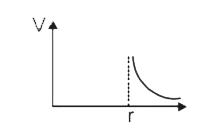
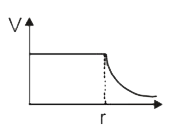
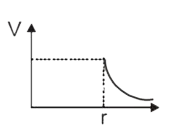
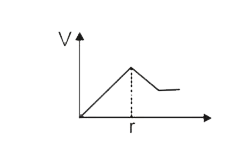
The dependence of electric potential V on the distance 'r' from the centre of a charged spherical shell is shown by :

A

B

C

D

Text Solution

AI Generated Solution

The correct Answer is:

To solve the problem of determining the dependence of electric potential \( V \) on the distance \( r \) from the center of a charged spherical shell, we will follow these steps: ### Step 1: Understand the Concept of Electric Potential The electric potential \( V \) at a point in space due to a charge distribution is defined as the work done in bringing a unit positive charge from infinity to that point without any acceleration. ### Step 2: Analyze the Electric Field Inside and Outside the Spherical Shell For a charged spherical shell: - **Inside the shell**: The electric field \( E \) is zero. Therefore, the potential \( V \) remains constant throughout the interior of the shell. - **Outside the shell**: The electric field \( E \) behaves as if all the charge were concentrated at the center of the shell. The electric field at a distance \( r \) from the center (where \( r > R \), \( R \) being the radius of the shell) is given by: \[ E = \frac{kQ}{r^2} \] where \( k = \frac{1}{4\pi\epsilon_0} \) and \( Q \) is the total charge on the shell. ### Step 3: Calculate the Electric Potential Outside the Shell Using the relation between electric field and potential: \[ dV = -E \, dr \] Integrating from infinity to a point \( r \) outside the shell: \[ V(r) - V(\infty) = -\int_{\infty}^{r} E \, dr = -\int_{\infty}^{r} \frac{kQ}{r^2} \, dr \] Calculating the integral: \[ V(r) - 0 = -\left[-\frac{kQ}{r}\right]_{\infty}^{r} = \frac{kQ}{r} \] Thus, for \( r > R \): \[ V(r) = \frac{kQ}{r} \] ### Step 4: Calculate the Electric Potential Inside the Shell Since the electric field inside the shell is zero: \[ E = 0 \implies dV = 0 \] Thus, the potential \( V \) inside the shell is constant and equal to the potential at the surface of the shell: \[ V = V(R) = \frac{kQ}{R} \] ### Step 5: Summarize the Results - For \( r < R \) (inside the shell): \[ V = \frac{kQ}{R} \quad \text{(constant)} \] - For \( r > R \) (outside the shell): \[ V = \frac{kQ}{r} \quad \text{(decreasing with increasing } r\text{)} \] ### Conclusion The graph of \( V \) versus \( r \) will show a constant value \( \frac{kQ}{R} \) for \( r < R \) and a hyperbolic decrease for \( r > R \). Therefore, the correct option for the dependence of electric potential \( V \) on the distance \( r \) from the center of a charged spherical shell is that \( V \) is constant inside the shell and decreases as \( r \) increases outside the shell.
Promotional Banner

Topper's Solved these Questions

  • ELECTROSTATICS

    MOTION|Exercise Exercise - 2 (Objective Problems | NEET)|64 Videos
  • ELECTROSTATICS

    MOTION|Exercise Exercise -3 Section (A)|41 Videos
  • ELECTROSTATICS

    MOTION|Exercise SELF PRACTICE PROBLEM|27 Videos
  • ELECTRONICS - SEMI CONDUCTOR

    MOTION|Exercise EXERCISE - 3|29 Videos
  • ELECTROSTATICS - I

    MOTION|Exercise EXERCISE - 4 (Level -II) PREVIOUS YEAR - JEE ADVANCED|13 Videos

Similar Questions

Explore conceptually related problems

An isolated solid metal sphere of radius R is given an electric charge. The variation of the intensity of the electric field with the distance r from the centre of the sphere is best shown by

Which one of the following graphs represents the variation of electric field with distance r from the centre of a charged spherical conductor of radius R?

The electric field at a distance (3R)/2 from the centre of a charged conducting spherical shell of radius R is E. The electric field at a distance R/2 from the centre of the sphere is :

The electric field at a distance 3R//2 from the centre of a charge conducting spherical shell of radius R is E . The electric field at a distance R//2 from the centre of the sphere is

A spherical shell of radius 10 cm is carrying a charge q. If the electric potential at distances 5 cm, 10 cm and 15 cm from the centre of the spherical shell is V_(1), V_(2) and V_(3) respectively, then

Two concentric spherical shells of radii r and R(rltR) have surface charge densities -sigma and +sigma respectively. The variation ofelectric potential V with distance x from the centre O of the shells plotted. Which of the following graphs best depict the variation qualitatively?

A point charge q is placed at a distance of r from the centre O of an uncharged spherical shell of inner radius R and outer radius 2R. The electric potential at the centre of the shell will be

The variation of electrostatic potential with radial distance r from centre of positively charged metallic thin shell of radius R is given by graph

A thin spherical conducting shell of radius R has a charge q. Another charge Q is placed at the centre of the shell. The electrostatic potential at a point P a distance R/2 from the centre of the shell is

MOTION-ELECTROSTATICS-Exercise -1 (Objective Problems | NEET)
  1. A cylinder of radius R and length l is placed in a uniform electric fi...

    Text Solution

    |

  2. A surface enclosed an electric dipole, the flux through the surface is...

    Text Solution

    |

  3. A square of side 20cm. Is enclosed by a surface of sphere of 80 cm. ra...

    Text Solution

    |

  4. A charge q is located at the centre of a cube. The electric flux throu...

    Text Solution

    |

  5. The volume charge density as a function of distance X from one face in...

    Text Solution

    |

  6. A hollow sphere of charge does not produce an electric field at any-

    Text Solution

    |

  7. Calculate the earth's potential. Assume earth has a surface charge den...

    Text Solution

    |

  8. The electric field inside a spherical shell of uniform surface charge ...

    Text Solution

    |

  9. A hollow metal sphere of radius 5 cm is charged so that the potential ...

    Text Solution

    |

  10. A charged spherical conductor of radius R carries a charge Q. a point ...

    Text Solution

    |

  11. The electric field intensity at a point located at distance r(r lt R) ...

    Text Solution

    |

  12. The dependence of electric potential V on the distance 'r' from the ce...

    Text Solution

    |

  13. Potential difference beween centre and surface of the sphere of radius...

    Text Solution

    |

  14. A solid sphere of radius R has charge q uniformly distributed over its...

    Text Solution

    |

  15. Two similar very small conducting spheres having vharges 40 muC and -2...

    Text Solution

    |

  16. Three concentric conducting spherical shells carry charges as : +4Q on...

    Text Solution

    |

  17. A solid metallic sphere has a charge +3Q. Concentric with this sphere ...

    Text Solution

    |

  18. Shown in the figure a spherical shell with an inner radius 'a' and an ...

    Text Solution

    |

  19. In the previous question assume that the electrostatic potential is ze...

    Text Solution

    |

  20. A positive charge q is placed in a spherical cavity made in a positive...

    Text Solution

    |
