Home
Class 12
PHYSICS
Two particles A and B, each of mass m, a...

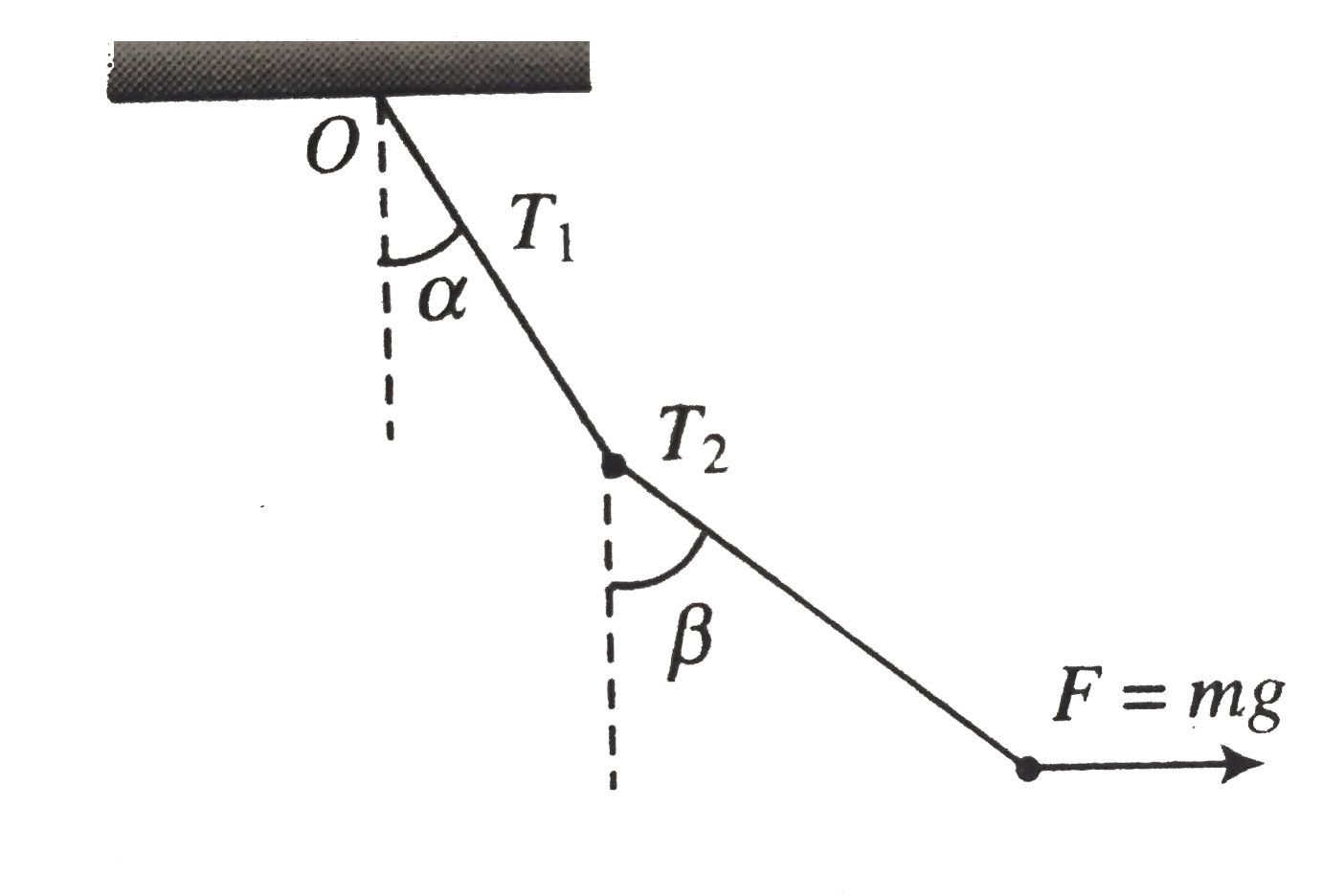
Two particles A and B, each of mass m, are kept stationary by appyling a horizontal force F=mg on particle B as shown in fig.

A

a, b

B

b, c

C

c, d

D

a, c

Text Solution

Verified by Experts

The correct Answer is:

D
Promotional Banner

Topper's Solved these Questions

  • NEWTON'S LAWS OF MOTION & FRICTION

    MOTION|Exercise Exercise - 1 (SECTION-A:- String Constrained, Wedge Constrained, Newtons Law theory Question, Equillibrium Questions (Normal and Tension), Problems with Acceleration (F=ma), Wedge problems)|27 Videos
  • NEWTON'S LAWS OF MOTION & FRICTION

    MOTION|Exercise Exercise - 1 SECTION-B :- Pulley Block System|12 Videos
  • NEWTON'S LAWS OF MOTION & FRICTION

    MOTION|Exercise Problem|26 Videos
  • MODERN PHYSICS -1

    MOTION|Exercise EXERCISE-4 ( LEVEL- II)|39 Videos
  • NLM & FRICTION

    MOTION|Exercise EXERCISE-4 ( LEVEL-II)|15 Videos

Similar Questions

Explore conceptually related problems

Two partical A and B each of mass m are kept stationary by applying a horizontal force F = mg on partical B as show in figure .Then

Two particle A & B each of mass m are in equilibrium in a vertical plane under action of a horizontal force F=mg on particle B, as shown in figure Then :

Two bodies A and B each of mass M are fixed together by a massless spring A force F acts on the mass B as shown in fig At the instant shown the mass A has acceleration a. What is the acceleration of mass B?

Two bodies A and B each of mass m are fixed together by a massless spring . A force F acts on the mass B as shown in fig .3 (a)18. At the instant shown , the body A has an acceleration a What is the acceleration of B ?

Two particles A and B , each of mass m , are connected by a light rod of length L lying on a smooth horizontal surface. A particle of mass m moving with speed v_(0) strikes to the end of rod and sticks to A as shown . Find (a) the velocity of the center of mass, (b) the angular velocity about the center of mass of system ( A+B+ particle) and (c) the linear speeds of A and B immediately after collision.

Four particles A,B, C and D each of mass m are kept at the corners of a square of side L. Now the particle D is taken to infinity by an external agent keeping the other particles fixed at their respective positions . The work done by the gravitational force acting on the particle D During its movement is

Two blocks A and B each of mass m are placed on a smooth horizontal surface. Two horizontal force F and 2F are applied on blocks A and B, respectively, as shown in fig. Block A does not slide on block B. Then then the normal reaction acting between the two blocks is (assume no friction between the blocks)

Two identicle particles A and B, each of mass m, are interconnected by a spring of stiffness k. If particle B experiences a forec F and the elongation of the spring is x, the acceleration of particle B relative to particle A is equal to

Two blocks 'A' and 'B' each of mass 'm' are placed on a smooth horizontal surface . Two horizontal force F and 2F are applied on the blocks A and B , respectively , as shown in figure . The block A does not slide on block B . The normal reaction acting between the two blocks is

Three particles A, B and C of mass m, m and 2m lie in a straight line as shown. The only force acting on these particles is due to the gravitational attraction towards each other. Let the magnitude of net force on them be F_(A), F_(B) and F_(C ) respectively. Then, F_(A):F_(B):F_(C ) is equal to :

MOTION-NEWTON'S LAWS OF MOTION & FRICTION -Questions For Practice
  1. The linear momentum P of a body moving in one dimension varies with ti...

    Text Solution

    |

  2. A thief stole a box full of valuable articles of weight W and while ca...

    Text Solution

    |

  3. When a horse pulls a cart, the force that helps the horse to move forw...

    Text Solution

    |

  4. A player catches a ball of 200 gm moving with a speed of 20 m/s. if th...

    Text Solution

    |

  5. A body of weight w1 is suspended from the ceiling of a room through a...

    Text Solution

    |

  6. Two objects A and B of masses m(A) and m(B) are attached by strings as...

    Text Solution

    |

  7. Two particles A and B, each of mass m, are kept stationary by appyling...

    Text Solution

    |

  8. A body of mass 5 kg is suspended by the string making angles 60^(@) a...

    Text Solution

    |

  9. The mass of a lift is 600 kg and it is moving upwards with a uniform a...

    Text Solution

    |

  10. A person standing oin the floor of an elevator drops as coin. The coin...

    Text Solution

    |

  11. If the tension in the cable supporting an elevator is equal to the wei...

    Text Solution

    |

  12. A body of mass 8 kg is hanging from another body of mass 12 kg. The co...

    Text Solution

    |

  13. Two blocks of mass 8 kg and 5 kg are connected by a heavy rope of mass...

    Text Solution

    |

  14. A particle stays at rest as seen in a frame. We can conclude that

    Text Solution

    |

  15. A particle is found to be at rest when seen from a frame S(1) and movi...

    Text Solution

    |

  16. A person says that he mesured the acceleration of a particle to be non...

    Text Solution

    |

  17. A particle is observed from two frames S(1) and S(2). The frame S(2) m...

    Text Solution

    |

  18. A block of mass m is placed on a smooth wedge of incination theta. The...

    Text Solution

    |

  19. If the arrangement in fig is given a downward acceleration then the ra...

    Text Solution

    |

  20. A smooth wedge A is fitted in a chamber hanging from a fixed ceiling n...

    Text Solution

    |
