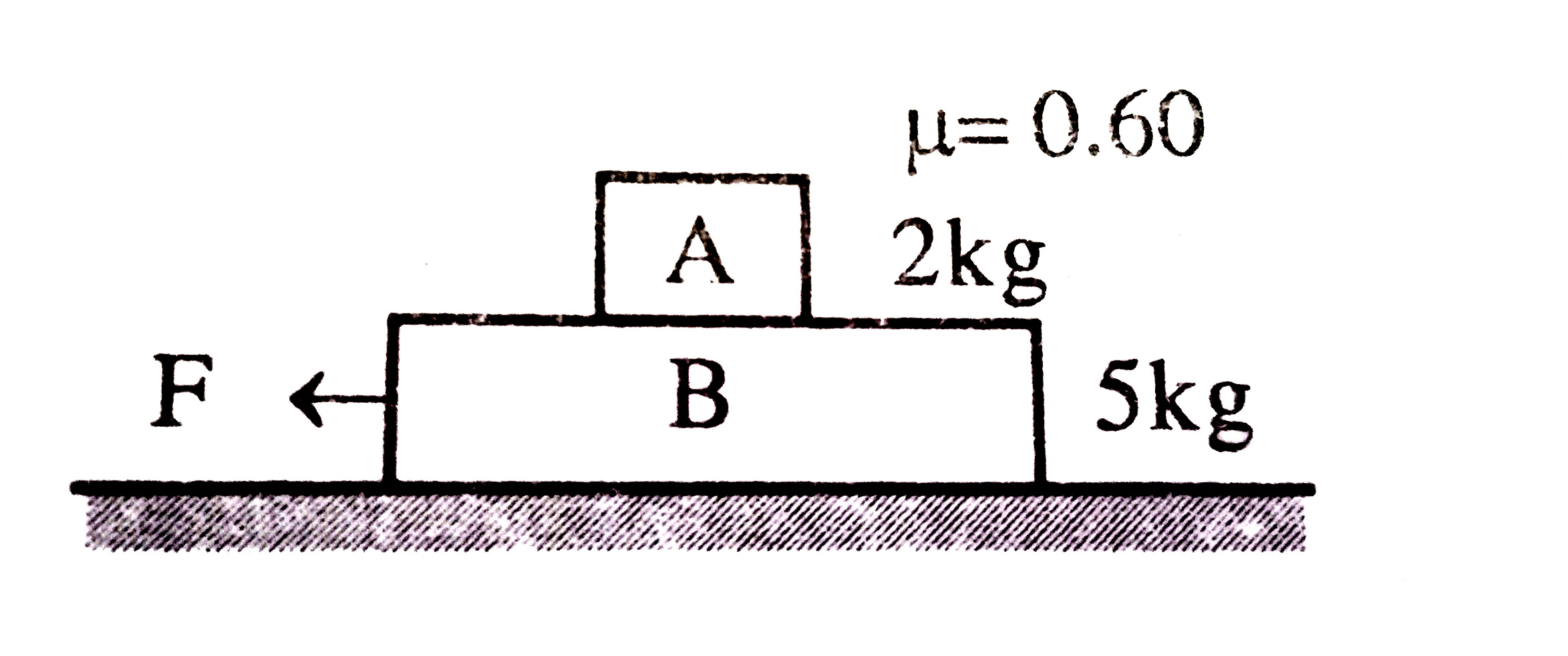
A
B
C
D
Text Solution
Verified by Experts
The correct Answer is:



Topper's Solved these Questions
NEWTON'S LAWS OF MOTION & FRICTION
MOTION|Exercise Exercise - 2 SECTION-F :- Direction of friction, Pulley Block system on horizontal plane, Pulley Block system on inclined plane, Two Block system, Two Block on Inclined plane|3 VideosNEWTON'S LAWS OF MOTION & FRICTION
MOTION|Exercise Exercise - 3 Section-A|22 VideosNEWTON'S LAWS OF MOTION & FRICTION
MOTION|Exercise Exercise - 2 SECTION-D :- Spring force and spring cutting problems|1 VideosMODERN PHYSICS -1
MOTION|Exercise EXERCISE-4 ( LEVEL- II)|39 VideosNLM & FRICTION
MOTION|Exercise EXERCISE-4 ( LEVEL-II)|15 Videos
Similar Questions
Explore conceptually related problems
MOTION-NEWTON'S LAWS OF MOTION & FRICTION -Exercise - 2 SECTION-E:- Static friction, Kinetic friction
- A force barF=hati+4hatj acts on block shown. The force of friction act...
Text Solution
|
- A chain is lying on a rough table with a fraction 1/n of its length ha...
Text Solution
|
- Block A weights 4 N and block B weights 8 N. The coefficient of kineti...
Text Solution
|
- Block B rests on a smooth surface .The coefficient of static friction ...
Text Solution
|
- In the above problem, if F = 250 N, the acceleration of A and B are -
Text Solution
|
- A body A of mass 1 kg rests on a smooth surface. Another body B of mas...
Text Solution
|
- A block of mass 1 kg lies on a horizontal surface in a truck. The coef...
Text Solution
|
- Starting from rest , a body slides down at 45^(@) inclined plane in tw...
Text Solution
|
- A horizontal force of 1 N is needed to keep a block of mass 0.25 kg sl...
Text Solution
|
- A block A of mass 2 kg rests on another block B of mass 8 kg which res...
Text Solution
|
- Two block (A) 2kg and (B) 5kg rest one over the other on a smooth hori...
Text Solution
|
- A car is moving along a straight horizontal road with a speed v(0) . I...
Text Solution
|
- Two block A and B of masses 5 kg. and 3 kg. respectively rest on smoot...
Text Solution
|