Home
Class 12
PHYSICS
Draw graph for following equation : v...

Draw graph for following equation :
`v=v_(0)-at`

A

B

C

D

Text Solution

AI Generated Solution

The correct Answer is:

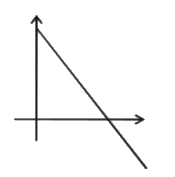
To draw the graph for the equation \( v = v_0 - at \), we can follow these steps: ### Step 1: Identify the Variables In the equation \( v = v_0 - at \): - \( v \) is the final velocity. - \( v_0 \) is the initial velocity (y-intercept). - \( a \) is the acceleration (slope). - \( t \) is time (x-axis). ### Step 2: Rearrange the Equation The equation can be rearranged to fit the linear equation format \( y = mx + c \): - Here, \( v \) (final velocity) corresponds to \( y \). - \( -a \) (negative acceleration) corresponds to the slope \( m \). - \( v_0 \) is the y-intercept \( c \). Thus, we can express it as: \[ v = -at + v_0 \] ### Step 3: Determine the Intercept and Slope - **Y-Intercept (\( c \))**: When \( t = 0 \), \( v = v_0 \). This means the graph will intercept the y-axis at \( v_0 \). - **Slope (\( m \))**: The slope is \( -a \), which is negative if \( a \) is positive. This indicates that as time increases, the velocity decreases. ### Step 4: Plot the Points 1. **Point at \( t = 0 \)**: The point is \( (0, v_0) \). 2. **Point at \( t = t_1 \)**: Choose a value for \( t \) (for example, \( t_1 = \frac{v_0}{a} \)). Then calculate \( v \): \[ v = v_0 - a \cdot t_1 = v_0 - a \cdot \frac{v_0}{a} = 0 \] This gives the point \( (t_1, 0) \). ### Step 5: Draw the Graph - Draw a Cartesian plane with \( t \) on the x-axis and \( v \) on the y-axis. - Plot the points \( (0, v_0) \) and \( (t_1, 0) \). - Draw a straight line connecting these two points. The line should slope downwards from left to right, indicating that velocity decreases over time. ### Step 6: Label the Graph - Label the y-axis as "Velocity (v)" and the x-axis as "Time (t)". - Indicate the slope as negative and the intercept as \( v_0 \). ### Summary of the Graph The graph of the equation \( v = v_0 - at \) is a straight line that starts at \( v_0 \) on the y-axis and decreases linearly to zero as time increases, reflecting the negative acceleration. ---
Promotional Banner

Topper's Solved these Questions

  • UNITS AND DIMENSIONS, BASIC MATHEMATICS

    MOTION|Exercise Exercise - 1 (Objective Problems) (SECTION - D :- ERRORS )|19 Videos
  • UNITS AND DIMENSIONS, BASIC MATHEMATICS

    MOTION|Exercise Exercise - 2 (Objective Problems )|25 Videos
  • UNITS AND DIMENSIONS, BASIC MATHEMATICS

    MOTION|Exercise Exercise - 1 (Objective Problems) (SECTION - B : Dimension and use of dimensions )|28 Videos
  • UNIT & DIMENSIONS

    MOTION|Exercise Exercise - 4 (Level - II) (PREVIOUS YEAR JEE ADVANCED)|10 Videos
  • VECTOR

    MOTION|Exercise Exercise - 3|18 Videos

Similar Questions

Explore conceptually related problems

Draw graph for following equations :

Draw the graph of equation, x+y =0

Draw graph of the equations. x + y = 3

Draw graph of the equations. x - y = 4

Draw the graph of following linear equation in two variables x+y=4

Draw a graph of the equation: 2y+3=9

Draw the graph of equation x+y=5

Draw graph of the equation y=x+5

Draw the graph for the equation : 2y+4x+2=0

Draw the graph of the equation y-x=2

MOTION-UNITS AND DIMENSIONS, BASIC MATHEMATICS -Exercise - 1 (Objective Problems) (SECTION - C : Basic Maths )
  1. Internal radius of a ball is 3 cm and external radius is 4 cm. What wi...

    Text Solution

    |

  2. Find value of (1.01)^(1//2) according to binomial theorem

    Text Solution

    |

  3. Draw graph for following equation : v=v(0)-at

    Text Solution

    |

  4. Find the derivative of given functions w r.t. corresponding independen...

    Text Solution

    |

  5. s=5t^(3)-3t^(5)

    Text Solution

    |

  6. Find the derivative of given function w.r.t. corresponding independent...

    Text Solution

    |

  7. Find the derivative of given function w.r.t. corresponding independent...

    Text Solution

    |

  8. Find the first derivative & second derivative of given functions w.r.t...

    Text Solution

    |

  9. Find the first derivative & second derivative of given functions w.r.t...

    Text Solution

    |

  10. Find derivative of given functions w.r.t. the independent variable x. ...

    Text Solution

    |

  11. Find derivative of given functions w.r.t. the independent variable x. ...

    Text Solution

    |

  12. Find derivative of given functions w.r.t. the independent variable x. ...

    Text Solution

    |

  13. Find derivative of given functions w.r.t. the independent variable x. ...

    Text Solution

    |

  14. Suppose that the radius r and surface area S=4pi r^(2) of a sphere a...

    Text Solution

    |

  15. Particle 's position as a function of time is given by x=-t^(2)+4t+4 ...

    Text Solution

    |

  16. Find the maximum and minimum values of function 2x^(3)-15x^(2)+36+11

    Text Solution

    |

  17. Find integral of given function x^(2)-2x+1

    Text Solution

    |

  18. Find interals of given functions -3x^(-4)

    Text Solution

    |

  19. Find integrals of given functions {:(" "1),(" "int),(-2):} 5dx

    Text Solution

    |

  20. Find integrals of given functions {:(" "4),(" "int),(-2):} (x/2 +3)...

    Text Solution

    |
