Home
Class 12
PHYSICS
Find the heat current through the frustu...

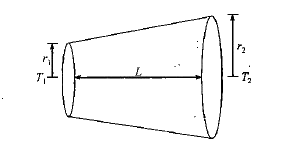
Find the heat current through the frustum of a cone shown in figure-4.20. Temperature of its two ends are maintained at `T_(1)` and `T_(2)`(T_(2)>T_(1))` respectively and the thermal conductivity of the material is k.

Text Solution

Verified by Experts

Here `r=r_(1)+((r_(2)-r_(1))/(L))x`
As shown in figure we consider an elemental disc at a distance x from left face. Then thermal resistance ofthis elemental disc is given as
`dR_(th)=(1)/(k).(dx)/(pi(r_(1)+(r_(2)-r_(1))/(L)x)^(2))`
Total thermal resistance offrustum is
`R_(th)=intdR_(th)=(1)/(kpi)int_(0)^(1)(dx)/(r_(1)+(r_(2)-r_(1))/(L).x)^(2)`
`=(L)/(kpi(r_(2)-r_(1)))[(1)/((r_(1)+(r_(2)-r_(1))/(L).x))]_(0)^(l)`
`=(L)/(kpi(r_(2)-r_(1)))[(1)/(r_(1))-(1)/(r_(2))]`
`=(L)/(kpi_(1)r_(2))`
Thus heat current through frustum is
`(dQ)/(dt)=(T_(2)-T_(1))/R_(th)=(kpi_(1)r_(2)(T_(2)-T_(1)))/(L)`
Promotional Banner

Topper's Solved these Questions

  • HEAT TRANSFER

    PHYSICS GALAXY - ASHISH ARORA|Exercise Practice Exercise 4.2|8 Videos
  • HEAT TRANSFER

    PHYSICS GALAXY - ASHISH ARORA|Exercise Practice Exercise 4.3|5 Videos
  • HEAT TRANSFER

    PHYSICS GALAXY - ASHISH ARORA|Exercise Illustrative Example 4.29|1 Videos
  • HEAT AND THERMAL EXPANSION

    PHYSICS GALAXY - ASHISH ARORA|Exercise UNSOLVED NUMRICAL PROBLEMS FOR PREPARATION OF NSEP, INPhO & IPhO|82 Videos
  • Kinetic Theory of Gases and Gas Laws

    PHYSICS GALAXY - ASHISH ARORA|Exercise Unsolved Numerical Problems for Preparation of NSEP, INPhO & IPhO|64 Videos

Similar Questions

Explore conceptually related problems

A hollow tube has a length l, inner radius R_(1) and outer radius R_(2) . The material has a thermal conductivity K. Find the heat flowing through the walls of the tube if (a) the flat ends are maintained at temperature T_(1) and T_(2) (T_(2)gtT_(1) (b) the inside of the tube is maintained at temperature T_(1) and the outside is maintained at T_(2) .

A thick cylindrical shell made of material of thermal conductivity k has inner and outer radii r and R respectively and its length is L. When the curved surface of the cylinder are lagged (i.e., given insulation cover) and one end is maintained at temperature T_(1) and the other end is maintained at T_(2)(lt T_(1)) , the heat current along the length of the cylinder is H. In another experiment the two ends are lagged and the inner wall and outer wall are maintained at T_(1) and T_(2) respectively. Find the radial heat flow in this case.

Consider two rods of equal cross - sectionai area A, one of Aluminium and other of iron joined end to end as shown in figure -4.8. Length of the two rods and their thermal coductivities are l_(1) , k_(1) and l_(2),k_(2) respectively . If the ends of the rods are maintained at temperature T_(1) and T_(2),(T_(1)gt T_(2)) find the temperature of the junction in steady state .

A composite cylinder is made of two materials having thermal conductivities K_(1) and K_(2) as shown. Temperature of the two flat faces of cylinder are maintained at T_(1) and T_(2) . For what ratio K_(1)//K_(2) the heat current throught the two materials will be same. Assume steady state and the rod is lagged (insulated from the curved surface).

Two identical vessels are filled with equal amounts of ice. The vessels are made from different materials. If the ice melts in the two vessels in times t_(1) and t_(2) respectively, then their thermal conductivities are in the ratio:

Two identical vessels are filled with equal amounts of ice. The vessels are made from different materials. If the ice melts in the two vessels in times t_(1) and t_(2) respectively, then their thermal conductivities are in the ratio

A slab of cunductivity k is in the shape of trapezoid as shown I figure. If the two end faces be maintained at temperature T_(1)=50^(@)C and T_(2)=25^(@)C , then determine the thermal current through the slab by ignoring any heat loss through the lateral surfaces. .

In the frame shown in figure made up of metallic rods of identical size, the ends A and F are maintained at T_(1) and T_(2) respectively. The rate of heat flow from A to C is omega . If C and D are instead maintained at T_(1) & T_(2) respectively find, find the total rate of heat flow.

Three rods of same cross-section but different length and conductivity are joined in series . If the temperature of the two extreme ends are T_(1) and T_(2) (T_(1)gtT_(2)) find the rate of heat transfer H.

Two conducting cylinders of equal length but different radii are connected in series between two heat baths kept at temperatures T_(1) = 300K and T_(2) = 100 K , as shown in the figure. The radius of the bigger cylinder is twice that of the smaller one and the thermal conductivities of the materials of the smaller and the larger cylinders are K_(1) and K_(2) respectively. If the temperature at the junction of the two cylinders in the steady state is 200 K, then K_(1)//K_(2)= __________. (##JA_18_PHY_P1_E02_008_Q01.png" width="80%">
