Home
Class 10
MATHS
In figure BD and CE intersect each other...

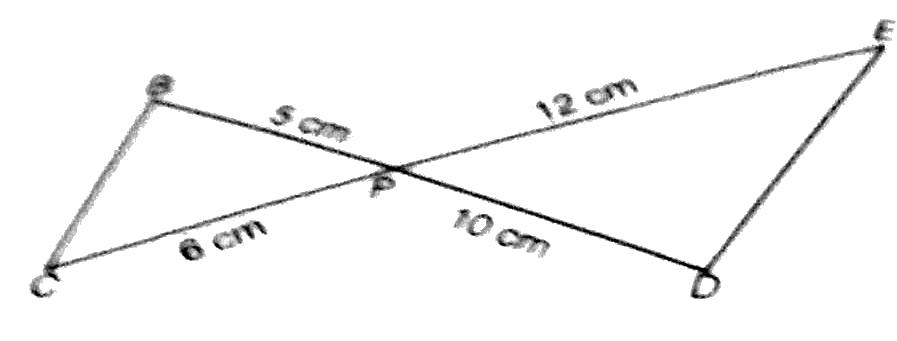
In figure BD and CE intersect each other at the point P. Is`DeltaPBC~DeltaPDE`? Why?

Text Solution

Verified by Experts

True
In `DeltaPBC and DeltaPDE`,
`angleBPC=angleEPD` [vertically opposite angle]
Now `(PB)/(PD)=5/10=1/2`
and `(PC)/(PE)=(6)/(12)=1/2`
From Eqs. (i) and (ii) `(PB)/(PD)=(PC)/(PE)`
Since. One angle of `DeltaPBC` is equal to one angle of `DeltaPDE` and the sides including these angles are proportional, so both triangles are similar.
Hence. `DeltaPBC~DeltaPDE`, by SAS similarity criterion.
Promotional Banner

Topper's Solved these Questions

  • SURFACE AREAS AND VOLUMES

    NCERT EXEMPLAR|Exercise Surface Areas And Volumes|62 Videos

Similar Questions

Explore conceptually related problems

In figure, BD an CE interesct each other at point P. is triangle PBC - triangle PDE? Why?

In the figure, two chords AB and CD intersect each other at the point P. Prove that : DeltaAPC ~ DeltaDPB

In the figure, two chords AB and CD intersect each other at the point P. Prove that : AP. PB = CP. DP

In Figure, two chords AB and CD intersect each other at the point P. Prove that: (i) DeltaA P C~ DeltaD P B (ii) A P*P B=C P*D P

In figure , if ABabs()DC and AC, PQ intersect each other at the point O. Prove that OA.CQ=OC.AP.

In the figure given below altiudes AD and CE of DeltaABC intersect each other at the point P. Show that . DeltaAEP~DeltaCDP

In the figure , altitudes AD and CE of DeltaABC intersect each other at the point P . Show that : DeltaAEP~DeltaCDP

In the figure given below altiudes AD and CE of DeltaABC intersect each other at the point P. Show that . DeltaABD ~ DeltaCBE

In Figure altitudes AD and CE of DABC intersect each other at the point P. Show that:(i) DeltaA E P~ DeltaC D P (ii) DeltaA B D ~DeltaC B E (iii) DeltaA E P~ DeltaA D B (iv) DeltaP D C ~DeltaB E C

In figure, two line segments AC and BD intersects each other at the point P such that PA = 6 cm, PB = 3 cm, PC = 2.5 cm, PD =5 cm, angleAPB=50^(@) and angleCDP=30^(@) . Then, anglePBA is equal to

NCERT EXEMPLAR-TRIANGLES-Triangles
  1. It is given that DeltaDEF~DeltaRPQ. Is it true to say that angleD = an...

    Text Solution

    |

  2. A and B are respectively the points on the sides PQ and PR of a Delta ...

    Text Solution

    |

  3. In figure BD and CE intersect each other at the point P. IsDeltaPBC~De...

    Text Solution

    |

  4. In DeltaPQR and DeltaMST, angleP=55^(@),angleQ=25^(@),angleM=100^(@)an...

    Text Solution

    |

  5. Is the following statement true? Why? "Two quadrilaterals are similar,...

    Text Solution

    |

  6. Two sides and the perimeter of one triangle are respectively three tim...

    Text Solution

    |

  7. If in two right triangles, one of the acute angles of one triangle is ...

    Text Solution

    |

  8. The ratio of the corresponding altitudes of two similar triangles is 3...

    Text Solution

    |

  9. D is a point on side QR of DeltaPQR such that PDbotQR. Will it be corr...

    Text Solution

    |

  10. In figure, if angleD=angleC, then it is true that DeltaADE~DeltaACB? W...

    Text Solution

    |

  11. Is it true to say that, if in two triangles, an angle of one triangle ...

    Text Solution

    |

  12. In P Q R ,\ \ Q M|P R and PR^2-P Q^2=Q R^2.Prove that Q M^2=P MxxM R

    Text Solution

    |

  13. Find the value of x for which DEabs()AB in given figure.

    Text Solution

    |

  14. In figure, if angle1=angle2 and DeltaNSQ=DeltaMTR, then prove that Del...

    Text Solution

    |

  15. Diagonals of a trapezium PQRS intersect each other at the point 0 ,PQa...

    Text Solution

    |

  16. In figure , if ABabs()DC and AC, PQ intersect each other at the point ...

    Text Solution

    |

  17. Find the altitude of an equilateral triangle of side 8 cm.

    Text Solution

    |

  18. If DeltaABC~DeltaDEF, AB=4cm, DE=6,EF=9 cm and FD=12 cm, then find the...

    Text Solution

    |

  19. In figure, if DEabs()BC, then find the ratio of ar (DeltaADE) and ar(D...

    Text Solution

    |

  20. ABCD is a trapezium in which ABabs()DC and P,Q are points on AD and BC...

    Text Solution

    |
