Home
Class 12
PHYSICS
Two sources S1 " and "S2 separated 2.0 m...

Two sources `S_1 " and "S_2` separated 2.0 m, vibrate according to equation `y_1= 0.03 sin pi t " and " y_2= 0.02 sin pi t " where "y_1, y_2` and t are in M.K.S unit. They send out waves of velocity 1.5 m/s. Calculate the amplitude of the resultant motion of the particle co-linear with `S_1 " and "S_2` and located at a point to the left of `S_1`.

Text Solution

Verified by Experts
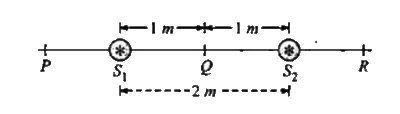
The situation is shown in figure 6.26.
The oscillations `y_(1)` and `y_(2)` have amplitudes `A_(1) = 0.03 m` and `A_(2) = 0.02 `m respectively.
The frequency of both sources is `n = (omega)/(2pi) = (1)/(2) = 0.5 Hz`
Now wavelength of each wave `lambda = (v)/(n) = (1.5)/(0.5) = 3.0 m`
The path differnece for all points `P_(2)` to the right of `S_(2) `is `Delta-(S_(1)P_(2) - S_(2)P_(2)) - S_(1)S_(2) = 2m` Phase difference `phi = (2pi)/(lambda) xx` path difference
= `(2pi)/(3) xx 2.0 = (4pi)/(3)`
The resultant amplitude for this point is given by `R = sqrt(A_(1)^(2) + A_(2)^(2) + 2A_(1) A_(2) cos phi)`
`sqrt((0.03)^(2) + (0.02)^(2) + 2 xx 0.03 xx 0.002 xx cos (4pi//3))`
Solving we get
`R = 0.0265 m`

The path difference for all points p, to the left of `S_(1)`
`Delta = (S_(2)p - S_(1)P) = S_(1)S_(2) = 2.0m`
Hence the resultant amplitude for all points to the of `S_(1)` is also 0.0265 m`
For a point Q midway between `S_(1)` and `S_(2)` the path difference is zero i.e. `phi = 0`. Hence constructive interferne takes place at Q thus amplitude at this point is maximum and given as
`R = sqrt(A_(1)^(2) + A_(2)^(2) + 2A_(1)A_(2))`
Promotional Banner

Topper's Solved these Questions

  • WAVES

    PHYSICS GALAXY - ASHISH ARORA|Exercise Practice Exercise 6.1|12 Videos
  • WAVES

    PHYSICS GALAXY - ASHISH ARORA|Exercise Practice Exercise 6.2|11 Videos
  • WAVE OPTICS

    PHYSICS GALAXY - ASHISH ARORA|Exercise Unsolved Numerical Problems|28 Videos
  • X-RAYS

    PHYSICS GALAXY - ASHISH ARORA|Exercise Unsolved Numerica Problem for Preparation|23 Videos

Similar Questions

Explore conceptually related problems

Two sources S_1 " and "S_2 separated 2.0 m, vibrate according to equation y_1= 0.03 sin pi t " and " y_2= 0.02 sin pi t " where "y_1, y_2 and t are in M.K.S unit. They send out waves of velocity 1.5 m/s. Calculate the amplitude of the resultant motion of the particle co-linear with S_1 " and "S_2 and located at a point To the right of S_2 .

Two sources S_1 " and "S_2 separated 2.0 m, vibrate according to equation y_1= 0.03 sin pi t " and " y_2= 0.02 sin pi t " where "y_1, y_2 and t are in M.K.S unit. They send out waves of velocity 1.5 m/s. Calculate the amplitude of the resultant motion of the particle co-linear with S_1 " and "S_2 and located at a point In the middle of S_2 " and "S_2 .

Standing waves are produced by superposition of two waves y_(1) = 0.05 sin(3pi t - 2x), y_(2) = 0.05 six(3pi t +2x) where x and y are measured in metre and t in second. Find the amplitude of the particle at x = 0.5m.

A source of sound vibrates according to the equation y=0.05cos "pi t". It sends out wave of velocity "1.5ms^(-1)" .The wavelength of the wave is?

A particles executes SHM according to the equation y = 2 sin 2pit , where y is displacement in m and t is time in s. The distance covered by the particle in 4 s of its motion is

The equation of progressive wave is y = 0.2 sin 2pi [(t)/(0.01)-(x)/(0.3)] , where x and y are in metre and t is in second. The velocity of propagation of the wave is

Two parallel S.H.M.s have equations y_1=A_1sin(omegat+2pi) and y_2=A_2sin(omega/t+4pi) . The amplitude of the resultant motion is

Equation of a simple harmonic progressive wave is y= 0.03 sin 8pi ( (t)/( 0.016)- (x)/( 1.6) ) ,where all the quantities are in S.I.units The velocity of wave is

PHYSICS GALAXY - ASHISH ARORA-WAVES -Unsolved Numerical Problems for Preparation of NSE, INPhO & IPhO
  1. Two sources S1 " and "S2 separated 2.0 m, vibrate according to equatio...

    Text Solution

    |

  2. Write down the equation of a wave travelling in the negative direactio...

    Text Solution

    |

  3. Calculate the velocity of sound in a gas in which two waves of wavelen...

    Text Solution

    |

  4. The speed of sound in hydrogen is 1270 ms^(-1) at temperature T. the s...

    Text Solution

    |

  5. When a train is approaching the observer, the frequency of the whistle...

    Text Solution

    |

  6. The speed of longitudinal wave is 100 times, then the speed of transve...

    Text Solution

    |

  7. A copper wire is held at the two ends by rigid supports. At 30^(@)C, t...

    Text Solution

    |

  8. A train approaching a hill at a speed of 40 km//hr sounds a whistle of...

    Text Solution

    |

  9. A train approaching a hill at a speed of 40 km//hr sounds a whistle of...

    Text Solution

    |

  10. A wave of frequency 500 Hz has a phase velocity of 350 m//s. (a) How f...

    Text Solution

    |

  11. A wave of frequency 500 Hz has a phase velocity.of 350 m/s (ii) Wha...

    Text Solution

    |

  12. The velocity of sound in air at 14^@ C is 340 ms^(-1).What will it be ...

    Text Solution

    |

  13. A steel wire of length 1m, mass 0.1kg and uniform cross-sectional area...

    Text Solution

    |

  14. The equation y = A sin 2pi(500t - x//lambda) represents a wave. Speed ...

    Text Solution

    |

  15. Which of the following represents (a) a progressive wave and (b) a sta...

    Text Solution

    |

  16. The velocity of sound in hydrogen is 1270 m s^(-1) at 0^(@)C and the f...

    Text Solution

    |

  17. At what temperature is the velocity of sound in nitrogen equal to its ...

    Text Solution

    |

  18. Calculate the velocity of sound in a mixture of two gases obtained by ...

    Text Solution

    |

  19. Calculate the velocity of sound in a mixture of two gases obtained by ...

    Text Solution

    |

  20. Calculate the frequency of a ntoe emitted by a wire 20cm in length whe...

    Text Solution

    |

  21. In the spectrum of light of a luminous heavenly body the wavelength of...

    Text Solution

    |

