

Home
Class 11
PHYSICS
The velocity of a particle moving in a s...

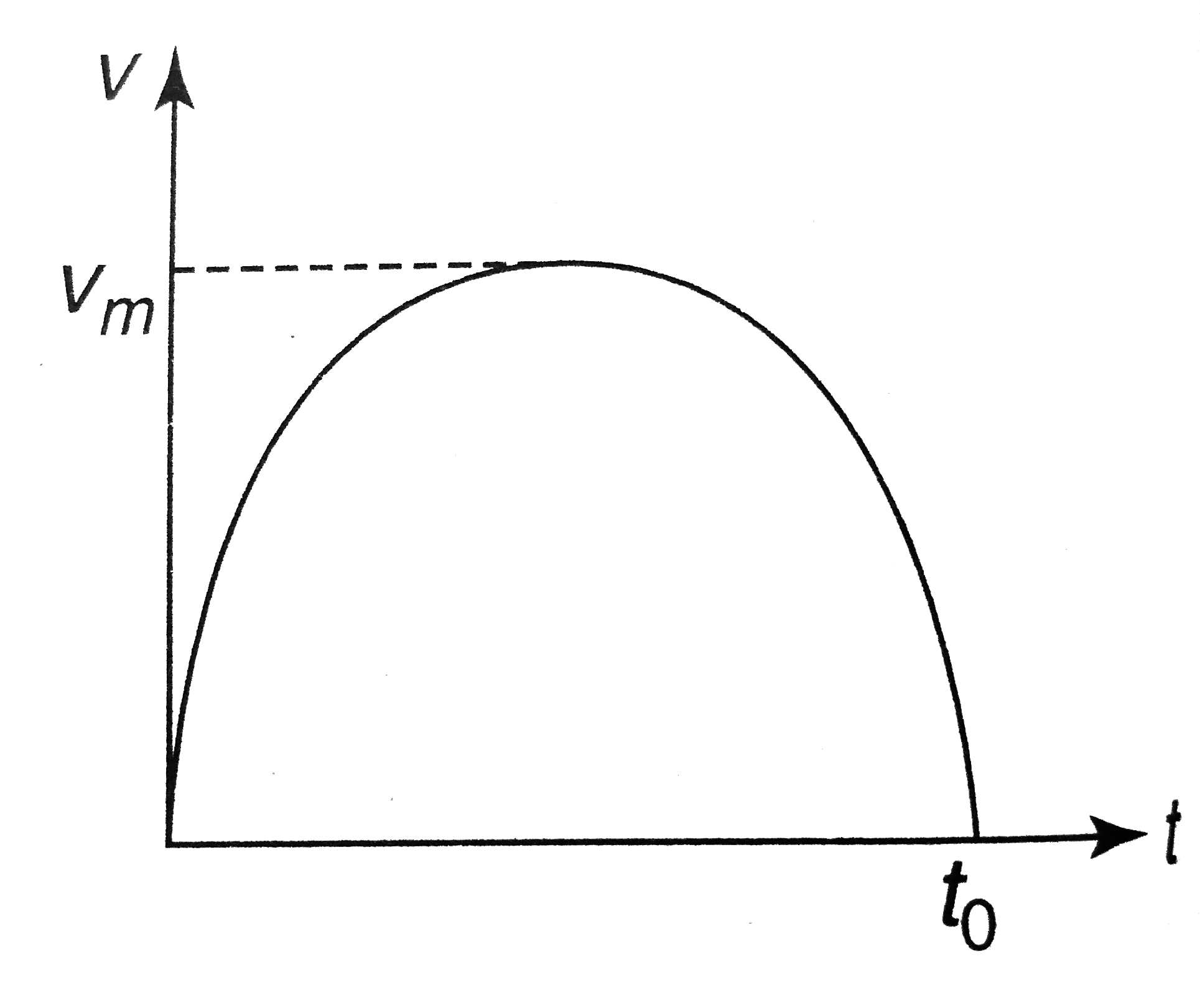
The velocity of a particle moving in a straight line varies with time in such a manner that `v` versus `t` graph is represented by one-half of an ellipse. The maximum velocity is `v_m` and the total time of motion is `t_0`
(i) average velocity of the particle is `(pi)/(4) v_m`
(ii) such motion cannot be realized in practical terms.

Promotional Banner

Similar Questions

Explore conceptually related problems

The acceleration of a particle moving along a straight line at any time t is given by a = 4 - 2v, where v is the speed of particle at any time t The maximum velocity is

The acceleration of a particle moving along a straight line at any time t is given by a = 4 - 2v, where v is the speed of particle at any time t The maximum velocity is

If maximum velocity of a particle executes simple harmonic motion v_m then its average velocity will be……….

The velocity -time (v - t) graph of a particle moving in a straight line is shown in figure. The acceleration of the particle at t = 9 is:

The velocity and time graph for a particle moving in a straight line s shown in the figure. Then, the average velocity between t=4 s and t=6 s is _____

A particle is moving in a straight line. It covers half of the total distance with velocity v_(0) Remaining half distance is covered with a velocity v_(1) for half the time and with velocity v_(2) for another half of time. Find the average velocity of the particle.

Force acting on a particle of mass m moving in straight line varies with the velocity of the particle as F=K//V K is constant then speed of the particle in time t

Force acting on a particle of mass m moving in straight line varies with the velocity of the particle as F=K//V K is constant then speed of the particle in time t

Force acting on a particle of mass m moving in straight line varies with the velocity of the particle as F=K//V K is constant then speed of the particle in time t