

Home
Class 12
CHEMISTRY
In the plot of molar conductivity (^ m) ...

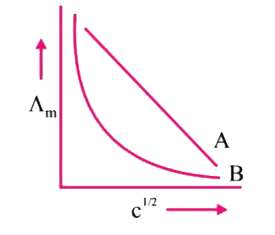
In the plot of molar conductivity (^ m) vs square root of concentration `(c^(1//2))` following curves are obtained for two electrolytes A and B :

Answer the following: (i) Predict the nature of electrolytes A and B.
(ii) What happens on extrapolation of ^ m to concentration approaching zero for electrolytes A and B?

Text Solution

Verified by Experts

(i) A strong electrolyte, B-Weak electrolyte
(ii) ^° m for weak electrolytes cannot be obtained by extrapolation while ^° m for strong electrolytes can be obtained as intercept.
Promotional Banner

Topper's Solved these Questions

  • PRACTICE - PAPER

    CBSE COMPLEMENTARY MATERIAL|Exercise Section : D|4 Videos
  • PRACTICE PAPER 3

    CBSE COMPLEMENTARY MATERIAL|Exercise Section C|34 Videos

Similar Questions

Explore conceptually related problems

(a) A steady current of 2 amperes was passed through two electrolytic cells X and Y connected in series containing electrolytes FeSO_(4) and ZnSO_(4) until 2.8 g of Fe deposited at the cathode of cell X. How long did the current flow ? Calculate the mass of Zn deposited at the cathode of cell Y (Molar mass : Fe= 56 g mol^(-1) Zn-65.3g mol^(-1) , 1F -96500 C mol^(-1) ) (b) In the plot of molar conductivity (wedge_(m)) vs Square root of concentration (c^(1//2)) , following curves are obtained for two electrolytes. A and B: Answer the following : (i) Predict the nature of electrolytes A and B. (ii) What happens on extrapolation of wedge_(m) to concentration approaching zero for electrolytes A and B ?

The following curve is obtained when molar conductivity (wedge_(m)) is plotted against the square root of concentration, c^(1//2) for two electrolytes A and B (a) How do you account for the increase in the molar conductivity of the electrolyte A on dilution. (b) As seen from the graph, the value of limiting molar conductivity (wedge_(m)^(0)) for electrolyte B cannot be obtained graphically. How can this value be obtained?1

On the basis of Eo values identify which amongst the following is the strongest oxidising agent Cl_(2)(g)+2e^(-)rarr2Cl^(-)E^(@)=+1.36V , MnO_(4)^(-)+8H^(+)+5e^(-)rarrMn^(2+)+4H_(2)OE^(@)=+1.51V Cr_(2)O_(7)^(2-)+14H^(+)+6e^(-)rarr2Cr^(3+)+7H_(2)O E^(@)=+1.33V (ii) The following figure 2, represents variation of (Λ_(m)) vs √c for an electrolyte. Here Λ_(m) is the molar conductivity and c is the concentration of the electrolyte. a) Define molar conductivity b) Identify the nature of electrolyte on the basis of the above plot. Justify your answer. c) Determine the value of Λmo for the electrolyte. d) Show how to calculate the value of A for the electrolyte using the above graph.

To obeserve the effect of concentration on the conductivity, electrolytes of different natures are taken in two vessels A and B, A contains weak electrolyte, e.g., NH_(4)OH and B contains strong electrolyte, e.g., NaCl . In both containers, the concentration of respective electrolyte is increased and the conductivity observed :

Statement: For a weak electrolyte, the plot of molar conductivity (Lambda_(m)) against sqrt(C )(C is concentration in mol litre^(-1)) is nearly linear. Explanation: The molar conductivity at infinite dilution (Lambda_(m)) for an electrolyte can be considered equal to the sum of the limiting molar conductivities of the individual ions.

Above plot represents the variation of molar conductance against sqrtC (where C = molar concentration of the electrolyte) . Select the correct option among following .

A graph was plotted between the molar conductance of various electrolytes (HCI, KCI and CH_(3)COOH) and root of their concentrations in molar per litre. Which of the following is correct match?

CBSE COMPLEMENTARY MATERIAL-PRACTICE PAPER 1-Questions
  1. Explain why ozone is thermodynamically less stable then oxgen ?

    Text Solution

    |

  2. Write the name of gas released when Cu added to dilute HNO(3)

    Text Solution

    |

  3. Cu reacted to Conc. HNO(3), which type of gas released during the rea...

    Text Solution

    |

  4. Give one disproportionation reaction of phosphorus acid (H(3)PO(3)).

    Text Solution

    |

  5. Draw the structure of XeF(2) molecule.

    Text Solution

    |

  6. Account for the following: Although Fluorine has less negative elect...

    Text Solution

    |

  7. Account for the following: Acidic character decreases from N(2)O(3) ...

    Text Solution

    |

  8. Write a chemical reaction to test sulphur dioxide gas. Write chemical ...

    Text Solution

    |

  9. E("Cell") for the given redox reaction is 2.71 V Mg((s))+Cu((0.01 M)...

    Text Solution

    |

  10. A steady current of 2 amperes was passed through two electrolytic cell...

    Text Solution

    |

  11. In the plot of molar conductivity (^ m) vs square root of concentratio...

    Text Solution

    |

  12. How do you convert the following : Phenol to Anisole

    Text Solution

    |

  13. How will you convert ethanol to propan-2-ol ?

    Text Solution

    |

  14. Explain the mechanism of the following reaction: CH(3)CH(2)OH overse...

    Text Solution

    |

  15. Why phenol undergoes electrophilic substitution more easily than benze...

    Text Solution

    |

  16. o-nitrophenol is more volatile than p-nitrophenol it is due to

    Text Solution

    |

  17. Account for the following: t-butyl chloride on heating with sodium m...

    Text Solution

    |

  18. Write the reaction involved in the following : Reimer-Tiemann reacti...

    Text Solution

    |

  19. Write the reaction involved in the following : Friedal-Crafts Alkyla...

    Text Solution

    |

  20. Give simple chemical test to distinuish between Ethanol and Phenol.

    Text Solution

    |