Home
Class 12
PHYSICS
Deduce the expression, N=N(0e)^(-lambdat...

Deduce the expression, `N=N_(0e)^(-lambdat)`, for the law of radioactive decay.

Text Solution

Verified by Experts
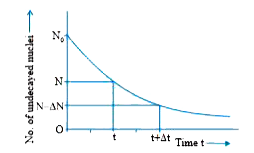
Radioactive decay Law: The rate of decay of radioactive nuclei is directly proportional to the number of undecayed nuclei at that time.
Derivation of Formula Suppose initially the number of atoms in radioactive element is No and N the number of atoms after time t.
After time t, let dN be the number of atoms which disintegrate in a short interval dt, then rate of disintegration will be `(dN)/(dt)`, this is also called the activity of the substance/element.
According to Rutherford-Soddy law
`(dN)/(dt), alphaN`
or `(dN)/(dt), =- lambdaN` ..(i)
where `lambda` is a constant, called decay constant or disintegration constant of the element. Its unit is `s^(–1)`. Negative sign shows that the rate of disintegration decreases with increase of time. For a given element/substance `lambda` is a constant and is different for different elements. Equation (i) may be rewritten as
`(dN)/N=(-lambdadt)`
Integrating `log_e, N=-lambdat+C`...(ii )
where C is a constant of integration.
At `t=0, N=N_0`
`therefore log_e N_0=0+C * * C = log_e N_0`
`therefore` Equation (ii) gives `log_eN=-lambdat+log_e N_0`
or `log_eN-log_eN_0=-lambdat`

According to this equation, the number of undecayed atoms/nuclei of a given radioactive element decreases exponentially with time (i.e., more rapidly at first and slowly afterwards).
Mark of `N=N_0/16` in terms of `T_(1//2)` is shown in fig.
Promotional Banner

Topper's Solved these Questions

  • CBSE Examination Paper Delhi–2014

    CBSE COMPLEMENTARY MATERIAL|Exercise Set-II (Questions Uncommon to Set-I)|10 Videos
  • CBSE Examination Paper Delhi–2014

    CBSE COMPLEMENTARY MATERIAL|Exercise SET-III (Questions Uncommon to set-I and II)|9 Videos
  • CBSE EXAMINATION PAPER - 2016

    CBSE COMPLEMENTARY MATERIAL|Exercise SECTION - E|17 Videos
  • CBSE EXAMINATION PAPER, DELHI REGION - 2015 (CODE NO. 55/1/1/D)

    CBSE COMPLEMENTARY MATERIAL|Exercise SECTION E|6 Videos

Similar Questions

Explore conceptually related problems

Deduce the expression, N=N_(0)^(-lambdat) for the law of radioactive decay. (b) Is the nucleus formed in the decay of the nucleus ._(11)^(12)Na , an isotope or isobar?

Radioactive Decay Law

Expand the following N=N_(0)e^(-lambdat)

Radioactive decay follows first-order kinetic. The mean life and half-life of nuclear decay process are tau = 1// lambda and t_(1//2) = 0.693//lambda . Therefore are a number of radioactive elements in nature, their abundance is directly proportional to half life. The amount remaining after n half lives of radioactive elements can be calculated using the relation: N = N_(0) ((1)/(2))^(n) The rate of radioactive decay is

Stability Curve and Laws of Radioactive Decay

The mathematical equation of law of radioactive decay is

Radioactive disintergation always follow I order kinetics and is independent of all external factors and is represented by the relation N = N_(0) e^(-lambda t) where lambda is decay constant and N atoms are left at time t . The radioactive nature of element is expressed in terms of average life numerically equal to decay constant (1//lambda) however all the radioactive do not lose their radioactive nature in thier average life. The radioactive emission involves alpha, beta particles as well as gamma- rays.The penertrating power order is alpha lt beta lt gamma . The emissions can perntrate even thick steel walls but are however unable to penttrate Pb blocks. The S unit fo rate of decay is dps . The percentage of atoms decayed in average life of a radioactive element is:

