

Home
Class 11
PHYSICS
A pulley is attached to one arm of a bal...

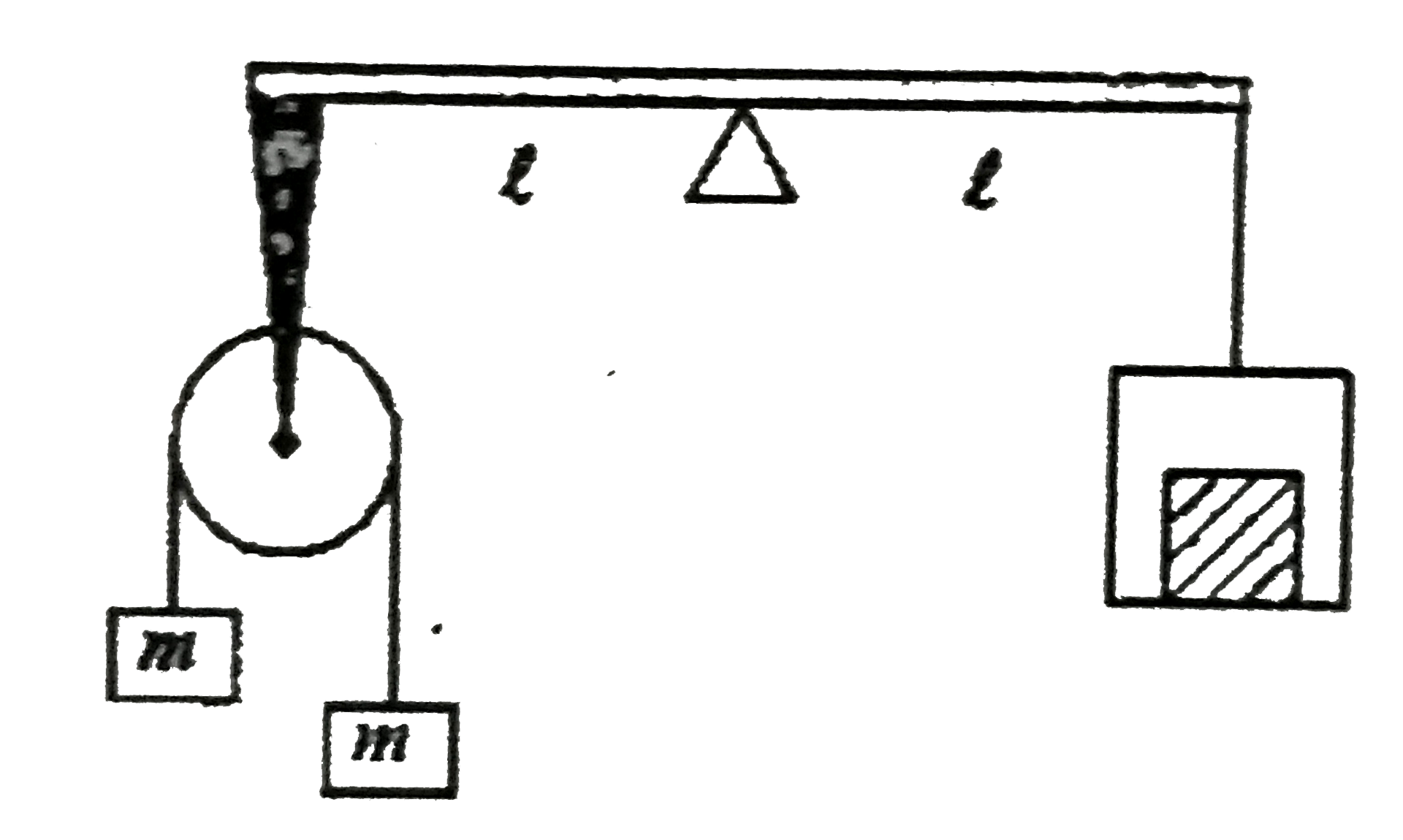
A pulley is attached to one arm of a balance and a string passed around it carries two masses `m_(1)` and `m_(2)`. The pulley is provided with a clamp due to which `m_(1)` and `m_(2)` do not move. On removing the clamp, `m_(1)` and `m_(2)` start moving. How much change in counter mass has to be made to restore balance ?

Promotional Banner

Similar Questions

Explore conceptually related problems

A pulley is attached to one arm of a balance and a string passed around it carries two masses m_(1) and m_(2) . The pulley is provided with a clamp due to which m_(1) and m_(2) do not move . On removing the clamp m_(1) and m_(2) start moving . How much counterweight is to be reduced or increased to restore balance ?

A pulley is attached to one arm of a balance and a string passed around it carries two masses m_(1) and m_(2) . The pulley is provided with a clamp due to which m_(1) and m_(2) do not move . On removing the clamp m_(1) and m_(2) start moving . How much counterweight is to be reduced or increased to restore balance ?

A massless string passes over a frictionless pulley and carries two masses m_1 and m_2(m_1 > m_2) at it's ends. If g is the acceleration due to gravity, then the thrust on the pulley is (m_1>m_2) .

Two masses m_(1) and m_(2) are connected by a light string passing over a smooth pulley. When set free m_(1) moves downward by 2 m in 2 s. The ratio m_(1)//m_(2) is

Two masses m_(1) and m_(2) are attached to a spring balance S as shown in figure. m_(1) gt m_(2) then the reading of spring balance will be . .

In the given arrangement, all strings and pulleys are light. When the system was released it was observed that M and m_(0) do not move. Find the masses M and m_(0) in terms of m_(1) "and" m_(2) . Find the acceleration of all the masses if string is cut just above m_(2) .