Home
Class 12
CHEMISTRY
which of the following statement is corr...

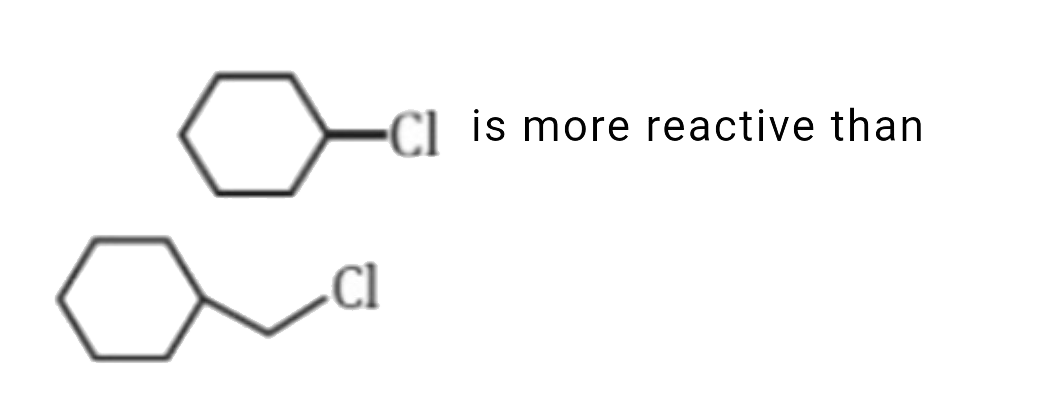
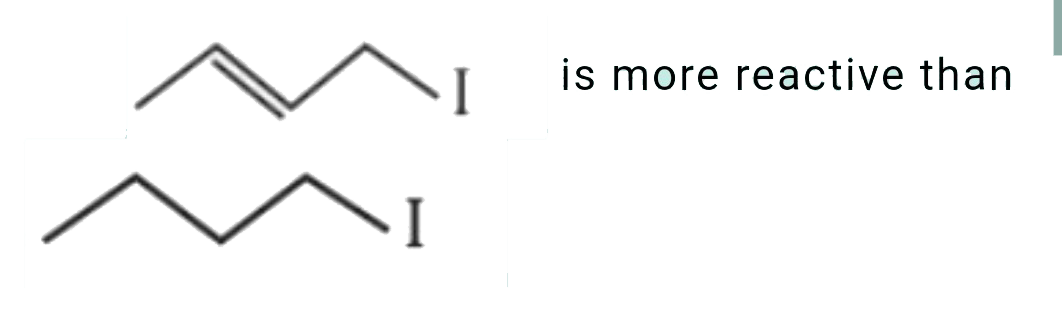
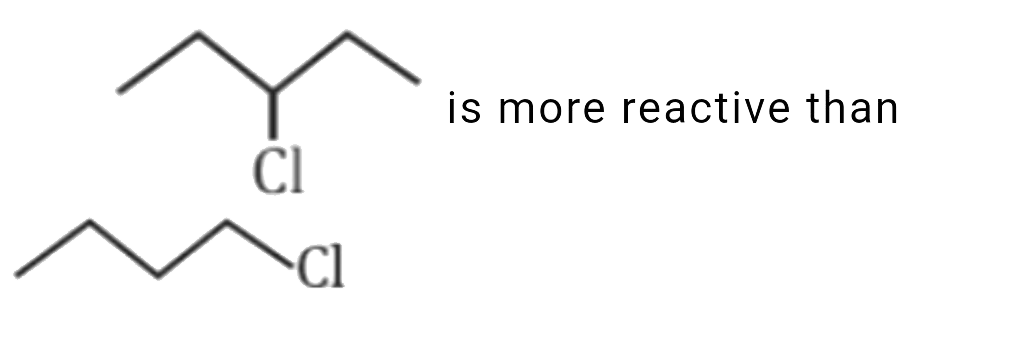
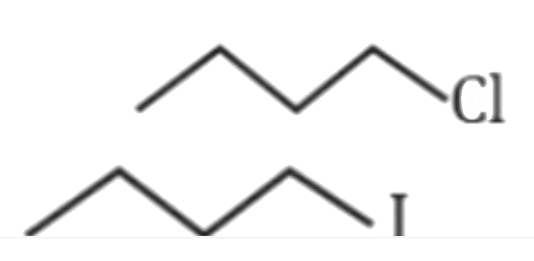
which of the following statement is correct for the reactivity in `S_(N)2` reaction ?

A

B

C

D

is more reactive than

Text Solution

AI Generated Solution

The correct Answer is:
To determine the correct statement regarding the reactivity in \( S_N2 \) reactions, let’s analyze the factors that influence the reactivity of alkyl halides in these reactions step by step. ### Step 1: Understanding \( S_N2 \) Mechanism The \( S_N2 \) reaction is a bimolecular nucleophilic substitution reaction where the nucleophile attacks the electrophilic carbon atom from the opposite side of the leaving group. This results in an inversion of configuration at the carbon center. **Hint:** Remember that \( S_N2 \) reactions involve a backside attack by the nucleophile. ### Step 2: Role of Nucleophile The strength of the nucleophile is crucial for \( S_N2 \) reactions. A strong nucleophile will effectively attack the electrophilic carbon. The nucleophile should be electron-rich and capable of forming a bond with the carbon atom. **Hint:** Strong nucleophiles enhance the reactivity in \( S_N2 \) reactions. ### Step 3: Leaving Group Ability The leaving group must be a good leaving group, meaning it should be able to depart easily from the carbon atom. Good leaving groups are typically weak bases, which can stabilize the negative charge after leaving. **Hint:** The weaker the bond between the carbon and the leaving group, the better the leaving group. ### Step 4: Steric Hindrance Steric hindrance around the carbon atom affects the reactivity in \( S_N2 \) reactions. The less steric hindrance there is, the more reactive the alkyl halide will be. Methyl halides are the most reactive due to minimal steric hindrance, followed by primary, secondary, and tertiary alkyl halides, which have increasing steric hindrance. **Hint:** Methyl halides are the most reactive in \( S_N2 \) due to less steric hindrance. ### Step 5: Reactivity Order The general order of reactivity for alkyl halides in \( S_N2 \) reactions is: 1. Methyl halides (most reactive) 2. Primary alkyl halides 3. Secondary alkyl halides 4. Tertiary alkyl halides (least reactive) **Hint:** Remember the reactivity decreases as the number of alkyl groups attached to the carbon increases. ### Step 6: Considering Hybridization The hybridization of the carbon atom also plays a role. Carbon atoms with higher \( s \)-character (like \( sp^2 \) or \( sp \)) are more electronegative and can stabilize the positive charge better, making them less favorable for \( S_N2 \) reactions compared to \( sp^3 \) hybridized carbons. **Hint:** \( sp^3 \) hybridized carbons are more favorable for \( S_N2 \) reactions. ### Conclusion Based on the analysis, the correct statement regarding the reactivity in \( S_N2 \) reactions is that methyl halides are the most reactive, followed by primary, secondary, and tertiary alkyl halides. The factors influencing reactivity include the strength of the nucleophile, the ability of the leaving group, and steric hindrance. **Final Answer:** The correct statement for the reactivity in \( S_N2 \) reaction is that methyl halides are the most reactive due to less steric hindrance and a good leaving group.
Promotional Banner

Topper's Solved these Questions

  • JEE MOCK TEST 24

    NTA MOCK TESTS|Exercise CHEMISTRY|25 Videos
  • JEE MOCK TEST 3

    NTA MOCK TESTS|Exercise CHEMISTRY|25 Videos

Similar Questions

Explore conceptually related problems

Which of the following are correct for S_(N^(2)) reaction?

Which of the following statements is (are) correct about the following reaction ? 2Pbo(s) + C(s) to 2Pb(s) + CO_(2) (g)

Which of the following is the correct order of decreasing S_(N^(2)) reactivity ?

The correct order of reactivity towards S_(N) 1 reaction is

Which of the following halides will be most reactive in S_(N)1 reaction and S_(N)2 reactions, respectively

Which of the following statements is correct regarding the rate of hydrolyisi of the compounds (A) and (B) By S_(N^(1)) reaction ?

NTA MOCK TESTS-JEE MOCK TEST 26-CHEMISTRY
  1. Which one is the wrong statement ?

    Text Solution

    |

  2. When MnO(2) is fused with KOH, a coloured compound is formed. The prod...

    Text Solution

    |

  3. A metal is illumimated by light of two different wavelength 248nm and ...

    Text Solution

    |

  4. The number and type of bonds between two carbon atoms in CaC(2) are:

    Text Solution

    |

  5. For the reaction: X(2)O(4)(l)rarr2XO(2)(g) DeltaU=2.1 cal , DeltaS...

    Text Solution

    |

  6. A balloon filled with oxygen is placed in a tank full of hydrogen gas ...

    Text Solution

    |

  7. In the Hall-Heroult process for the extraction of Al, which of the fol...

    Text Solution

    |

  8. Which of the following acts as an oxidising as well as reducing agent ...

    Text Solution

    |

  9. Determine the order of stability of the following resonating structure...

    Text Solution

    |

  10. The ionization energies of Li and Na are 520 kJ mol ^-1 and 495 kJ mol...

    Text Solution

    |

  11. In the following reaction sequence, structures of P and Q , are respec...

    Text Solution

    |

  12. Provide the systematic name of the compound shown

    Text Solution

    |

  13. Which reagent can be used to convert a carboxylic acid chloride into a...

    Text Solution

    |

  14. Which of the following can not be made by reduction of ketone or alden...

    Text Solution

    |

  15. which of the following statement is correct for the reactivity in S(N)...

    Text Solution

    |

  16. pH of the anodic solution of the following cell is Pt, H2(1atm)|H^+(xM...

    Text Solution

    |

  17. The vapour pressure of pure water at 26^@C is 25.5 torr. . The vapour...

    Text Solution

    |

  18. The number of geometric isomers of the complex Cr(NH3)3Cl3 are

    Text Solution

    |

  19. A hydrocarbon (A) CnH(2n-4) on ozonolysis gives (CH3)2CHCH2CHO, 2 OH...

    Text Solution

    |

  20. The gas phase decomposition of dimethylether follows first order kinet...

    Text Solution

    |

