Home
Class 12
CHEMISTRY
Which are not position isomers?...

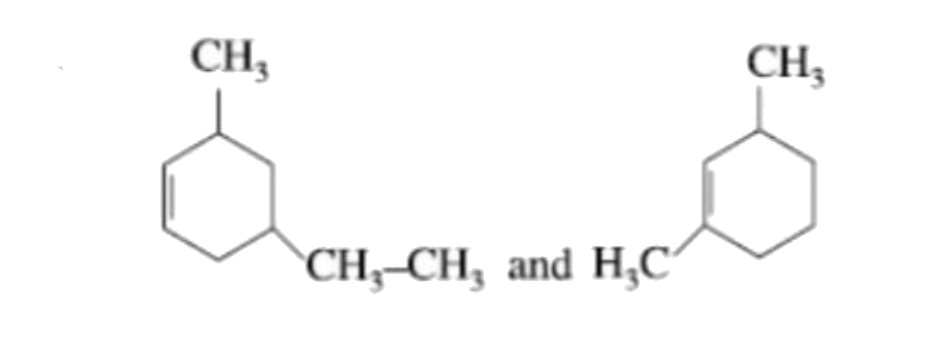
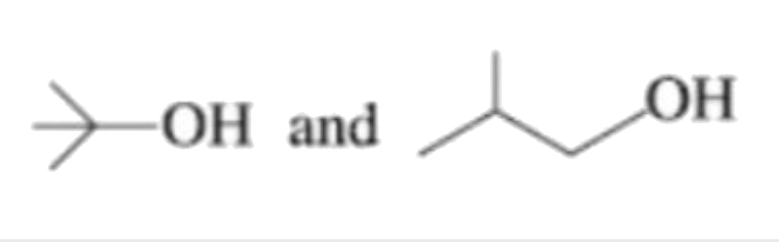
Which are not position isomers?

A

`CH_(3)-underset(CH_(3))underset("| ")"CH"-underset(CH_(3))underset("| ")"CH"-CH_(3) and CH_(3)-overset(CH_(3))overset("| ")underset(CH_(3))underset("| ")"C "-CH_(2)-CH_(3)`

B

`CH_(3)-underset(H)underset(|)CH-CH_(2)-underset(Cl)underset(|)C=O and CH_(3)-underset(Cl)underset(|)CH-CH_(2)-underset(H)underset(|)C=O`

C

D

Text Solution

AI Generated Solution

The correct Answer is:

To determine which compounds are not position isomers, we need to understand what position isomers are. Position isomers are compounds that have the same molecular formula and the same carbon skeleton (main chain), but differ in the position of a functional group or substituent on that skeleton. ### Step-by-Step Solution: 1. **Identify the Compounds**: Start by listing the compounds you are analyzing. For example, let's say we have the following compounds: - Compound A: CH3-CH2-CH(CH3)-OH - Compound B: CH3-CH(CH3)-CH2-OH - Compound C: CH3-CO-CH2-CHO - Compound D: CH3-CH2-CH2-CHO 2. **Check the Main Chain**: For each compound, identify the main carbon chain. The main chain is the longest continuous chain of carbon atoms. - For Compound A: The main chain is 3 carbons (C1, C2, C3). - For Compound B: The main chain is also 3 carbons (C1, C2, C3). - For Compound C: The main chain is 3 carbons (C1, C2, C3). - For Compound D: The main chain is 4 carbons (C1, C2, C3, C4). 3. **Identify the Functional Groups**: Look at the functional groups or substituents attached to the main chain. - Compound A has an -OH group on the third carbon. - Compound B has an -OH group on the second carbon. - Compound C has a carbonyl (C=O) and an aldehyde (CHO) group. - Compound D has an aldehyde (CHO) group at the end of the chain. 4. **Determine Position Isomers**: Now, check if the compounds are position isomers by comparing the positions of the functional groups. - Compounds A and B are position isomers because they have the same main chain and differ in the position of the -OH group. - Compound C and D are not position isomers of A and B because they have different functional groups (C=O and CHO) and hence are functional isomers. 5. **Conclusion**: Based on the analysis, the compounds that are not position isomers are Compound C and Compound D, as they differ in functional groups and do not have the same main chain structure as A and B. ### Final Answer: The compounds that are not position isomers are Compound C (CH3-CO-CH2-CHO) and Compound D (CH3-CH2-CH2-CHO).
Promotional Banner

Topper's Solved these Questions

  • NTA JEE MOCK TEST 32

    NTA MOCK TESTS|Exercise CHEMISTRY|25 Videos
  • NTA JEE MOCK TEST 34

    NTA MOCK TESTS|Exercise CHEMISTRY|25 Videos

Similar Questions

Explore conceptually related problems

Which os not position isomer of A

Which of the following pairs of compound are not position isomers ?

Which of the following pairs of compounds are not position isomers?

Which of the following pairs of compounds are not position isomers?

The number the following pairs of compounds are not positional isomers ?

Four structural isomers are possible corresponding to the molecular formula C_(3)H_(9)N . Out of these, two are primary amines which are position isomers. All are more basic than aniline. 7. Which of these liberate N_(2) gas on treatment with nitrous acid?

Four structural isomers are possible corresponding to the molecular formula C_(3)H_(9)N . Out of these, two are primary amines which are position isomers. All are more basic than aniline. 10. Which of these will not react with benzene sulphonyl chloride?

Four structural isomers are possible corresponding to the molecular formula C_(3)H_(9)N . Out of these, two are primary amines which are position isomers. All are more basic than aniline. 9. How will you prepare one of these primary amines by Hoffmann bromamide reaction?

NTA MOCK TESTS-NTA JEE MOCK TEST 33-CHEMISTRY
  1. Assume 100% ionisation of the following aq. Solution of (I) [Pt(NH(3...

    Text Solution

    |

  2. During an electrolysis of conc. H(2)SO(4), peroxydisulphuric acid (H(2...

    Text Solution

    |

  3. 1 M NH(4)OH and 1 M HCl are mixed to make a total volume of 300 mL. If...

    Text Solution

    |

  4. Which are not position isomers?

    Text Solution

    |

  5. Which of the following has highest K(a) value?

    Text Solution

    |

  6. Which of following reagents does not give isobutane when reacted with ...

    Text Solution

    |

  7. The final product obtained in the reaction

    Text Solution

    |

  8. Which of the following will not be formed when calcium formate is dist...

    Text Solution

    |

  9. Which of the following chemicals can be added for sweetening of food i...

    Text Solution

    |

  10. C(4)H(7)OCl overset(NH(3))rarr C(4)H(9)ON underset(KOH)overset(Br(2))r...

    Text Solution

    |

  11. What is the simplest formula of a solid whose unit cell has the atom A...

    Text Solution

    |

  12. 0.1 M KMnO(4) is used for the following titration. What volume of the ...

    Text Solution

    |

  13. CO(2) gas is liquefaction for 1 mole of CO(2). Then which stateme...

    Text Solution

    |

  14. Which of the following statement about anhydrous aluminium chloride is...

    Text Solution

    |

  15. Which one of the following is the correct statement?

    Text Solution

    |

  16. A solution containing 10 g of a non- voltile, higher nonelectrolyte an...

    Text Solution

    |

  17. For the reaction 3AhArr C+2D, initially A was taken. At equilibrium th...

    Text Solution

    |

  18. How many of the following are polar aprotic solvents?

    Text Solution

    |

  19. How many Cr-O bonds are equivalent in chromate dianion ?

    Text Solution

    |

  20. 5 ml As(2)S(3) is mixed with distilled water and 0.01 M solution of an...

    Text Solution

    |
