Home
Class 12
CHEMISTRY
The correct orientation of dipoles in py...

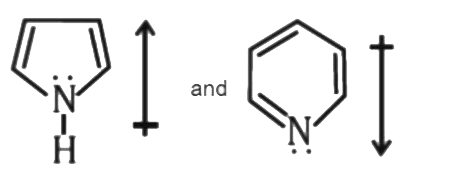
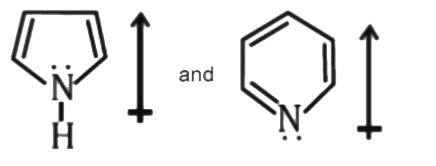
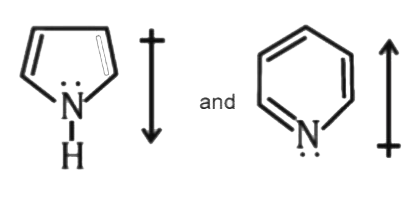
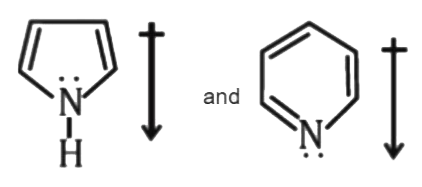
The correct orientation of dipoles in pyrrole and pyridine is

A

B

C

D

Text Solution

AI Generated Solution

The correct Answer is:

To determine the correct orientation of dipoles in pyrrole and pyridine, we need to analyze the molecular structure and the electronegativity of the atoms involved. Here’s a step-by-step solution: ### Step 1: Understand the Structures of Pyrrole and Pyridine - **Pyrrole** is a five-membered ring containing four carbon atoms and one nitrogen atom. The nitrogen in pyrrole has a lone pair of electrons that participates in resonance. - **Pyridine** is a six-membered aromatic ring containing five carbon atoms and one nitrogen atom. The nitrogen in pyridine does not have a lone pair that participates in resonance. **Hint:** Identify the key structural differences between pyrrole and pyridine. ### Step 2: Analyze Electronegativity - Nitrogen (N) is more electronegative than carbon (C). This means that in both compounds, the nitrogen atom will attract electron density towards itself, creating a dipole moment. **Hint:** Recall that electronegativity affects the distribution of electron density in a molecule. ### Step 3: Determine the Direction of Dipole Moments - In **pyrrole**, the lone pair on nitrogen is above the plane of the ring. This lone pair can participate in resonance, which stabilizes the molecule and affects the dipole moment. The dipole moment in pyrrole will point upwards due to the influence of the lone pair. - In **pyridine**, the nitrogen's lone pair is in an sp2 hybridized orbital and does not participate in resonance with the ring. The dipole moment in pyridine will point downwards, as the nitrogen atom pulls electron density towards itself, but the lone pair does not contribute to the overall dipole direction. **Hint:** Consider how lone pairs and resonance affect the orientation of dipoles in cyclic compounds. ### Step 4: Summarize the Dipole Orientation - The dipole moment in **pyrrole** is oriented upwards due to the resonance involving the lone pair on nitrogen. - The dipole moment in **pyridine** is oriented downwards because the lone pair does not participate in resonance and the nitrogen atom pulls electron density towards itself. **Hint:** Visualize the molecular structure to better understand the orientation of dipoles. ### Final Answer - The correct orientation of dipoles is: - **Pyrrole:** Upwards - **Pyridine:** Downwards
Promotional Banner

Topper's Solved these Questions

  • NTA JEE MOCK TEST 34

    NTA MOCK TESTS|Exercise CHEMISTRY|25 Videos
  • NTA JEE MOCK TEST 36

    NTA MOCK TESTS|Exercise CHEMISTRY|25 Videos

Similar Questions

Explore conceptually related problems

The correct order of dipole moment is :

The correct order of dipole moment is :

Correct order of dipole moment is

NTA MOCK TESTS-NTA JEE MOCK TEST 35-CHEMISTRY
  1. For the reaction 5Br^(-)(aq)+BrO(3)^(-)(aq)+6H^(+)(aq)rarr 3Br(2)(aq...

    Text Solution

    |

  2. Polyvinyl alcohol is an important polymer. The structure is given belo...

    Text Solution

    |

  3. Text Solution

    |

  4. The correct orientation of dipoles in pyrrole and pyridine is

    Text Solution

    |

  5. Upon long standing concetrated HNO(3)

    Text Solution

    |

  6. In which of the following crystals alternate tetrahedral voids are occ...

    Text Solution

    |

  7. Which of the following represents correcty the changes in thermodynami...

    Text Solution

    |

  8. What represents the best method for converting a carboxylic acid to an...

    Text Solution

    |

  9. Aluminum carbide (Al(4)C(3)) liberates methane on treatment with water...

    Text Solution

    |

  10. Give the major product of the following reaction

    Text Solution

    |

  11. Which of the following is correct?

    Text Solution

    |

  12. The van der Waals equation for one mole of a real gas can be written a...

    Text Solution

    |

  13. For the reaction 2CO(g)+O(2)(g)rarr 2CO(2), DeltaH=-500kJ. Two mol...

    Text Solution

    |

  14. There are four complexes of Ni. Select the complexes/es which will be ...

    Text Solution

    |

  15. A mixture of three alkyl chloride CH(3)Cl, CH(3)CH(2)Cl, CH(3)CH(2)CH(...

    Text Solution

    |

  16. A cell contains two hydrogen electrodes. The negative electrode is in ...

    Text Solution

    |

  17. The number of compounds in which complete delocalisation of pi- electr...

    Text Solution

    |

  18. Among the following metals how many metals are extracted by self-reduc...

    Text Solution

    |

  19. In the esterification C(2)H(5)OH(l)+CH(3)COOH(l)" an "hArr CH(3)COOC...

    Text Solution

    |

  20. The number of unbranched isomers (including stereoisomers) of C(6)H(12...

    Text Solution

    |
