Home
Class 12
CHEMISTRY
Phenol on treatment with CO(2) in the pr...

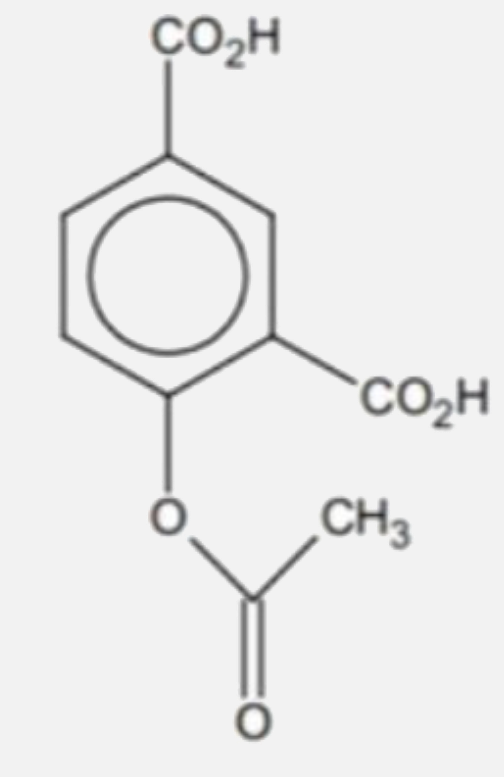
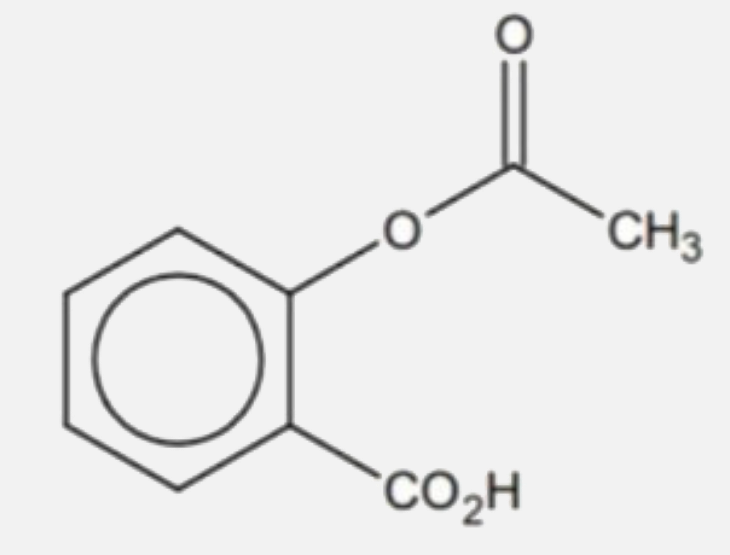
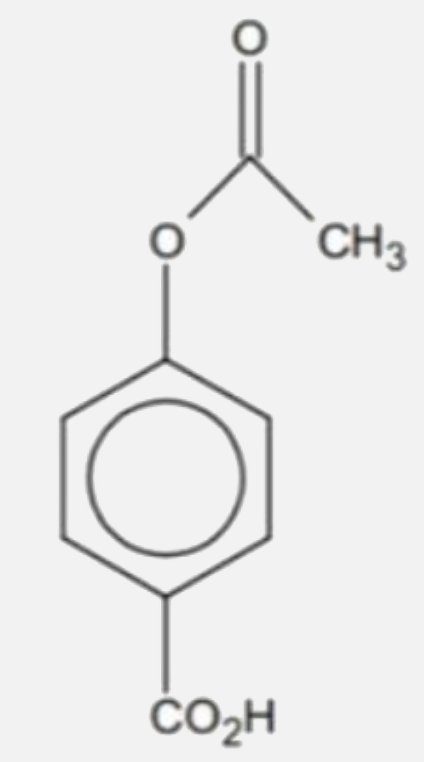
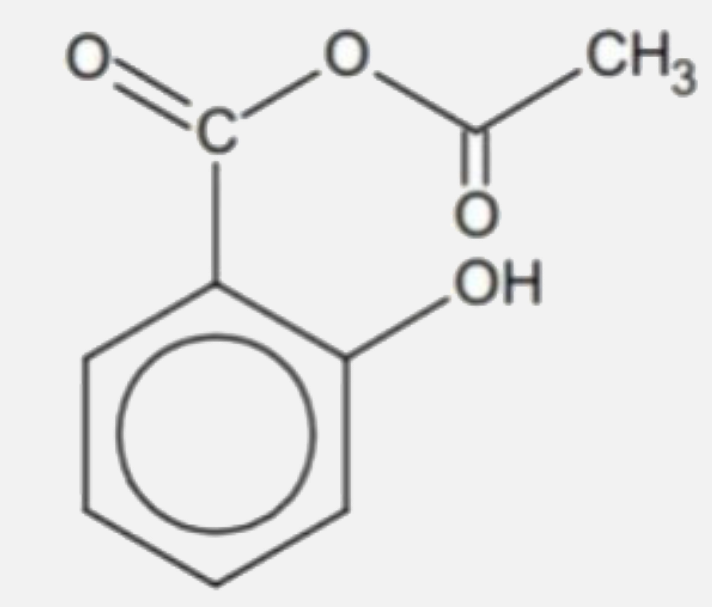
Phenol on treatment with `CO_(2)` in the presence of `NaOH` followed by acidification produces compound X as the major product. X on treatment with `(CH_(3)CO)_(2)O` in the presence of catalytic amount of `H_(2)SO_(4)` produces

A

B

C

D

Text Solution

Verified by Experts

The correct Answer is:

B
Promotional Banner

Topper's Solved these Questions

  • NTA JEE MOCK TEST 49

    NTA MOCK TESTS|Exercise CHEMISTRY|25 Videos
  • NTA JEE MOCK TEST 51

    NTA MOCK TESTS|Exercise CHEMISTRY|25 Videos

Similar Questions

Explore conceptually related problems

HC-= CH on treatment with NH_(3) in the presence of FE- pyrite produces the following products.

Cinnamci acid is fomed when C_(6)H_(5)-CHO condenses with (CH_(3)CO_(2))O in the presence of

Reaction of phenol with NaOH followed by heating with CO_(2) under high pressure , and subsequent acidification gives compounds X as the major product , which can be purified by steam distillation . When reacted with acetic anhydride in the presence of a trace amount of conc. H_(2)SO_(4) compound X produces Y as the major product . Compound Y is

Ethanol on treatment with ethanenitrile in the presence of conc. H_(2)SO_(4) followed by hydrolysis will yields

What happens when phenol is warmed with CO_(2) in the presence of aqueous NaOH?

The major product obtained on interactionof phenol with NaOH and CO_(2) is

Treatment of benzene with CO/HCl in the presence of anhydrous "AlCl"_(3)//"CuCl" followed by reaction with Ac_(2)"O"//"NaOAc" gives compound X as the major product. Compound X upon reaction with Br_(2)//Na_(2)CO_(3) , followed by heating at 473 K with moist KOH furnishes Y as the major product. Reaction of X with H_(2)//Pd-C , followed by H_(3)PO_(4) treatment gives Z as the major product. The compound Y is

Treatment of benzene with CO/HCl in the presence of anhydrous "AlCl"_(3)//"CuCl" followed by reaction with Ac_(2)"O"//"NaOAc" gives compound X as the major product. Compound X upon reaction with Br_(2)//Na_(2)CO_(3) , followed by heating at 473 K with moist KOH furnishes Y as the major product. Reaction of X with H_(2)//Pd-C , followed by H_(3)PO_(4) treatment gives Z as the major product. The compound Z is

NTA MOCK TESTS-NTA JEE MOCK TEST 50-CHEMISTRY
  1. Consider the following sequence of reactions overset(H^(+)//Delta)r...

    Text Solution

    |

  2. An alkali is titrated against an acid with methyl orange as indicator,...

    Text Solution

    |

  3. In Bohr 's model of hydrogen when an electron jumps from n=1 to n=3 ho...

    Text Solution

    |

  4. Which of the following compound will undergo tautomerism?

    Text Solution

    |

  5. Which of the following lines correctly show the temperature dependence...

    Text Solution

    |

  6. The K(eq) values in HCN addition to following aldehydes are in the ord...

    Text Solution

    |

  7. An aqueous solution contains an unknown concentration of Ba^(2+). When...

    Text Solution

    |

  8. Which of the following is incorrect?

    Text Solution

    |

  9. At 518^(@)C the rate of decomposition of a sample of gaseous acetaldeh...

    Text Solution

    |

  10. The basic character of the transition metal monoxide follows the order

    Text Solution

    |

  11. The incorrect statement about the oxoacids, HClO(4) and HClO, is

    Text Solution

    |

  12. Trichloroacetaldehyde, C Cl(3)CHO reacts with chlorobenzene in presenc...

    Text Solution

    |

  13. When metal ‘M’ is treated with NaOH, a white gelatinous precipitate ‘X...

    Text Solution

    |

  14. Phenol on treatment with CO(2) in the presence of NaOH followed by aci...

    Text Solution

    |

  15. The recommended concentration of fluoride ion in drinking water is up ...

    Text Solution

    |

  16. how many sp^(2) carbon atoms are present in the final product?

    Text Solution

    |

  17. The total number of stereoisomers that can exist for M is

    Text Solution

    |

  18. One mole of N(2)O(4)(g) at 300 K is kept in a closed container under o...

    Text Solution

    |

  19. Among the following, the number of compounds that can react with PCl(5...

    Text Solution

    |

  20. The number of geometric isomers possible for the complex [CoL(2)Cl(2)]...

    Text Solution

    |
