Home
Class 12
PHYSICS
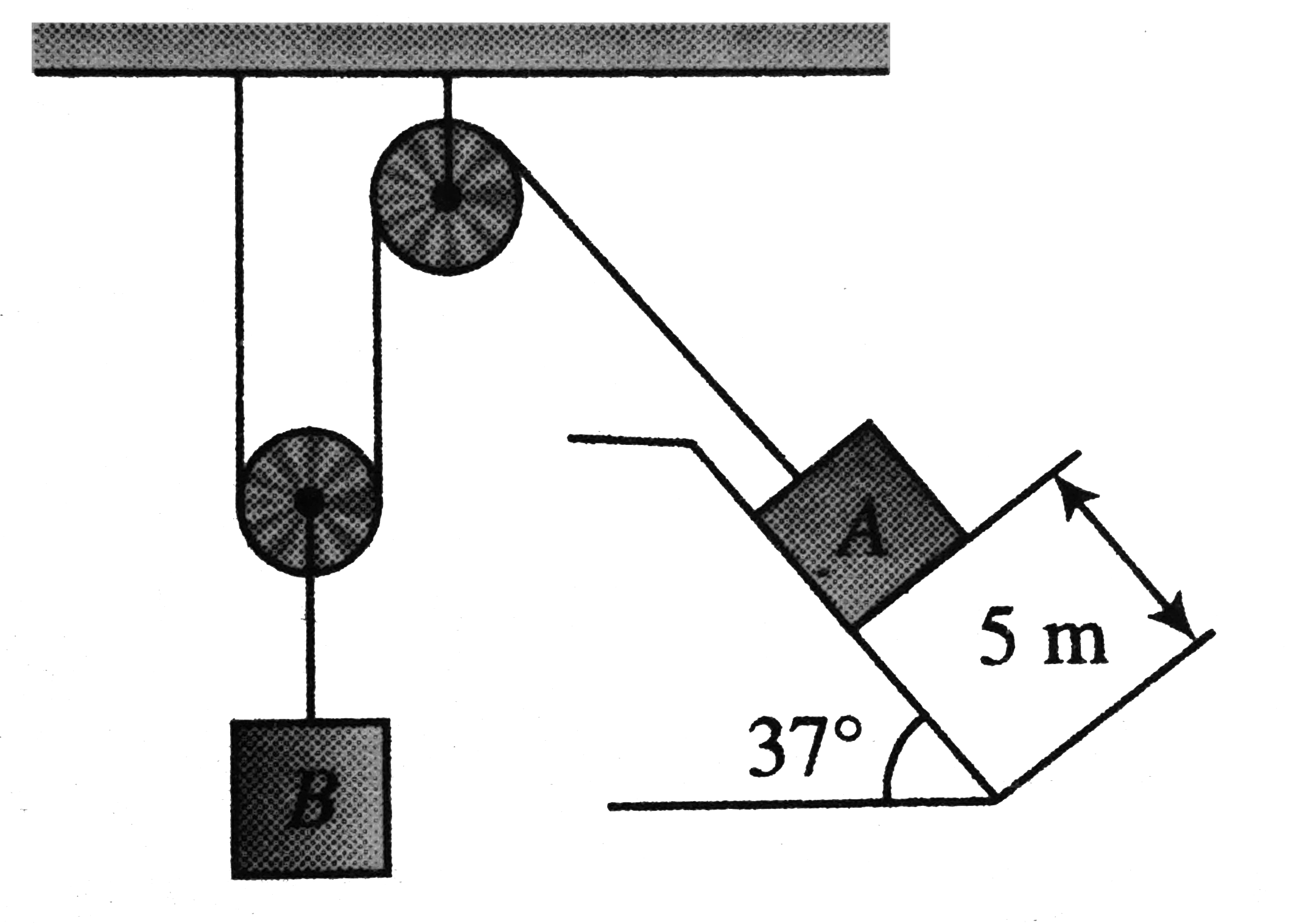
The blocks A and B shown in figure have ...

The blocks A and B shown in figure have masses `M_A=5kg` and `M_B=4kg`. The system is released from rest. The speed of B after A has travelled a distance `1m` along the incline is

A

`sqrt((15)/(2))`

B

`sqrt((15)/(8))`

C

`sqrt((5)/(6))`

D

`sqrt((5)/(2))`

Text Solution

Verified by Experts

The correct Answer is:

C
Promotional Banner

Topper's Solved these Questions

  • NTA JEE MOCK TEST 57

    NTA MOCK TESTS|Exercise PHYSICS|25 Videos
  • NTA JEE MOCK TEST 59

    NTA MOCK TESTS|Exercise PHYSICS|25 Videos

Similar Questions

Explore conceptually related problems

Consider the situation as shown in the figure. The system is released from rest. Find the speed of m when it has traveled a distance d on a rough surface.

In the arrangement shown in figure m_(A)=4.kg and m_(B)=1.0kg . The system is released from rest and block B is found to have a speed 0.3m//s after it has descended through a distance of 1.m find the coefficient of friction between the block and the table. Neglect friction elsewhere. (Take g=10 m//s^(2) ). .

Blocks A and B shown in the figure are having equal masses m. The system is released from rest with the spring unstretched. The string between A and ground is cut, when there is maximum extension in the spring. The acceleration of centre of mass of the two blocks at this instant is

In the arrangement shown in figure m_(A) = 4.0 kg and m_(B) = 1.0 kg. The system is released from rest and block B is found to have a speed 0.3 m/s after it has descended through a distance of 1m. Find the coefficient of friction between the block and the table. Neglect friction elsewhere. (Take g = 10 m/ s^(2) )

A block of mass M is placed on the top of a bigger block of mass 10 M as shown in figure. All the surfaces are frictionless. The system is released from rest, then the distance moved by the bigger block at the instant the smaller block reaches the ground :

A block A (mass 4M) is placed on the top of a wedge block B of base length l (mass=20M) as shown in figure. When the system is released from rest. Find the distance moved by the block B till the block A reaches ground Assume all surfaces are frictionless.

Two blocks of mass M and 2M are connected to the two ends of a light, inextensible string passing over an ideal pulley as shown in figure. The system is released from rest. (a) One second after the system is released, a particle of mass M hits the block of mass M and sticks to it. The particle hits the block with a speed of 10 m/s while travelling downward. Find the total distance travelled by block of mass 2M after it is released. (b) One second after the system is released, a particle of mass 2M hits the block of mass M and sticks to it. The particle hits the block with a speed of 10 m/s while travelling in upward direction. Find distance travelled by the block of mass 2M after it is released to the time it comes to rest for the first time (g = 10 m//s)^(2)

The system shown in figure is held at rest. The boxes A and B have masses of 100 kg and 200 kg respectively. The inclined planes are smooth and long enough. The boxes are released to move. Find the speed (cm/s) of 100 kg box after it had travelled a distance of 6 cm.

In the system shown in fig, mass of the block is m_(1) = 4 kg and that of the hanging particle is m_(2) = 1 kg. The incline is fixed and surface is smooth. Block is initially held at the top of the incline and the particle hangs a distance d = 2.0 m below it. [Assume that the block and the particle are on same vertical line in this position]. System is released from this position. After what time will the distance between the block and the particle be minimum ? Find this minimum distance. [ g = 10 m//s^(2) .]

NTA MOCK TESTS-NTA JEE MOCK TEST 58-PHYSICS
  1. An insulating solid sphere of the radius R is charged in a non - unifo...

    Text Solution

    |

  2. Suppose the gravitational force varies inversely as the n^(th) power o...

    Text Solution

    |

  3. A rod of length l (laterally thermally insulated) of the uniform cross...

    Text Solution

    |

  4. An ideal diatomic gas undergoes a thermodynamic process as shown in th...

    Text Solution

    |

  5. A man crosses a river in a boat. If he cross the river in minimum time...

    Text Solution

    |

  6. The friction coefficient between the board and the floor shown in figu...

    Text Solution

    |

  7. A radionuclide with half - life 1620 s is produced in a reactor at a c...

    Text Solution

    |

  8. A disc of radius R and mass M is pivoted at the rim and it set for sma...

    Text Solution

    |

  9. In a photoelectric effect experiment, stopping potential changes by 30...

    Text Solution

    |

  10. The length of a metal wire is l(1) when the tension in it is T(1) and ...

    Text Solution

    |

  11. A light ray is incident on lower medium boundary at an angle 30^(@) wi...

    Text Solution

    |

  12. 1000 kHz carrier wave is amplitude modulated by the signal frequency ...

    Text Solution

    |

  13. A pendulum clock (fitted with a small heavy bob that is connected with...

    Text Solution

    |

  14. The unit of electric permittivity is (C^(2))/(Nm^(2)). Find the dimens...

    Text Solution

    |

  15. The blocks A and B shown in figure have masses MA=5kg and MB=4kg. The ...

    Text Solution

    |

  16. A boat covers 24 km upstream and 36 km downstream in 6 hours while ...

    Text Solution

    |

  17. A non - conducting rod of length L with linear charge density lambda=l...

    Text Solution

    |

  18. The instaneous velocity of point B of the given rod of length 0.5 is 3...

    Text Solution

    |

  19. In Young's double - slit experiment, the distance between slits is d =...

    Text Solution

    |

  20. An observer standing on a railway crossing receives frequencies 2.2 kH...

    Text Solution

    |
