

Home
Class 12
CHEMISTRY
Which of the following curve will repres...

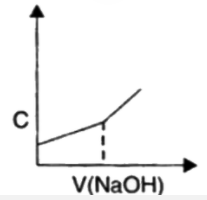
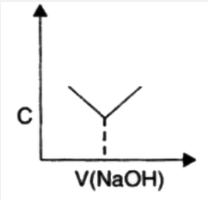
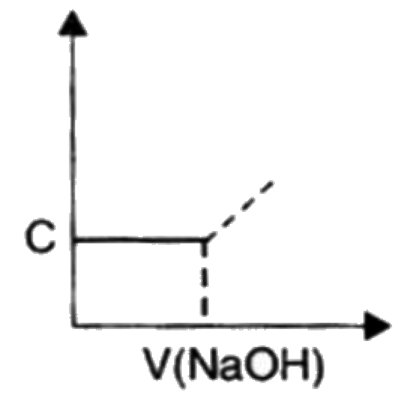
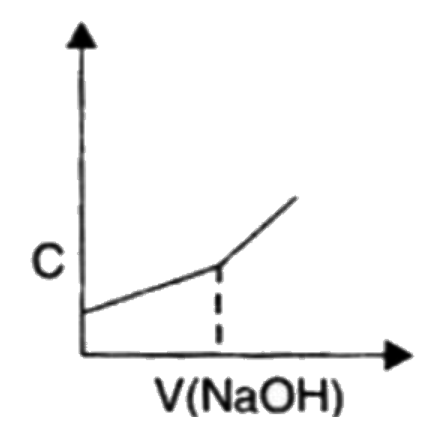
Which of the following curve will represent the variation of conductance C during titration of `CH_(3)COOH` by gradual addition of NaOH solution (V)

A

B

C

D

Text Solution

AI Generated Solution

The correct Answer is:
To determine the variation of conductance (C) during the titration of acetic acid (CH₃COOH) with sodium hydroxide (NaOH), we need to analyze the behavior of the weak acid and the strong base during the titration process. ### Step-by-Step Solution: 1. **Understanding the Components**: - **CH₃COOH (Acetic Acid)**: A weak acid that partially dissociates in solution. - **NaOH (Sodium Hydroxide)**: A strong base that completely dissociates in solution to give Na⁺ and OH⁻ ions. 2. **Initial Conductance**: - At the beginning of the titration, the solution contains only acetic acid, which has a low degree of dissociation. Therefore, the initial conductance is low. 3. **Addition of NaOH**: - As NaOH is gradually added, the OH⁻ ions react with the acetic acid (CH₃COOH) to form acetate ions (CH₃COO⁻) and water. This reaction increases the concentration of ions in the solution, leading to an increase in conductance. 4. **Formation of Sodium Acetate**: - The reaction can be represented as: \[ \text{CH}_3\text{COOH} + \text{NaOH} \rightarrow \text{CH}_3\text{COONa} + \text{H}_2\text{O} \] - Sodium acetate (CH₃COONa) is formed, which is highly ionized in solution. This contributes further to the increase in conductance. 5. **Near the Equivalence Point**: - As we approach the equivalence point, where all acetic acid has reacted with NaOH, the conductance continues to rise. However, the increase in conductance becomes more pronounced due to the presence of a large number of fast-moving OH⁻ ions. 6. **Post Equivalence Point**: - After the equivalence point, any additional NaOH will increase the concentration of OH⁻ ions significantly, leading to a sharp increase in conductance. 7. **Graphical Representation**: - The curve representing the conductance will show a gradual increase initially (as weak acid is titrated), followed by a steep rise as the strong base is added, particularly after reaching the equivalence point. ### Conclusion: The correct curve representing the variation of conductance during the titration of CH₃COOH by NaOH will show a gradual increase followed by a sharp rise, which corresponds to option D.
Promotional Banner

Topper's Solved these Questions

  • NTA JEE MOCK TEST 57

    NTA MOCK TESTS|Exercise CHEMISTRY|25 Videos
  • NTA JEE MOCK TEST 59

    NTA MOCK TESTS|Exercise CHEMISTRY|25 Videos

Similar Questions

Explore conceptually related problems

Which of the following plots represents correctly the variation of conductivity with concentration?

Which of the following curve represents the variation of lambda_(M) with sqrt(C) for AgNO_(3) ?

Which of the following curve represent variation of density of water with temperature best-

Which of the following curve gives the variation of lambda_(m) with sqrtC for CH_(3)COOH ?

NTA MOCK TESTS-NTA JEE MOCK TEST 58-CHEMISTRY
  1. The specific rotation of a pure enantiomer is +10^(@). The observed ro...

    Text Solution

    |

  2. A certain reaction occurs in two steps as (I) 2SO(2(g))+2NO(2(...

    Text Solution

    |

  3. An ideal gas is expand from (P(1),V(1),T(1)) to (P(2),V(2),T(2)) under...

    Text Solution

    |

  4. Which of the following electrolytes will have maximum coagulating valu...

    Text Solution

    |

  5. The possible product obtained from the reaction of cyclobutyl amine wi...

    Text Solution

    |

  6. Consider the reaction equilibrium, 2SO(2(g)) + O(2(g))hArr SO3 (g), De...

    Text Solution

    |

  7. The correct order of reactivity for the addition reaction of the follo...

    Text Solution

    |

  8. For the reaction, A+BrarrP,-(d[A])/(dt)=-(d[B])/(dt)=k[A][B] and Rt=...

    Text Solution

    |

  9. Which of the following cations has the strongest tendency towards comp...

    Text Solution

    |

  10. Which chemical change among the following involves absorption of heat?

    Text Solution

    |

  11. Which of the following curve will represent the variation of conductan...

    Text Solution

    |

  12. overset(Ca(OH)(2)(aq))rarrAoverset(NH(3)//Delta)underset(Br(2)+NaOH)ra...

    Text Solution

    |

  13. The electrode potential, E^(@), for the reduction of MnO(4)^(-)" to "M...

    Text Solution

    |

  14. What final product will form when alcoholic KOH is treated with 1, 1-...

    Text Solution

    |

  15. Consider the following antibiotics (i) Erythromycin (ii) Ofloxacin...

    Text Solution

    |

  16. How many statements is/are correct for given complex [Co(C(2)O(4))(3)]...

    Text Solution

    |

  17. The number of alkenes (including stereoisomers) which can produce 2 - ...

    Text Solution

    |

  18. The K(sp) of Mg(OH)(2) is 1xx10^(-12). 0.01 M Mg(OH)(2) will precipita...

    Text Solution

    |

  19. An organic compound A ( mol wt = 180) is acylated with CH3 COCl to get...

    Text Solution

    |

  20. 1.5 gm sample of bleaching power was suspended in water. If was treate...

    Text Solution

    |