Home
Class 12
CHEMISTRY
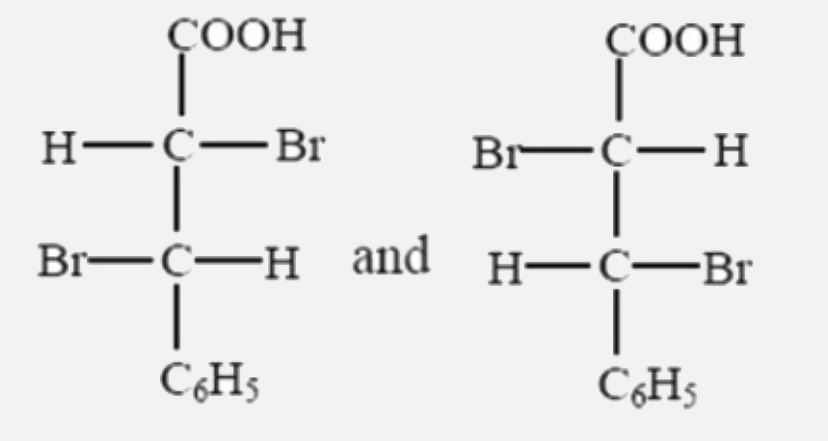
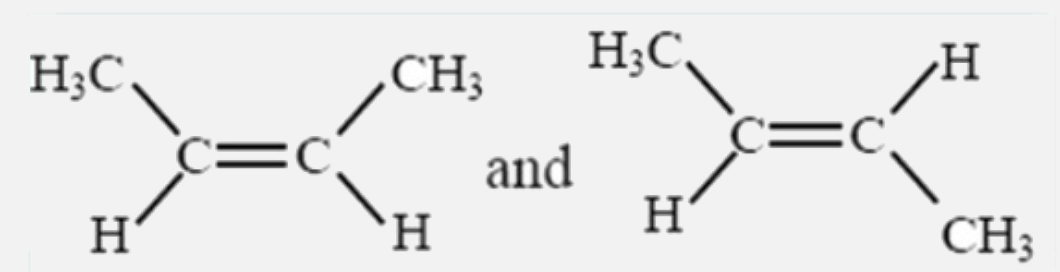
Which of the following pairs are diaster...

Which of the following pairs are diastereomers?

A

`{:(" "CHO" "CHO),(" | |"),(H-C-OH and HO-C-H""),(" | |"),(" "CH_(3)" "CH_(3)):}`

B

C

D

All of these

Text Solution

AI Generated Solution

The correct Answer is:

To determine which of the given pairs are diastereomers, we need to follow these steps: ### Step 1: Understand the Definition of Diastereomers Diastereomers are stereoisomers that are not mirror images of each other. They have different physical properties and are not related as enantiomers. ### Step 2: Analyze Each Pair We will analyze each pair of compounds provided in the question to determine if they are diastereomers. 1. **Pair A**: Check if they are mirror images. 2. **Pair B**: Check if they are mirror images. 3. **Pair C**: Check if they are mirror images. 4. **Pair D**: Check if they are mirror images. ### Step 3: Identify the Pairs - **For Pair A**: If the compounds are mirror images, they are not diastereomers. - **For Pair B**: If the compounds are mirror images, they are not diastereomers. - **For Pair C**: If one is a cis isomer and the other is a trans isomer, they are not mirror images and thus are diastereomers. - **For Pair D**: If the compounds are mirror images, they are not diastereomers. ### Step 4: Conclusion After analyzing the pairs, we find that only **Pair C** consists of diastereomers because they are cis and trans forms of the same compound, which are not mirror images of each other. ### Final Answer The correct answer is **Option C**, as it contains the pair of diastereomers. ---
Promotional Banner

Topper's Solved these Questions

  • NTA NEET SET 116

    NTA MOCK TESTS|Exercise CHEMISTRY|45 Videos
  • NTA NEET SET 23

    NTA MOCK TESTS|Exercise CHEMISTRY|45 Videos

Similar Questions

Explore conceptually related problems

Which of the following pairs are isosters ?

Which of the following are diastereomers ?

Which one of the following is a diastereomer of (R )-4-bromo-cis-2-hexene?

Which of the following pairs are isodiapteric pairs?

R,S-configuration is a useful tool for determination of enantiomers, diasteromers and homomers. If configuration of all chiral centers are opposite then structures are enantiomers, if all chiral centers have same configuration then they are homomers and if some have same confguration and some have opposite configuration then they are diastereomers. Which of hte following is not diastereomer?

Which of the following pairs is correct

NTA MOCK TESTS-NTA NEET SET 19-CHEMISTRY
  1. Which of the following is not an essential amino acid -

    Text Solution

    |

  2. The reversible reaction [Cu(NH(3))(4)]^(2+)+SO(3)^(2-)hArr[Cu(NH(3))...

    Text Solution

    |

  3. Which of the following pairs are diastereomers?

    Text Solution

    |

  4. 4 ml of HCl solution of pH = 2 is mixed with 6 ml of NaOH solution of ...

    Text Solution

    |

  5. Which of the following is not a part of green chemistry?

    Text Solution

    |

  6. How many geometrical isomers are possible for the square planar comple...

    Text Solution

    |

  7. The IUPAC name of is

    Text Solution

    |

  8. Aoverset(redP)underset(HI)rarrCH(3)COOHoverset(LiAlH(4))rarrB. What is...

    Text Solution

    |

  9. How do you characterizes PbCrO(4)?

    Text Solution

    |

  10. In the reaction sequence C6H5CHOoverset(NaCN//HCl)rarr(X)overset(H2"O"...

    Text Solution

    |

  11. Prussian blue is -

    Text Solution

    |

  12. F-centers are

    Text Solution

    |

  13. Amongest H(2)O,H(2)S,H(2)Se and H(2)Te the one with highest boiling p...

    Text Solution

    |

  14. Among KO(2), KAlO(2), CaO(2) and NO(2)^(+), unpaired electrons is pres...

    Text Solution

    |

  15. An organic molecule necessarily shows optical acitivity if it

    Text Solution

    |

  16. Microcosmic salt reacts with coloured ions to form characteristic bead...

    Text Solution

    |

  17. CH(3)-overset(CH(3))overset("| ")underset(CH(3))underset("| ")"C "-C...

    Text Solution

    |

  18. Which of the following sequence represents the correct increasing orde...

    Text Solution

    |

  19. (CH(3))(2)C=CHCOCH(3) can be oxidised to (CH(3))(2) C=CHCOOH by

    Text Solution

    |

  20. Select the most stable carbocation:

    Text Solution

    |
