Home
Class 12
CHEMISTRY
The first (DeltaH(1)) and second (DeltaH...

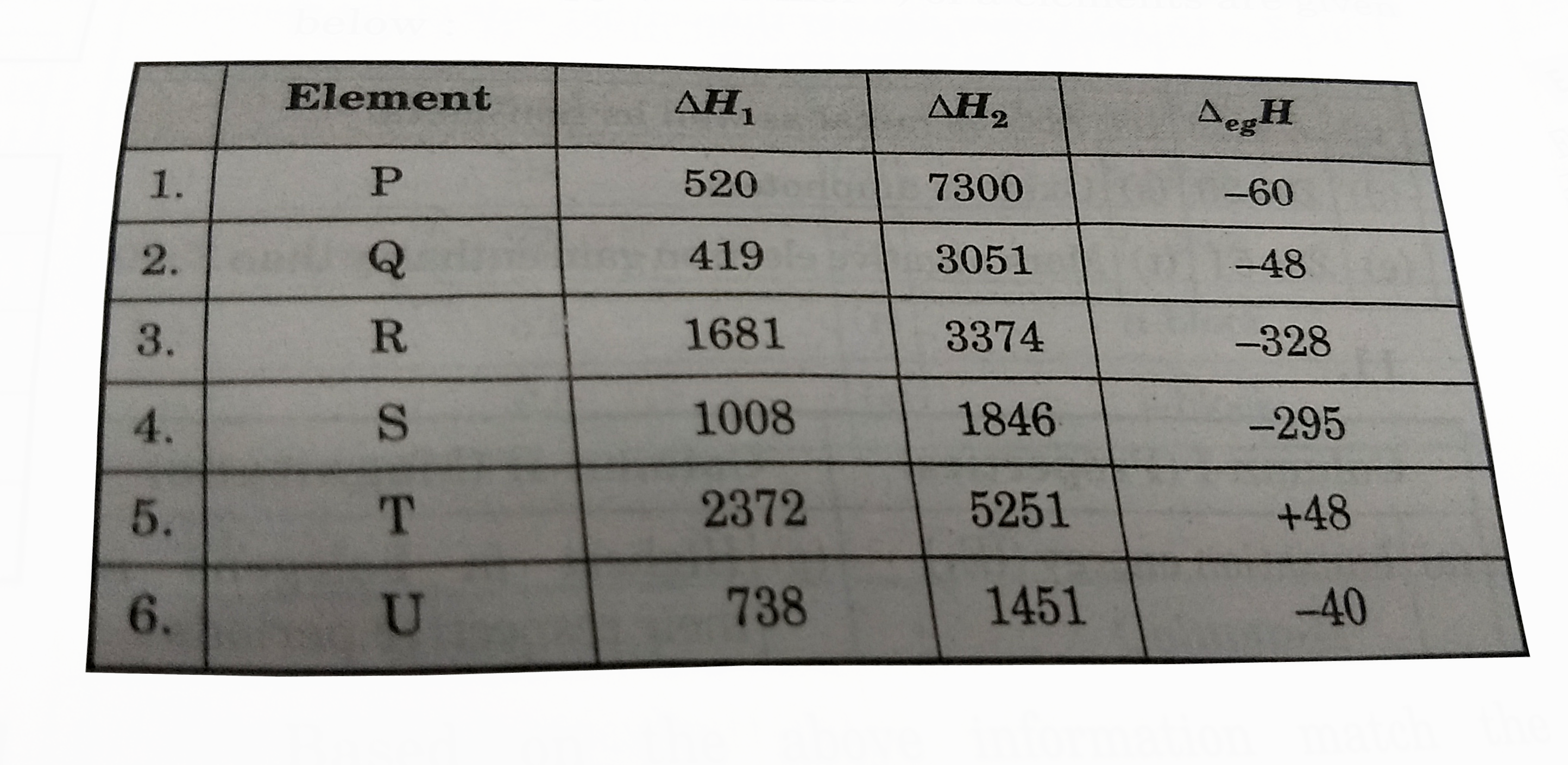
The first `(DeltaH_(1))` and second `(DeltaH_(2))` ionisation enthalpies (in `kJ mol^(-1))` and the `(DeltaH_(eg))` electron gain enthalpy (in `kJ mol^(-1))` of a elements are given below:

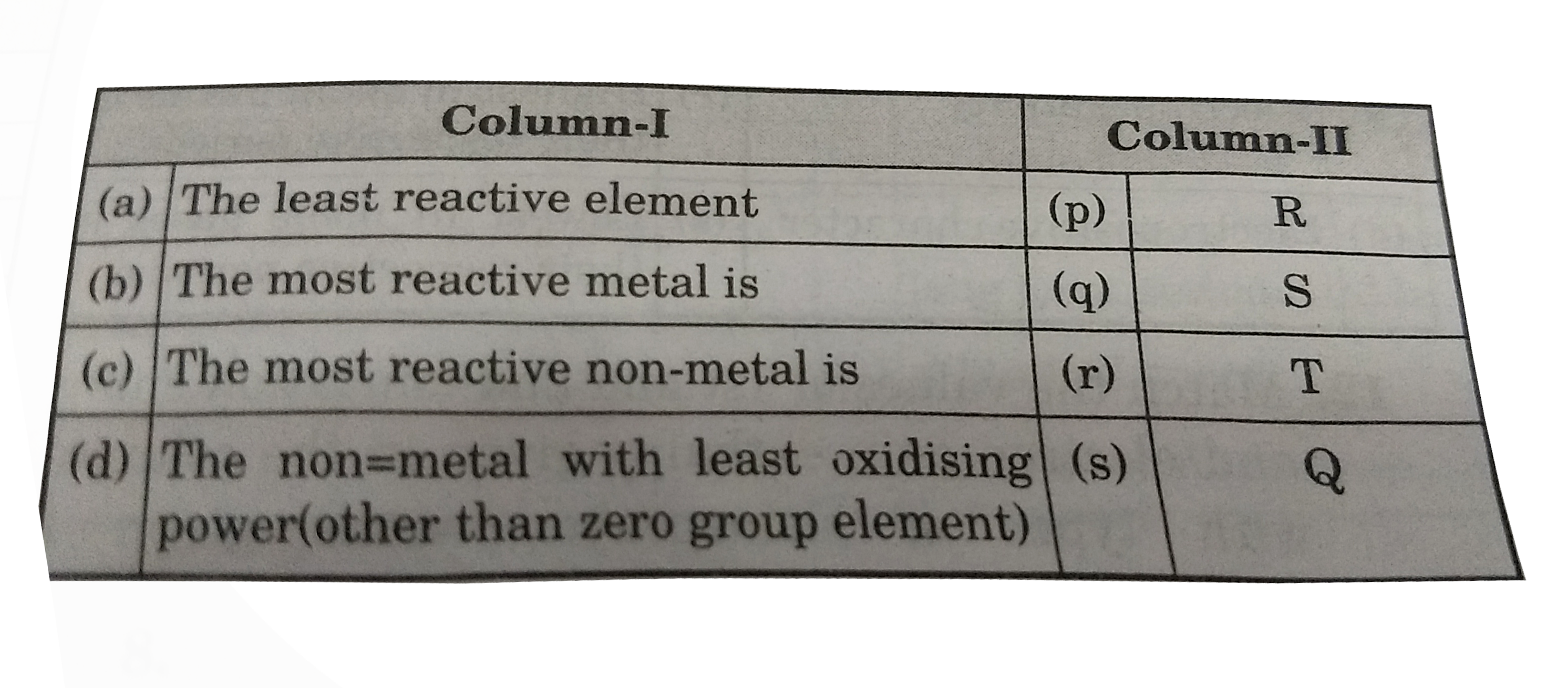
Based on the above information match the following columns.

A

V and II

B

II and V

C

V and III

D

IV and V

Text Solution

Verified by Experts

The correct Answer is:

B
Promotional Banner

Topper's Solved these Questions

  • NTA NEET TEST 22

    NTA MOCK TESTS|Exercise CHEMISTRY|45 Videos
  • NTA NEET TEST 64

    NTA MOCK TESTS|Exercise CHEMISTRY|45 Videos

Similar Questions

Explore conceptually related problems

The first (Delta_(i)H_(1)) and second (Delta_(i)H_(2)) ionization enthalpies ("in kJ mol"^(-1)) and the electron gain enthalpy (Delta_(eg)H)("in kJ mol"^(-1)) of the elements I, II, III, IV and V are given below the least reactive non - metal and the most reactive metal of these are respectively

The second electron gain enthalpies (in kJ mol^(-1) ) of oxygen and sulphur respectively are:

Ionisation of energy F^(ɵ) is 320 kJ mol^(-1) . The electronic gain enthalpy of fluorine would be

First and second ionisation enthalpies(in KJ/mol) of few elements are given below: Which of the above elements will form halides with formula MX_(2) ?

DeltaH_(comb)^(@) of carbon is -x kJ mol^(-1) . The standard formation of enthalpy of CO_(2)(g) will be

When the first electron gain enthalpy (triangle_(eg)H) of oxygen is -141 kJ//mol, its second electron gain enthalpy is :

First and second electrons gains enthalpies of oxygen and -141 and +702 kJ mol^(-1) . How is large number of oxides accounted for ?

The first four ionization enthalpies of an element are 578 kJ mol^(-1), 1817kJ mol^(-1), 2745kJ mol^(-1) , and 11575 kJ mol^(-1) . The element is

NTA MOCK TESTS-NTA NEET TEST 25-CHEMISTRY
  1. Choose the incorrect match :

    Text Solution

    |

  2. Which of the following solutions will have the highest boiling point?

    Text Solution

    |

  3. The first (DeltaH(1)) and second (DeltaH(2)) ionisation enthalpies (in...

    Text Solution

    |

  4. Which of the following undergoes reduction with H(2)O(2) in an alkalin...

    Text Solution

    |

  5. The metal that produces red violet colour in the non - luminous flame ...

    Text Solution

    |

  6. Among the oxyacids of phosphorous the dibasic acid is

    Text Solution

    |

  7. Mark the correct statements(s) (1) Manganeses exhibits +7 oxidation ...

    Text Solution

    |

  8. Which among the following statement are true for the complex [Co(NH(...

    Text Solution

    |

  9. In the balanced chemical reaction IO(3)^(ө)+aI^(ө)+bH^(ө)rarrcH(2)O+...

    Text Solution

    |

  10. Halogens exist in -1, +1, +3, +5 and +7 oxidation states. The halogen ...

    Text Solution

    |

  11. In petrochemical industry , alcohols are directly converted to gasolin...

    Text Solution

    |

  12. In Lassaigne's test for the detection of halogen , the sodium fusion e...

    Text Solution

    |

  13. All carbon atoms are sp^(2) hybridised in

    Text Solution

    |

  14. Which if the following pairs of compound is a ring chain isomer ?

    Text Solution

    |

  15. For two weak acids A and B, the ratio of their percent ionization is 4...

    Text Solution

    |

  16. The maximum number of carbon atoms arranged linearly in the molecule, ...

    Text Solution

    |

  17. The number of atoms in a cubic based unit cell having one atom on each...

    Text Solution

    |

  18. The IUPAC name of the following compound is (CH(3))(2)CH-CH(2)CH=CH-...

    Text Solution

    |

  19. Chlorination of benzene in the presence of halogen carrier is an examp...

    Text Solution

    |

  20. Aryl halides do not undergo uncleophilic substitution reactions under ...

    Text Solution

    |
