


Home
Class 12
CHEMISTRY
Which of the following carbocations woul...

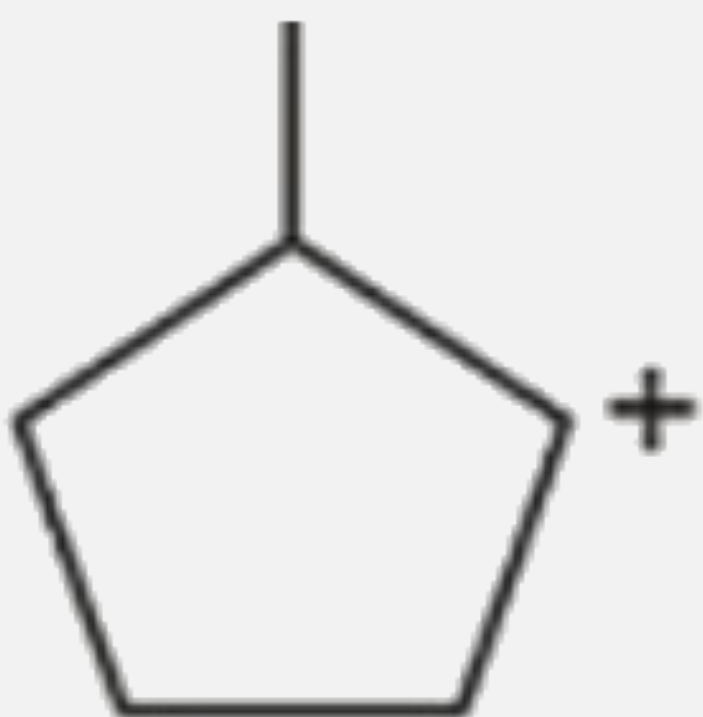
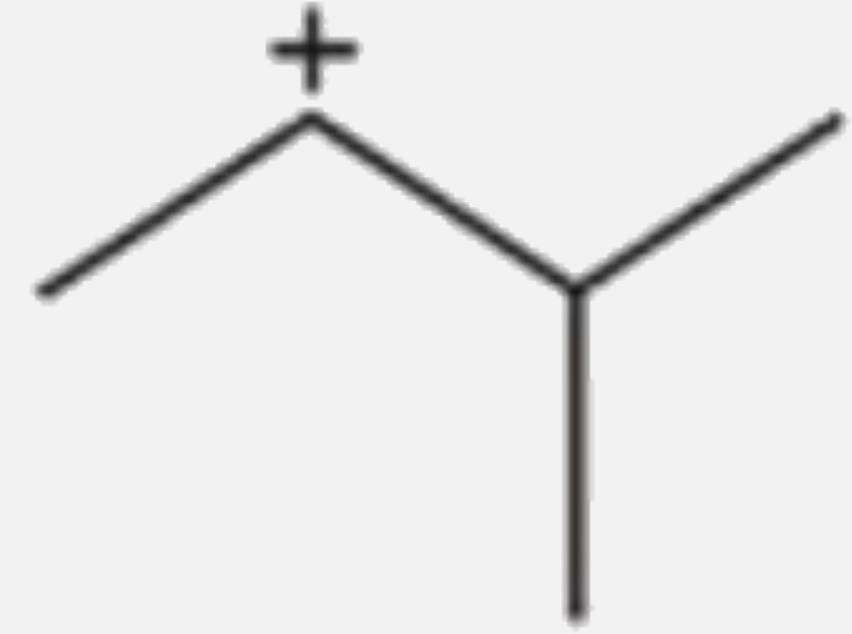
Which of the following carbocations would not likely rearrange to more stable carbocation ?

A

B

C

D

none of these

Text Solution

AI Generated Solution

The correct Answer is:
To determine which carbocation would not likely rearrange to a more stable carbocation, we need to analyze the stability of different types of carbocations (primary, secondary, and tertiary) and their potential for rearrangement. ### Step-by-Step Solution: 1. **Understand Carbocation Stability**: - Tertiary carbocations (3°) are the most stable due to hyperconjugation and inductive effects from surrounding alkyl groups. - Secondary carbocations (2°) are less stable than tertiary but more stable than primary (1°). - Primary carbocations (1°) are the least stable and are less likely to rearrange to a more stable form. **Hint**: Remember the order of stability: Tertiary > Secondary > Primary. 2. **Identify the Carbocations**: - Analyze the given carbocations in the question. Identify whether they are primary, secondary, or tertiary. **Hint**: Look for the number of carbon atoms attached to the positively charged carbon atom. 3. **Evaluate Rearrangement Possibilities**: - A primary carbocation can rearrange to a secondary carbocation if there is a possibility of a hydride or alkyl shift. - A secondary carbocation can rearrange to a tertiary carbocation, which is more stable. - A tertiary carbocation is already the most stable and typically does not rearrange. **Hint**: Consider the possibility of shifts (hydride or alkyl) that would lead to a more stable carbocation. 4. **Determine Which Carbocation Does Not Rearrange**: - If a carbocation is tertiary, it will not rearrange because it is already in its most stable form. - If a carbocation is primary and cannot rearrange to a more stable form, it is also a candidate. **Hint**: Focus on the carbocation that is either tertiary or a primary carbocation that lacks the ability to rearrange. 5. **Select the Correct Option**: - Based on the analysis, identify which option corresponds to a carbocation that would not likely rearrange to a more stable carbocation. **Hint**: Compare the stability of the carbocations and their potential for rearrangement based on the previous steps. ### Conclusion: After analyzing the stability and potential rearrangements of the carbocations, the answer to the question is **Option B**, as it represents a carbocation that would not likely rearrange to a more stable carbocation.
Promotional Banner

Topper's Solved these Questions

  • NTA NEET SET 56

    NTA MOCK TESTS|Exercise CHEMISTRY|45 Videos
  • NTA NEET SET 58

    NTA MOCK TESTS|Exercise CHEMISTRY|45 Videos

Similar Questions

Explore conceptually related problems

Which of the folllowing carbocations would you expect to rearrange?

Which of the following carbocation is most stable?

Which of the following carbocation is most stable?

Which of the following carbocations is most stable ?

Which of the following carbocations is most stable ?

Which of the following carbocations is most stable ?

NTA MOCK TESTS-NTA NEET SET 57-CHEMISTRY
  1. the study of action of drag is know as

    Text Solution

    |

  2. Molecular size of ICI and Br2 is nearly same but boiling point of ICI...

    Text Solution

    |

  3. Which of the following carbocations would not likely rearrange to more...

    Text Solution

    |

  4. Which reaction does hydroquinone undergo most readily ?

    Text Solution

    |

  5. Ethyl alcohol on oxidation with acidified K(2)Cr(2)O(7) gives

    Text Solution

    |

  6. Calculate the mass of a non-volatile solute (molar mass 40"g mol"^(-1)...

    Text Solution

    |

  7. Oxidising power of chlorine in aqueous solution can be determined by t...

    Text Solution

    |

  8. The rate law for the chemical reaction 2NO2Cl rarr 2NO2 +Cl2 + Cl2 = k...

    Text Solution

    |

  9. The hybridisation of atomic orbitals of nitrogen in NO2^+ , NO3^- and...

    Text Solution

    |

  10. Hard water can block radiators due to the formation of

    Text Solution

    |

  11. When two moles of hydrogen expands isothermally against a constant pre...

    Text Solution

    |

  12. When mercuric iodide is added to the aqueous solution of potassium iod...

    Text Solution

    |

  13. At CMC, the surfactant molecules :

    Text Solution

    |

  14. Reaction : 2Fe^(3+)+3I^(-) hArr 2Fe^(2+) + I3^(-) The standard reducti...

    Text Solution

    |

  15. The first and second dissociation constant of an acid H(2)A are 1.0xx1...

    Text Solution

    |

  16. Which of the following has the highest molar conductivity in solution?

    Text Solution

    |

  17. X reacts with dilute nitric acid to form 'laughing gas' . What is X ?

    Text Solution

    |

  18. In case of condensation of polymers ?

    Text Solution

    |

  19. How many octahedral and tetrahedral holes are present per unit cell in...

    Text Solution

    |

  20. Which of the following carbohydrate is a reducing sugar ?

    Text Solution

    |