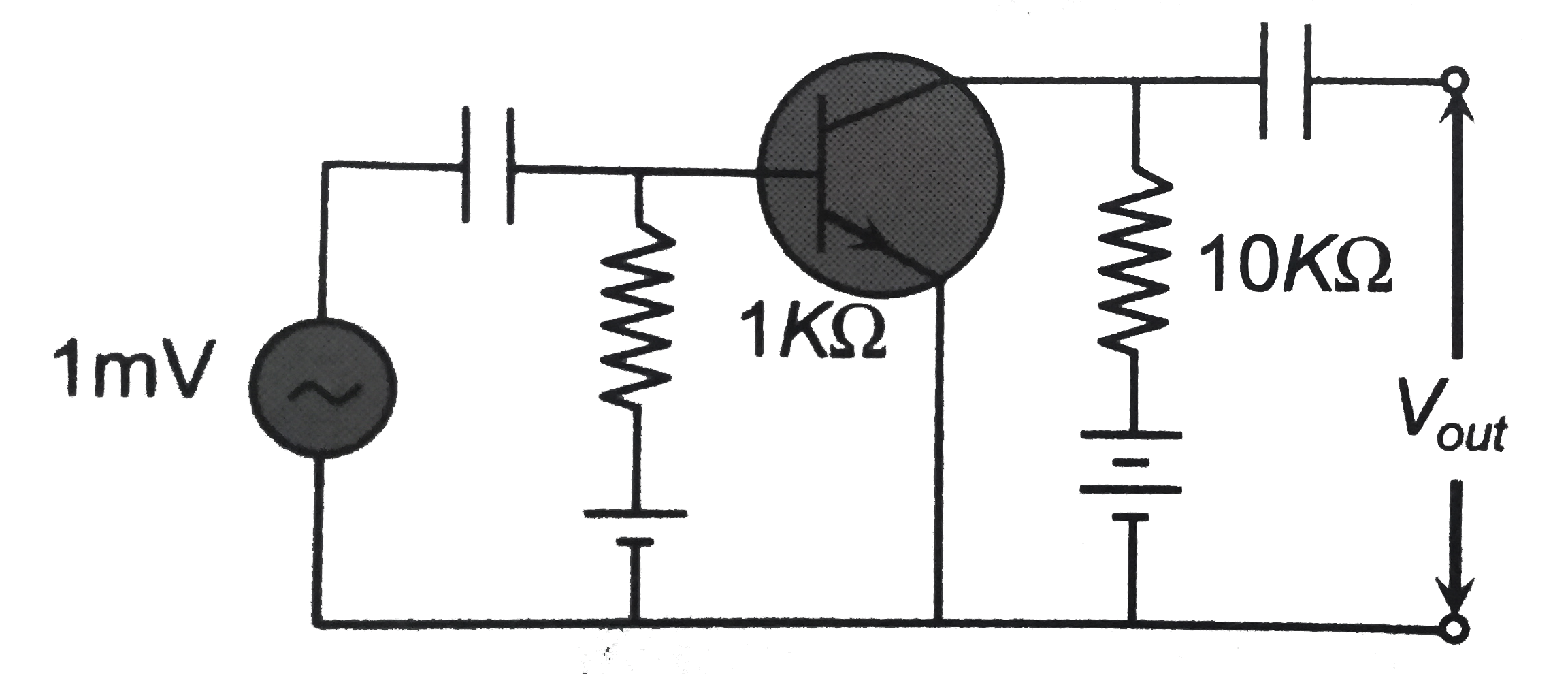
A
B
C
D
Text Solution
Verified by Experts
The correct Answer is:



Topper's Solved these Questions
Similar Questions
Explore conceptually related problems
NTA MOCK TESTS-NTA NEET SET 65-PHYSICS
- How many alpha and beta-particles are emitted in the transformation ""...
Text Solution
|
- In nuclear reaction .(4)Be^(9)+.(2)He^(4)rarr.(6)C^(12)+X,X will be
Text Solution
|
- The time period of oscillations of a block attached to a spring is t(1...
Text Solution
|
- The phase difference between two waves represented by y(1)=10 ^(...
Text Solution
|
- The maximum kinetic energy of a photoelectron is 3 eV. What is its sto...
Text Solution
|
- From the following graph of photocurrent against collector plate poten...
Text Solution
|
- A liquid drop having surface energy E is spread into 512 droplets of s...
Text Solution
|
- A body floats in a liquid contained in a beaker. The whole system as s...
Text Solution
|
- Given that, velocity of light in quartz =1.5xx10^(8)m//s and velocity ...
Text Solution
|
- Light has the following wave property
Text Solution
|
- On applying a constant torque, a wheel at rest, turns through 400 radi...
Text Solution
|
- If the ratio of the concentration of electron to that of holes in a se...
Text Solution
|
- In the following common emitter configuration an NPN transistor with c...
Text Solution
|
- Coefficient of linear expansion of brass and steel rods are alpha(1) a...
Text Solution
|
- A public park , in the form of a square , has an area of (100pm0.2 ) m...
Text Solution
|
- In a Young's double slit experiment, 12 fringes are observed to be for...
Text Solution
|
- If numerical aperture of a microscope is increased, then its
Text Solution
|
- A wave of frequency 500 Hz has velocity 360 m/sec. The distance betwee...
Text Solution
|
- If E and B represent electric and magnetic field vectors of the electr...
Text Solution
|
- The potential energy for a force filed vecF is given by U(x,y)=cos(x+y...
Text Solution
|