Home
Class 12
PHYSICS
The measurement of an unknown resistance...

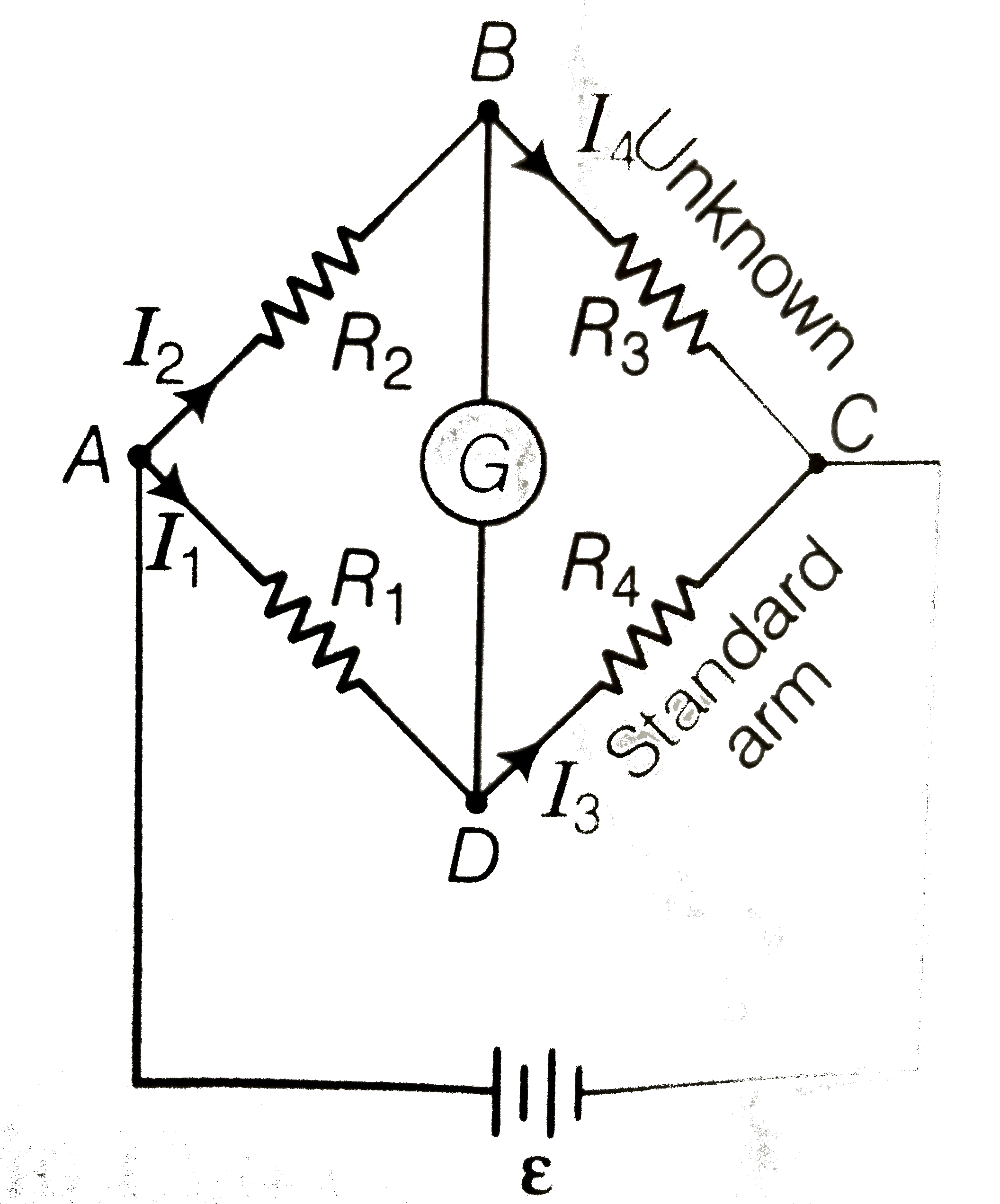
The measurement of an unknown resistance R is to be carried out using Wheatstone bridge (see Fig. 2(EP).3). Two students perform an experiment in two way. The first student takes `R_(2)=10 Omega` and `R_(1)=5Omega`. The other student takes `R_(2)=1000Omega` and `R_(1)=500Omega`. In the standard arm, both take `R_(3)=5Omega`. Both find `R=(R_(2))/(R_(1))R_(3)=10Omega` within errors.

A

The errors of measurement of two students are the same

B

Errors of measurement do depend on the accuracy with which `R_(2) and R_(1)` can be measured

C

If the student uses large values of `R_(2) and R_(1)` the currents through the arms will be feeble. This will make determination of null point accurately more difficult.

D

Whatstone bridge is a very accurate instrument and has no errors of measurement.

Text Solution

Verified by Experts

The correct Answer is:
B, C

Given, for first student, `R_(2)=10Omega,R_(1)=5Omega,R_(3)=5Omega`
For second student, `R_(1)=500Omega,R_(3)=5Omega`.

Now, according to whatstone bridge rule,
`(R_(2))/(R)=(R_(1))/(R_(3))impliesR=R_(3)xx(R_(2))/(R_(1))`
Now putting all the values in Eq. (i) we get `R=10Omega` for both students. Thus, we can analyse that the wheatstone bridge is mot sensitive and accurate if resistances are of same value.
Thus, the errors of measurement of the two students depend on the accuracy and sensitivity of the bridge, which inturn depends on the accuracy with which `R_(2) and R_(1)` can be measured. when `R_(2) and R_(1)` are larger, the currents through the arms of bridge is very weak. this can make the determination of null point accurately more difficult.
Promotional Banner

Topper's Solved these Questions

  • COMMUNICATION SYSTEM

    NCERT EXEMPLAR|Exercise Communication System|30 Videos
  • DUAL NATURE OF RADIATION AND MATTER

    NCERT EXEMPLAR|Exercise Dual Nature Of Radiation And Matter|29 Videos

Similar Questions

Explore conceptually related problems

Find the current through the resistance R in Fig if R =10 Omega and R=20Omega .

In the given circuit, R_(1) = 10Omega R_(2) = 6Omega and E = 10V, then correct statement is

In the circuit shown in figure Current through R_(2) is zero if R_(4) = 2 Omega and R_(3) = 4 Omega In this case

In Fig. 27-43, the current in resistance 6 is i_(6)= 2.80 A the resistances are R_(1)=R_(2)=R_(3)=2.00 Omega, R_(4)=16.0 Omega, R_(5)=8.00 Omega and R_(6)=4.00 Omega . Wat is the emf of the ideal battery?

In the circuit shown below E_(1) = 4.0 V, R_(1) = 2 Omega, E_(2) = 6.0 V, R_(2) = 4 Omega and R_(3) = 2 Omega . The current I_(1) is

In the given circuit values are as follows epsi=2V,epsi_(2)=4V,R_(1)=1Omega and R_(2)=R_(3)=1Omega . Calculate the current through R_(1),R_(2) and R_(3)

The potential difference in volt across the resistance R_(3) in the circuit shown in figure, is (R_(1)=15Omega,R_(2)=15Omega, R_(3)=30Omega, R_(4)=35Omega)

Find the currents in the Y connection of 3 resistances R_(1) = 10Omega , R_(2)=20Omega and R_(3)= 30 Omega . When the terminals of R_(1) , R_(3) and R_(3) are maintained at potentials V_(1) = 10V, V_(2) =6V and V_(3) = 15V.

In the circuit shown in Fig. the emf of the sources is equal to xi = 5.0 V and the resistances are equal to R_(1) = 4.0 Omega and R_(2) = 6.0 Omega . The internal resistance of the source equals R = 1.10 Omega . Find the currents flowing through the resistances R_(1) and R_(2) .

In the given figure, E=12V, R_(1)=3Omega, R_(2)=2Omega" and "r=1Omega . The choose the correct option/s

NCERT EXEMPLAR-CURRENT ELECTRICITY-Current Electricity
  1. Consider a simple circuit shown in Fig. 2(ET).2. stands for a variable...

    Text Solution

    |

  2. Temperature dependence of resistivity p(T) of semiconductors, insulato...

    Text Solution

    |

  3. The measurement of an unknown resistance R is to be carried out using ...

    Text Solution

    |

  4. In a meter bridge the point D is a neutral point (Fig. 2(EP).4).

    Text Solution

    |

  5. Is the motion of a charge across junction momentum conserving ? Why or...

    Text Solution

    |

  6. The relaxation time tau is nearly independent of applied electric fiel...

    Text Solution

    |

  7. What are the advantages of the nll-point method in a Wheatstone bridge...

    Text Solution

    |

  8. What is the advantages of using thick metallic strips to join wires in...

    Text Solution

    |

  9. For wiring in the home, one uses Cu wires or A1 wires. What considerat...

    Text Solution

    |

  10. Why are alloys used for making standard resistance coils?

    Text Solution

    |

  11. Power P is to be delivered to a device via transmission cables having ...

    Text Solution

    |

  12. AB is a potentiometer wire Fig. If the value of R is increased, in whi...

    Text Solution

    |

  13. While doing an experiment with potentiometer (figure) it was found tha...

    Text Solution

    |

  14. A cell of emf E and internal resistance r is connected across an exter...

    Text Solution

    |

  15. First a set of n equal resistors of R each are connected in series to ...

    Text Solution

    |

  16. Let there be n resistors R(1) . . . R(n) with R(max)=max(R(1) . . ....

    Text Solution

    |

  17. The circuit in Fig. shows two cells connected in opposition to each o...

    Text Solution

    |

  18. Two cells of same emf E but internal resistance r(1) and r(2) are conn...

    Text Solution

    |

  19. Two conductors are made of the same material and have the same length....

    Text Solution

    |

  20. Suppose there is a circuit consister of only resistance and batteries ...

    Text Solution

    |

