Home
Class 12
PHYSICS
The circuit in Fig. shows two cells con...

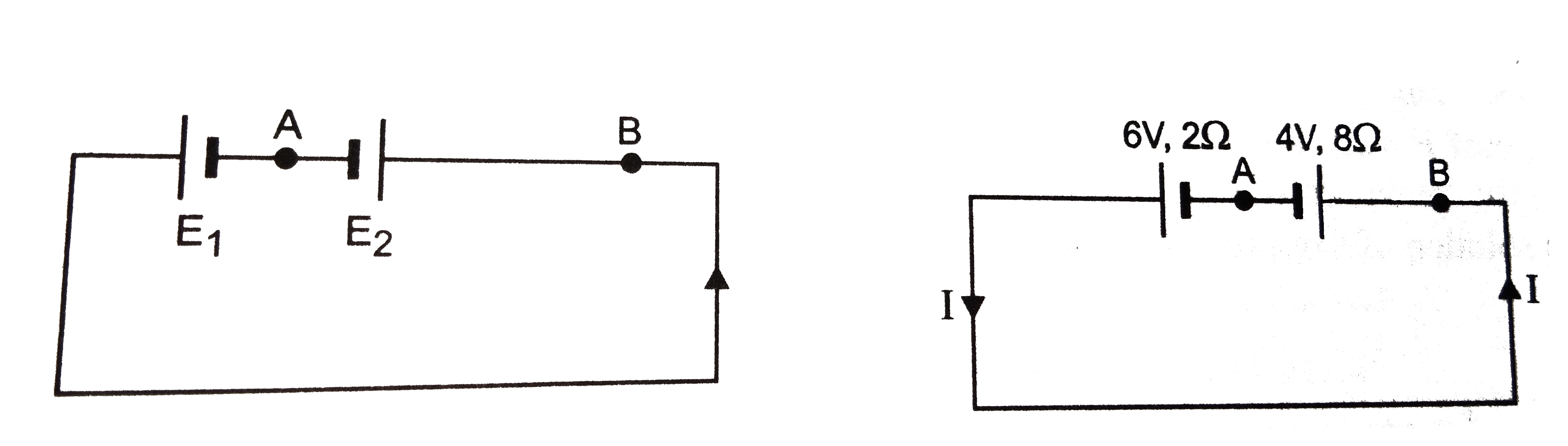
The circuit in Fig. shows two cells connected in opposition to each other. Cell `E_(1)` is of emf `6V` and internal resistance `2Omega,` the cell `E_(2)` is of emf `4 V` sand internal resistance `8omega`. Find the potential difference between the points `A` and `B`.

Text Solution

Verified by Experts

Applying Ohm's law
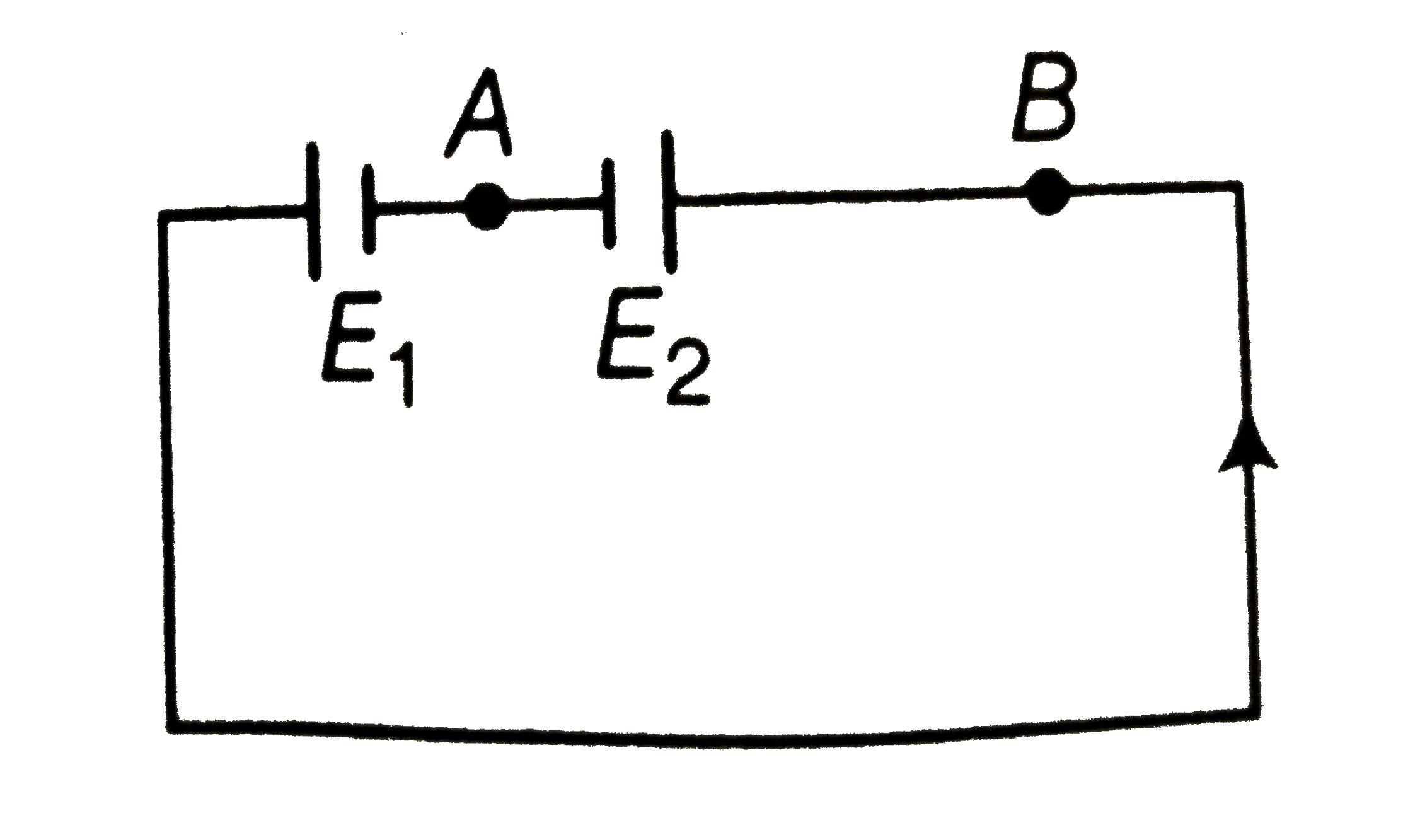
Effective resistance `=2Omega+8Omega=10Omega` and effective emf of two cells `=6-4=2V`, so the electric current is given by
`I=(6-4)/(2+8)=0.2A`
Along anti-clockwise direction, since `E_(1) gt E_(2)`.
The direction of flow of current is always from high potential to low potential. Therefore
`V_(B) gt V_(A)`.
`impliesV_(B)-4V-(0.2)xx8=V_(A)`
Therefore, `V_(B)-V_(A)=3.6V`
Promotional Banner

Topper's Solved these Questions

  • COMMUNICATION SYSTEM

    NCERT EXEMPLAR|Exercise Communication System|30 Videos
  • DUAL NATURE OF RADIATION AND MATTER

    NCERT EXEMPLAR|Exercise Dual Nature Of Radiation And Matter|29 Videos

Similar Questions

Explore conceptually related problems

Two cells e_(1) and e_(2) connected in opposition to each other as shown in figure. The cell of emf 9 V and internal resistance 3Omega the cell is of emf 7V and internal resistance 7Omega . The potential difference between the points A and B is

A cell E_1 of emf 6V and internal resistance 2 Omega is connected with another cell E_2 of emf 4V and internal resistance 8 Omega (as shown in the figure). The potential difference across points X and Y is :

In the shown circuit the following battery is of emf 4V and internal resistance 8 Omega . Find the potential difference between points x and y as shown in the circuit.

In the circuit shown in fig. the cell has emf 10V and internal resistance 1 Omega

If n cells each of emf E and internal resistance rare connected in parallel, then the total emf and internal resistances will be

Two batteries of emf 4 V and 8 V with internal resistances 1Omega and 2Omega are connected in a circuit with a resistance of 9Omega as shown in figure. The current and potential difference between the points P and Q are

NCERT EXEMPLAR-CURRENT ELECTRICITY-Current Electricity
  1. Is the motion of a charge across junction momentum conserving ? Why or...

    Text Solution

    |

  2. The relaxation time tau is nearly independent of applied electric fiel...

    Text Solution

    |

  3. What are the advantages of the nll-point method in a Wheatstone bridge...

    Text Solution

    |

  4. What is the advantages of using thick metallic strips to join wires in...

    Text Solution

    |

  5. For wiring in the home, one uses Cu wires or A1 wires. What considerat...

    Text Solution

    |

  6. Why are alloys used for making standard resistance coils?

    Text Solution

    |

  7. Power P is to be delivered to a device via transmission cables having ...

    Text Solution

    |

  8. AB is a potentiometer wire Fig. If the value of R is increased, in whi...

    Text Solution

    |

  9. While doing an experiment with potentiometer (figure) it was found tha...

    Text Solution

    |

  10. A cell of emf E and internal resistance r is connected across an exter...

    Text Solution

    |

  11. First a set of n equal resistors of R each are connected in series to ...

    Text Solution

    |

  12. Let there be n resistors R(1) . . . R(n) with R(max)=max(R(1) . . ....

    Text Solution

    |

  13. The circuit in Fig. shows two cells connected in opposition to each o...

    Text Solution

    |

  14. Two cells of same emf E but internal resistance r(1) and r(2) are conn...

    Text Solution

    |

  15. Two conductors are made of the same material and have the same length....

    Text Solution

    |

  16. Suppose there is a circuit consister of only resistance and batteries ...

    Text Solution

    |

  17. Two cells of voltage 10Vand 2 V and internal resistance 10 Omega and 5...

    Text Solution

    |

  18. A room AC run for 5 hour at a voltage of 220V The wiring of the room c...

    Text Solution

    |

  19. In an experiment with a potentiometer, V(B)=10V. R is adjusted to the ...

    Text Solution

    |

  20. (a). Consider circuit in figure. How much energy is absorbed by electr...

    Text Solution

    |

