Home
Class 12
PHYSICS
A small transparent slab containing mate...


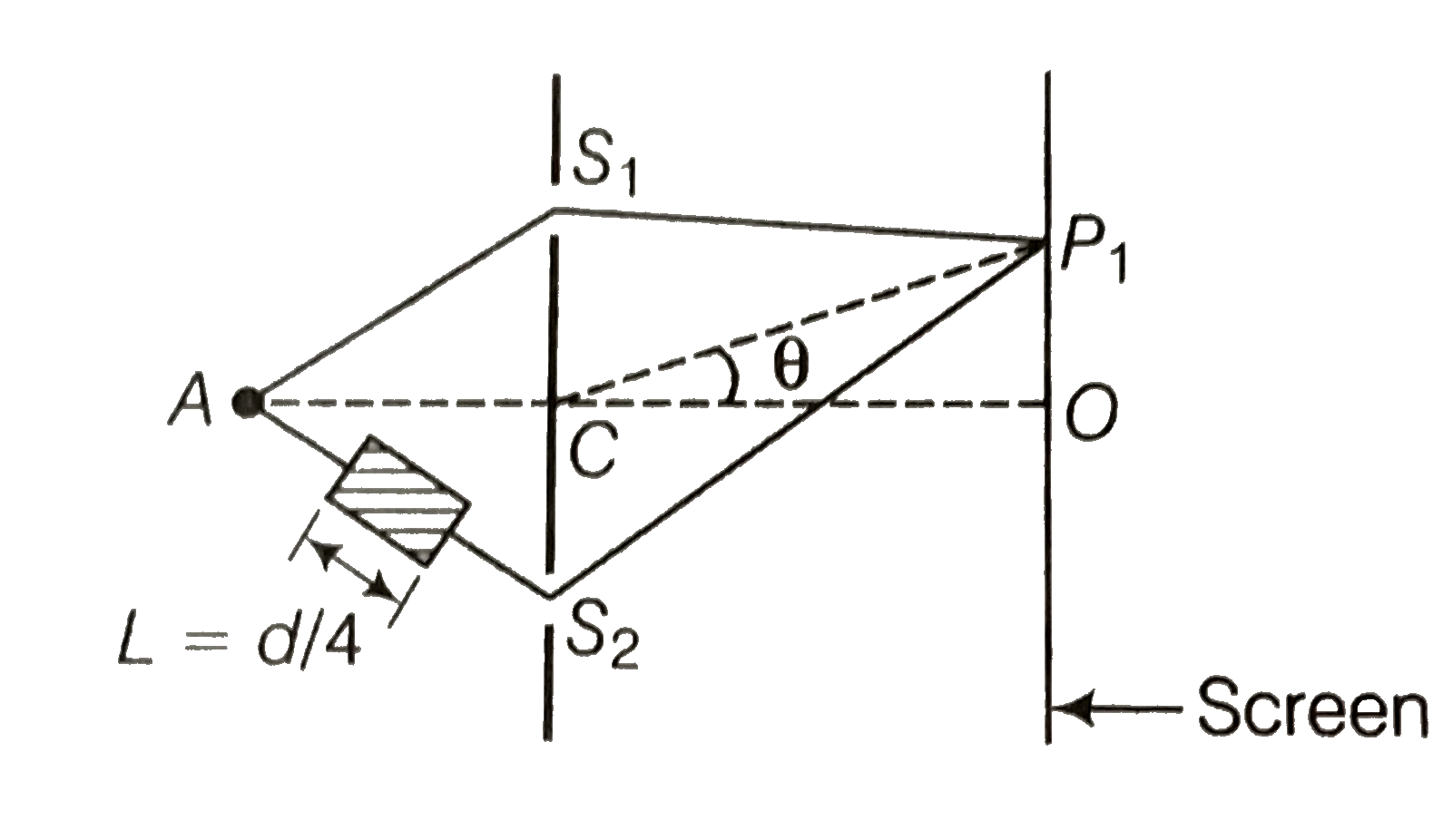
A small transparent slab containing material of `mu=1.5` is placed along `AS_(2)`(figure). What will be the distance from O of the principle maxima and of the first minima on either side of the principal maxima obtained in the absence of the glass slab ?

Text Solution

Verified by Experts

In case of transparent glass slabe of refractive indesx `mu`, the path difference will be calculated as `Deltax=2d sin theta+(mu-1)L`
In case of transparent glass slab of refractive index `mu`,
the path difference `=2d sin theta + (mu-1)L.`
For the principal maxima, (path difference is zero )
i.e., ` 2d sin theta _(0)+(mu-1)L=0`
or, `sin theta_(0)= -(L(mu-1))/(2d)=(-L(0.5))/(2d)" " [:. L=d//4]`
or `sin theta_(0)=(-6)/(16)`
`:. OP=D tan theta_(0)~~D sin theta_(0)=(-D)/(16)`
For the first minima, the path difference is `pm(lambda)/(2)`
`:. 2d sin theta_(1)+0.5L = pm(lambda)/(2)`
or `sin theta_(1)=(pm lambda//2 -0.5L)/(2d)=(pm lambda//2-d//8)/(2d)`
`=(pm lambda//2- lambda//8)/(2 lambda)=pm(1)/(4)-(1)/(16)`
[`:.` The diffraction occurs if the wavelength of waves in nearly equal to the side width (d)]
On the positive side `sin theta'_(1)^(+)= +(1)/(4)-(1)/(16)=(3)/(16)`
On the negative side `sin theta''_(1)^(-)=-(1)/(4)-(1)/(16)=-(5)/(16)`
The First principal maxima on the positive side is at distance
`D tan theta'_(1)^(+)=D ( sin theta'_(1)^(+))/(sqrt(1- sin^(2) theta'_(1)))=D(3)/(sqrt(16^(2)-3^(2)))=(3D)/(sqrt(247))` above point O
The first principal minima on the negative side is at distance
`D tan theta''_(1)=(5D)/(sqrt(16^(2)-5^(2))=(5D)/(sqrt(231))` below point O.
Promotional Banner

Topper's Solved these Questions

  • SEMICONDUCTOR ELECTRONICS: MATERIAL,DEVICES AND SIMPLE CIRCUIT

    NCERT EXEMPLAR|Exercise Semiconductor Electronics: Material,Devices And Simple Circuit|26 Videos

Similar Questions

Explore conceptually related problems

A small transparent slab (mu = 1.5) is placed along AS_(2) as shown. AC=CO=D,S_(1)C=S_(2)S=d lt ltD The distance of princpal maxima front 'O' is

A small transparent slab (mu = 1.5) is placed along AS_(2) as shown. AC=CO=D,S_(1)C=S_(2)S=d lt ltD The distance of first minima below the point O is

A small transparent slab (mu = 1.5) is placed along AS_(2) as shown. AC=CO=D,S_(1)C=S_(2)S=d lt ltD The distance of first minima above O is

Light of wavelength 6 xx10^(-5) cm falls on screen at a distance of 100 cm from a narrow slit. Find the width of the slit if the first minima lies 1mm on either side of the central maximum

A point object O is placed at a distance of 41 cm from a convex lens of focal length f = 20 cm on its principal axis. A glass slab of thickness 3 cm and refractive index mu = 1.5 is placed between the lens and the object with its faces perpendicular to the principal axis of the lens. Image of the object is formed at point I_(1) . Now the glass slab is tilted by an angle of theta = 1° (as shown in the Figure) and the final image is formed at I_(2) . Calculate the distance between points I_(1) and I_(2) . Consider only paraxial rays for the lens and near normal incidence for the glass slab.

Light of wavelength lambda = 500 nm falls on two narrow slits placed a distance d = 50 xx 10^-4 cm apart, at an angle phi= 30^@ relative to the slits as shown in figure. On the lower slit a transparent slab of thickness 0.1 mm and refractive index 3/2 is placed. The interference pattern is observed at a distance D=2m from the slits. Then, calculate (a) position of the central maxima. (b) the order of maxima at point C of screen . (c)how many fringes will pass C, if we remove the transparent slab from the lower slit?

In YDSE arrangement as shown in figure, fringes are seen on screen using monochromatic source S having wavelength 3000 Å (in air). S_1 and S_2 are two slits seperated by d = 1 mm and D = 1m. Left of slits S_1 and S_2 medium of refractive index n_1 = 2 is present and to the right of S_1 and S_2 medium of n_2 = 3/2 , is present. A thin slab of thickness 't' is placed in front of S_1 . The refractive index of n_3 of the slab varies with distance from it's starting face as shown in figure. In order to get central maxima at the centre of screen, the thickness of slab required is :

NCERT EXEMPLAR-WAVE OPTICS-Wave Optics
  1. In a Young's double slit experiment, the source is white light. One of...

    Text Solution

    |

  2. Figure shows a standard two slit arrangement with slits S(1), S(2). P(...

    Text Solution

    |

  3. Two source S(1) and S(2) of intensity I(1) and I(2) are placed in fron...

    Text Solution

    |

  4. Consider sunlight incident on a pinhole of width 10^(3)Å. The image of...

    Text Solution

    |

  5. Consider the diffraction pattern for a small pinhole. As the size of t...

    Text Solution

    |

  6. For light diverging from a point source

    Text Solution

    |

  7. Is Huygen's principle valid for longitudinal sound waves?

    Text Solution

    |

  8. Consider a point at the focal point of a convex lens. Another convex l...

    Text Solution

    |

  9. What is the shape of the wavefront on earth for sunlight ?

    Text Solution

    |

  10. Why is the diffraction of sound wave more evident in daily experience ...

    Text Solution

    |

  11. The human eye has an approximate angular resolution of phi = 5.8xx10^(...

    Text Solution

    |

  12. A polariod (I) is placed infront of a monochromatic source. Another p...

    Text Solution

    |

  13. Can reflection result in plane polarised light if the light is inciden...

    Text Solution

    |

  14. For the same objective, the ratio of least separation between two poin...

    Text Solution

    |

  15. Consider a two slit interference arrangements (figure) such that the d...

    Text Solution

    |

  16. Figure shown a two slit arrangement with a source which emits unpolar...

    Text Solution

    |

  17. A small transparent slab containing material of mu=1.5 is placed along...

    Text Solution

    |

  18. Four identical monochromatic sources A,B,C,D as shown in the (figure) ...

    Text Solution

    |

  19. The optical properties of a medium are governed by the relative permit...

    Text Solution

    |

  20. To ensure almost 100% transmittivity, photographic lenses are often co...

    Text Solution

    |
