

Home
Class 12
PHYSICS
Four identical monochromatic sources A,B...

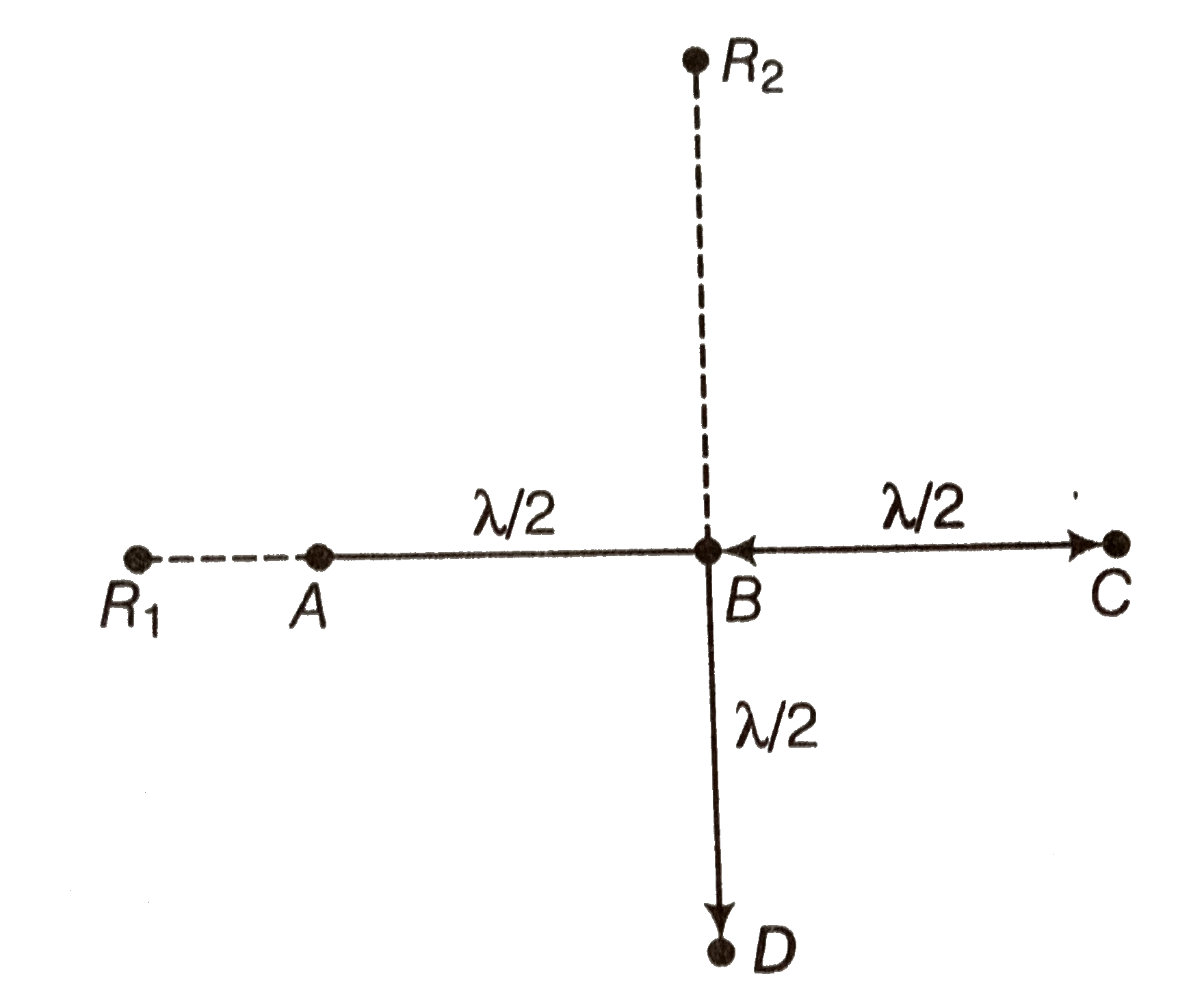
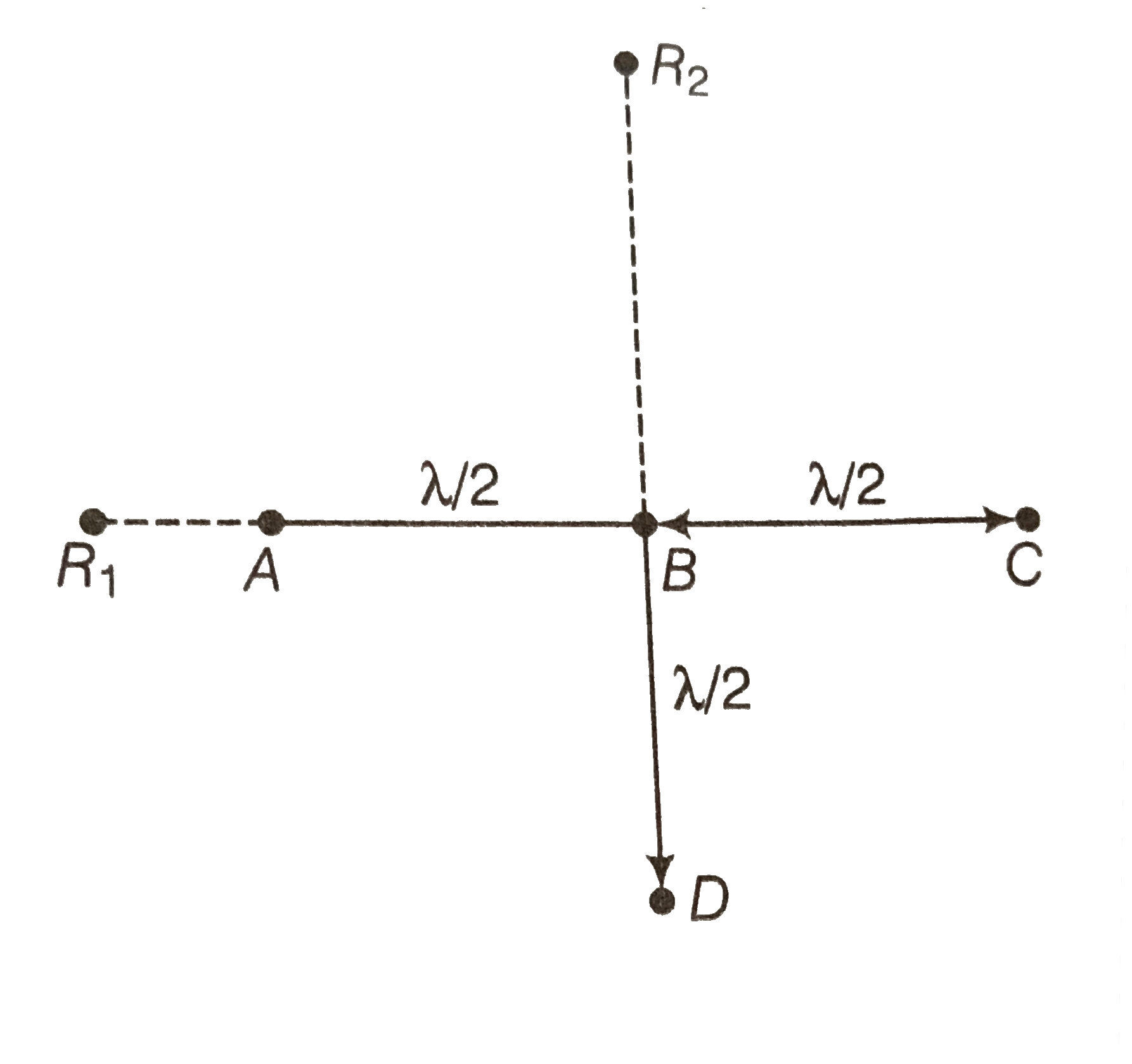
Four identical monochromatic sources A,B,C,D as shown in the (figure) produce waves of the same wavelength `lambda` and are coherent. Two receiver `R_(1)` and `R_(2)` are at great but equal distances from B.
(i) Which of the two receivers picks up the larger signal when B is turned off?
(iii) Which of the two receivers picks up the larger singnal when D is turned off ?
(iv) Which of the two receivers can distinguish which of the sources B or D has been turned off ?

Text Solution

Verified by Experts

Consider the disturbances at the reciever `R_(1)` which is at a distance d from B.
Let the wave at `R_(1)` because of A be `y_(A) = a cos omega t` . The path difference of the signal from A with that from B is `lambda//2` and hence, the phase difference is `pi`.
Thus, the wave at `R_(1)` because of B is
`y_(B)=a cos (omega t- pi)= - a cos omegat`.
The path difference of the signal from C with that from A is `lambda ` and hence the phase difference is `2 pi`.
Thus, the wave at `R_(1)` because of C is `y_(C)= a cos (omega t -2 pi)=a cos omega t`

The path difference between the signal from D with that of A is
`sqrt(d^(2)+((lambda^(2))/(2)))-(d-lambda//2)=d(1+(lambda)/(4d^(2)))^(1//2)-d+(lambda)/(2)`
`=d(1+(lambda)/(4d^(2)))^(1//2)-d+(lambda)/(2)~~(lambda)/(2)" "( :. d gt gtlambda)`
Therefore,phase difference is `pi`.
`:. Y_(D)= a cos (omegat-pi)= - a cos omega t`
Thus, the signal picked up at `R_(1)` from all the four sources is `Y_(R_(1))=y_(A)+y_(B)+y_(C)+y_(D)`
`=a cos omegat-a cos omega t +a cos omega t- a cos omega t =0`
(i) Let the signal picked up at `R_(2)` from B be `y_(B)= a_(1) cos omega t`.
The path difference between signal at D and that at B is `lambda//2`.
`: y_(D)= -a_(1) cos omega t`
The path difference between signal at A and that at B is
`sqrt(d^(2)+((lambda^(2))/(2)))-d=d(1+(lambda^(2))/(4d^(2)))^(1//2)-d " " underline~ (1 lambda^(2))/(8d^(2))`
As `d gt gt lambda`, therefore this path difference `rarr0`
and phase difference `=(2 pi)/(lambda)((1)/(8) lambda^(2)/(d^(2))) rarr 0`
Hence, `y_(A)=a_(1) cos (omegat- phi)`
Similarly, `y_(C)=a_(1) cos (omegat- phi)`
`:.` Signal picked up by `R_(2)` is
`y_(A)+y_(B)+y_(C)+y_(D)=y=2a_(1) cos (omegat- phi)`
`:. |y|^(2)=4a_(1)^(2) cos^(2)(omega t- phi)`
`:. lt I gt =2a_(1)^(2)`
Thus, `R_(1)` picks up the larger signal.
(ii) If B is switched off,
`R_(1)` picks up `y= a cos omega t`
`:. (:I_(R_(1)):)=(1)/(2)a^(2)`
`R_(2)` pick up `y=a cos omega t`
`:. (:I_(R_(2)):)=a^(2) lt cos ^(2) omegat gty=(a^(2))/(2)`
(iii) Thus, `R_(1) " and " R_(2)` pick up the same signal
If D is switched off.
`R_(1)` pick up `y= a cos omega t`
`:. (:I_(R_(1)):)=(1)/(2)a^(2)`
`R_(2)` picks up `y= a cos omega t`
`:. (:I_(R_(2)):)=9a^(2) lt cos ^(2) omegat gty=(9a^(2))/(2)`
Thus, `R_(2)` picks up larger signal compared to `R_(1)`.
(iv) Thus, a signal at `R_(1)` indicates B has been switched off and an enhanced signal at `R_(2)` indicates D has been switched off.
Promotional Banner

Topper's Solved these Questions

  • SEMICONDUCTOR ELECTRONICS: MATERIAL,DEVICES AND SIMPLE CIRCUIT

    NCERT EXEMPLAR|Exercise Semiconductor Electronics: Material,Devices And Simple Circuit|26 Videos

Similar Questions

Explore conceptually related problems

Four identical monochromatic source A, B, C, D as shown in figure produce waves of the same wavelength lambda and are coherent. Two receivers R_(1) and R_(2) are at great but equal distance from B. The choose the correct statements.

Which contents are lost when the computer turn off?

Two sources are called coherent if they produce waves

Two sources are called coherent if they produce waves

Two coherent point sources S_1 and S_2 are separated by a small distance d as shown. The fringes obtained on the screen will be

Four identical coherent sourc e emiting monochromatic light if same wavelength lambda are placed at A,B,C and D as shown. Two receivers R_(1) and R_(2) are at but equal distance from B. The path difference between signals reaching from A&D at R_(1) is (lambda)/(2) and between signals reaching from A & B at R_(2) is ~= 0 . Also assume that intensities of waves emitted by A,B,C &D reaching at R_(1) and R_(2) is same.

Two sources of light are said to be coherent if the waves produced by them have the same

NCERT EXEMPLAR-WAVE OPTICS-Wave Optics
  1. In a Young's double slit experiment, the source is white light. One of...

    Text Solution

    |

  2. Figure shows a standard two slit arrangement with slits S(1), S(2). P(...

    Text Solution

    |

  3. Two source S(1) and S(2) of intensity I(1) and I(2) are placed in fron...

    Text Solution

    |

  4. Consider sunlight incident on a pinhole of width 10^(3)Å. The image of...

    Text Solution

    |

  5. Consider the diffraction pattern for a small pinhole. As the size of t...

    Text Solution

    |

  6. For light diverging from a point source

    Text Solution

    |

  7. Is Huygen's principle valid for longitudinal sound waves?

    Text Solution

    |

  8. Consider a point at the focal point of a convex lens. Another convex l...

    Text Solution

    |

  9. What is the shape of the wavefront on earth for sunlight ?

    Text Solution

    |

  10. Why is the diffraction of sound wave more evident in daily experience ...

    Text Solution

    |

  11. The human eye has an approximate angular resolution of phi = 5.8xx10^(...

    Text Solution

    |

  12. A polariod (I) is placed infront of a monochromatic source. Another p...

    Text Solution

    |

  13. Can reflection result in plane polarised light if the light is inciden...

    Text Solution

    |

  14. For the same objective, the ratio of least separation between two poin...

    Text Solution

    |

  15. Consider a two slit interference arrangements (figure) such that the d...

    Text Solution

    |

  16. Figure shown a two slit arrangement with a source which emits unpolar...

    Text Solution

    |

  17. A small transparent slab containing material of mu=1.5 is placed along...

    Text Solution

    |

  18. Four identical monochromatic sources A,B,C,D as shown in the (figure) ...

    Text Solution

    |

  19. The optical properties of a medium are governed by the relative permit...

    Text Solution

    |

  20. To ensure almost 100% transmittivity, photographic lenses are often co...

    Text Solution

    |