Home
Class 12
PHYSICS
A particle moves in a closed orbit aroun...

A particle moves in a closed orbit around the origin, due to a force which is directed towards the origin. The de-broglie wavelength of the particles varies cyclically between two values `lambda_(1), lambda_(2) with lambda_(1)gtlambda_(2)`. Which of the following statements are true?

A

The particle could be moving in a circular orbit with origin as centre

B

The particle could be moving in an elliptic orbit with orbit with origin as its focus

C

When the de-Broglie wavelength is `lamda_(1),` the particle is nearer the origin that when its value is `lamda_(2)`

D

When the de-Broglie wavelength is `lamda_(2),` the particle is nearer the origin than when its value if `lamda_(1)`

Text Solution

Verified by Experts

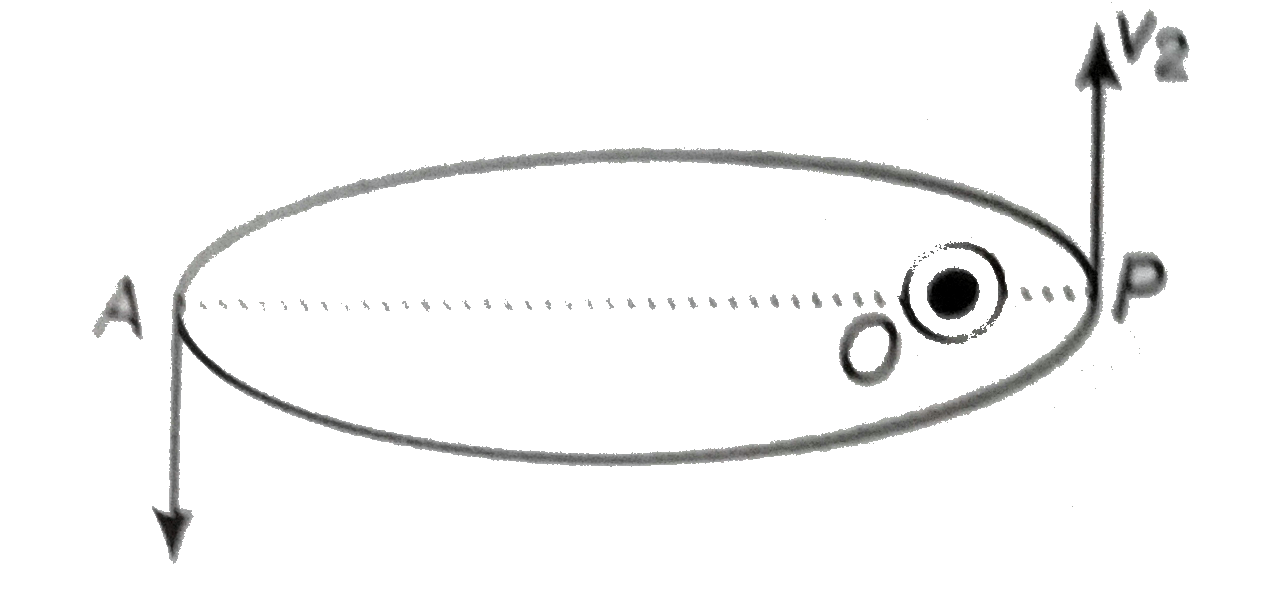
The de-Broglie wavelength of the particle can be varying cyclically between two values `lamda_(1) and lamda_(2),` if particle is moving in an elliptical orbit with origin as its one focus.
Consider the figure given below

Let `v_(1),v_(2)` be the speed of particle at A and B respectively and origin is at focous O. If `lamda_(1),lamda_(2)` are the de-Broglie waveiengths associated with particle while moving at A and B respectively. Then,
`" "lamda_(1)=h/(mv_(1))`
and `" "lamda_(2)=h/(mv_(2))`
`therefore" "(lamda_(1))/(lamda_(2))=(v_(2))/(v_(1))`
since `" "lamda_(1)gtlamda_(2)`
`therefore" "v_(2)gtv_(1)`
By law of conservation of angular momentum, the particle moves faster when it is closer to focous.
From figure, we note that origin O is closed top P than A.
Promotional Banner

Topper's Solved these Questions

  • CURRENT ELECTRICITY

    NCERT EXEMPLAR|Exercise Current Electricity|31 Videos
  • ELECTRIC CHARGES AND FIELD

    NCERT EXEMPLAR|Exercise Electric Charges And Field|31 Videos

Similar Questions

Explore conceptually related problems

A particle moves in a closed orbit around the origin, due to a force which is directed towards the origin. The de-broglie wavelength of the particles varries cyclists between two valuse lambda_(1), lambda_(2) with lambda_(1)gtlambda_(2) . Which of the following statements are true?

The de-Broglie wavelength of an electron, an alpha -particle and a proton are lambda_(e), lambda_(alpha), lambda_(p) . Which is wrong from the following:

If veca and vecb are two unit vectors perpenicualar to each other and vecc= lambda_(1)veca+ lambda_2 vecb+ lambda_(3)(vecaxx vecb), then which of the following is (are) true ?

Two sound waves of wavelengths lambda_(1) and lambda_(2) (lambda _(2) gt lambda_(1)) produces n beats//s , the speed of sound is

The wavelength of electron waves in two orbits (lambda_(1) : lambda_(2))

A charged particle is associated from rest through a certain potential difference. The de-Broglie wavelength is lambda_(1) when it is accelerated through V_(1) and is lambda_(2) when accelerated through V_(2) . The ratio lambda_(1)//lambda_(2) is

The energy of a photon is E which is equal to the kinetic energy of a proton.If lambda1 be the de-Broglie wavelength of the proton and lambda2 be the wavelength of the photon,then the ratio (lambda_(1))/(lambda_(2)) is proportional to

NCERT EXEMPLAR-DUAL NATURE OF RADIATION AND MATTER-Dual Nature Of Radiation And Matter
  1. Two particles A(1) and A(2) of masses m(1), m(2) (m(1)gtm(2)) have the...

    Text Solution

    |

  2. The de-broglie wavelength of a photon is twice the de-broglie waveleng...

    Text Solution

    |

  3. Photons absorbed in matter are converted to heat. A source emitting n ...

    Text Solution

    |

  4. A particle moves in a closed orbit around the origin, due to a force w...

    Text Solution

    |

  5. A proton and an alpha-particle are accelerated, using the same potenti...

    Text Solution

    |

  6. (i) In the explanations of photoelectric effect, we assume one photon ...

    Text Solution

    |

  7. There are materials which absorb photon of shorter wavelength and emit...

    Text Solution

    |

  8. Do all the electrons that absorb a photon come out as photoelectrons?

    Text Solution

    |

  9. There are two sources of light, each emitting with a power of 100W. On...

    Text Solution

    |

  10. Consider figure for photoemission. How would you reconcile with moment...

    Text Solution

    |

  11. Consider a metal exposed to light of wavelength 600nm. The maximum ene...

    Text Solution

    |

  12. Assuming an electron is confined to a 1nm wide region, find the wavele...

    Text Solution

    |

  13. Two monochromatic beam A and B of equal intensity I, hit a screen. The...

    Text Solution

    |

  14. Two particles A and B of de-broglie wavelength lambda(1) and lambda(2)...

    Text Solution

    |

  15. A neutron beam of energy E scatters from atoms on a surface with a spa...

    Text Solution

    |

  16. Consider a thn target (10^(-2) m square, 10^(-3) m thinkness) of sodiu...

    Text Solution

    |

  17. Consider an electron in front of metallic surface at a distance d (tr...

    Text Solution

    |

  18. A student performs an experiment on photoelectric effect, using two ma...

    Text Solution

    |

  19. A particle A with a mass m(A) is moving with a velocity v and hits a p...

    Text Solution

    |

  20. Consider a 20W bulb emitting light of wavelength 5000Å and shinning on...

    Text Solution

    |