Home
Class 12
PHYSICS
A student performs an experiment on phot...

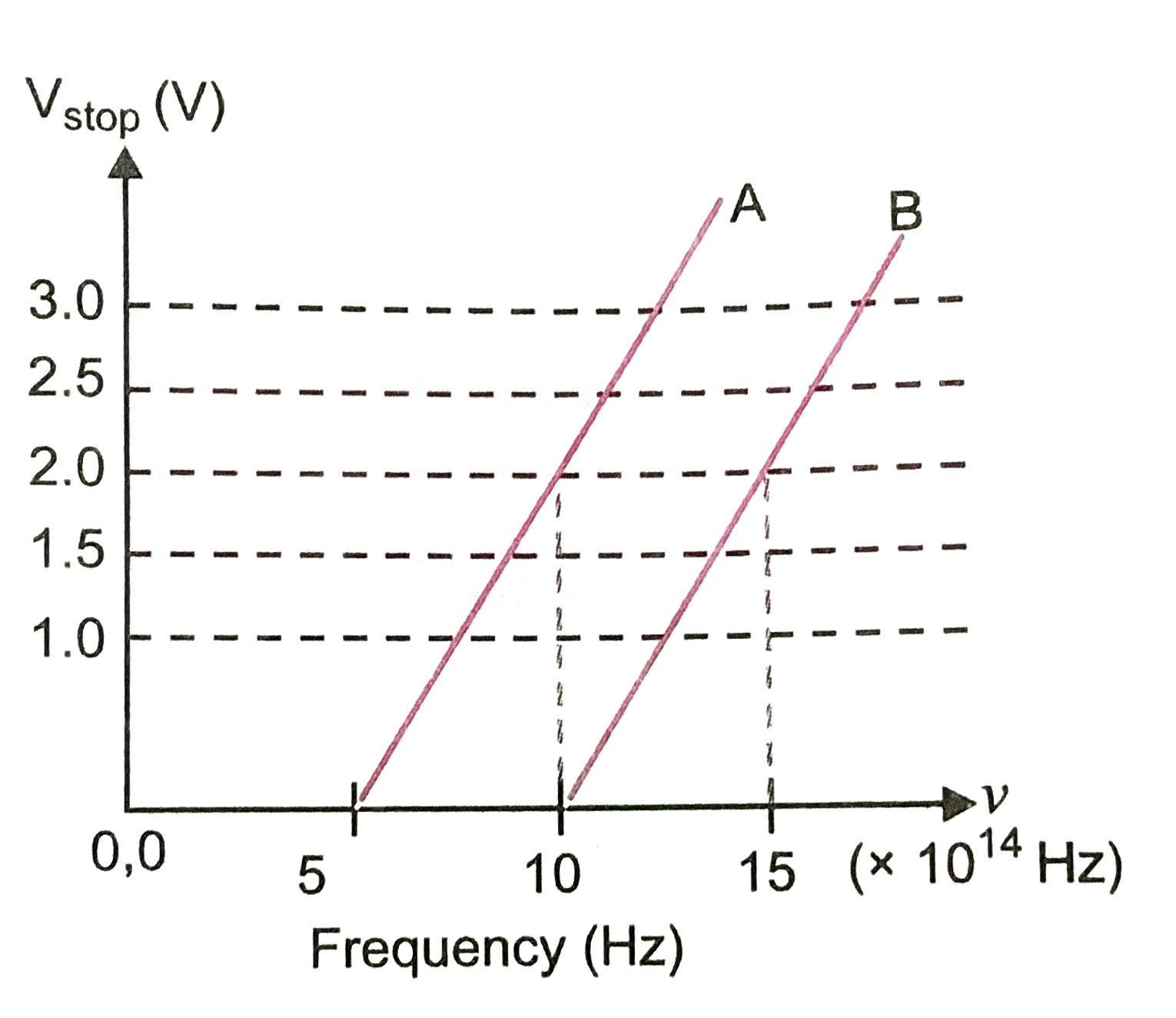
A student performs an experiment on photoelectric effect, using two materials A and B. A plot of `V_(stop)` vs `nu` is given in fig.
(i) Which material A or B has a higher work function?
(ii) Given the electric charge of an electron `=1.6xx10^(-19)C`, find the value of h obtained from the experiment for both A and B. Comment on whether it is consistent with Einstein's theory.

Text Solution

Verified by Experts

(i) Given, thresholed frequency of A is given by `v_(OA)=5xx10^(14)` Hz and
For B, `" "v_(OB)=10xx10^(14)Hz`
We know that
Work function, `" "phi=hv_(0)or phi_(0)propv_(0)`
`implies" "phi_(0)propv_(0)`
So, `" "(phi_(OA))/(phi_(OB))=(5xx10^(14))/(10xx10^(14))lt1`
`implies" "phi_(OA)ltphi_(OB)`
Thus, work function of B is higher than A.
(ii) For metal A, slope `=h/e=(2)/((10-5)10^(14))`
or `" "h=(2e)/(5xx10^(14))=(2xx1.6xxxx10^(-19))/(5xx10^(14))`
`" "=6.4xx10^(-34)Js`
For metal B, slope `=h/e=(2.5)/((15-10)10^(14))`
or `" "h=(2.5xx e)/(5xx10^(14))=(2.5xx1.6xx10^(-19))/(5xx10^(14))`
`" "=8xx10^(-34)Js`
Since, the value of h from experiment for metals A and B is different. Hence, experiment is not consistent with theory.
Promotional Banner

Topper's Solved these Questions

  • CURRENT ELECTRICITY

    NCERT EXEMPLAR|Exercise Current Electricity|31 Videos
  • ELECTRIC CHARGES AND FIELD

    NCERT EXEMPLAR|Exercise Electric Charges And Field|31 Videos

Similar Questions

Explore conceptually related problems

A student performs an experiment on photoelectric effect, using two materials A and B. A plot of V_(stop) vs. nu is given in fig. (i) Which material A or B has a higher work function? (ii) Given the electric charge of an electron =1.6xx10^(-19)C , find the value of h obtained from the experiment for both A and B. Comment on whether it is consistant with Eistein's theory.

A student performs an experiment on photoelectric effect using two materials A and B. A plot of stopping potential (V_(0)) vs freqency (v) is as shown in the figure. The value of obtained from the experiment for both A and B respectively is (Given electric charge of an electron =1.6xx10^(-19)C)

In an experiment on photoelectric effect, the slope of the cut off voltage versus frequency of incident light is found to be 4.12xx10^(-15)Vs . Given e=1.6xx10^(-19)C , estimate the value of Planck's constant.

Sketch the graphs, showing the variation of stopping potential V_s with frequency v of the incident radiations for two photosensitive materials A and B having threshold frequencies v_0gtv'_0 respectively. (i) which of the two metals A or B has higher work function? (ii) What information do you get from the slope of the graphs? (iii) What does the value of the intercept of graph A on the potential axis represent?

In moving from A to B along an electric field line, the work done by the electric field on an electron is 6.4 xx 10^-19 J . If phi_1 and phi_2 are equipotential surfaces, then the potential difference V_C - V_A is. .

In the study of a photoelectric effect the graph between the stopping potential V and frequency v of the incident radiation on two different metals P and Q is shown in fig. (i) which one of two metals have higher threshold frequency (ii) Determine the work function of the metal which has greater value (iii) Find the maximum kinetic energy of electron emitted by light of frequency 8xx10^(14) Hz for this metal.

In a photoelectric experiment, two metal pairs plates A and B are used for a given light intensity I and frequency f. work function of metal B is more than that of A. The correct variation of stopping potential difference versus frequency is given by:

In an experiment on photo electric emission, following observations were made, (i) Wavelength of the incident light =1.98xx10^(-7)m , (ii) Stopping potential =2.5 "volt" . Find: (a) Kinetic energy of photoelectrons with maximum speed. (b) Work function and (c )Threshold frequency,

Calculate the wavelength of light incident on a material of work function 2.0 eV if the stopping potential is 1.0 V . Given h = 6.625 xx10^(-34) Js and mass of electron =9.1xx10^(-31) kg

In an experiment on photoelectric effect, the emitter and the collector plates are placed at a separation of 10cm and are connected through an ammeter without any cell. A magnetic field B exists parallel to the plates. The work function of the emitter is 2.39 e V and the light incident on it has wavelengths between 400nm and 600nm. Find the minimum value of B for which the current registered by the ammeter is zero. Neglect any effect of space charge.

NCERT EXEMPLAR-DUAL NATURE OF RADIATION AND MATTER-Dual Nature Of Radiation And Matter
  1. Two particles A(1) and A(2) of masses m(1), m(2) (m(1)gtm(2)) have the...

    Text Solution

    |

  2. The de-broglie wavelength of a photon is twice the de-broglie waveleng...

    Text Solution

    |

  3. Photons absorbed in matter are converted to heat. A source emitting n ...

    Text Solution

    |

  4. A particle moves in a closed orbit around the origin, due to a force w...

    Text Solution

    |

  5. A proton and an alpha-particle are accelerated, using the same potenti...

    Text Solution

    |

  6. (i) In the explanations of photoelectric effect, we assume one photon ...

    Text Solution

    |

  7. There are materials which absorb photon of shorter wavelength and emit...

    Text Solution

    |

  8. Do all the electrons that absorb a photon come out as photoelectrons?

    Text Solution

    |

  9. There are two sources of light, each emitting with a power of 100W. On...

    Text Solution

    |

  10. Consider figure for photoemission. How would you reconcile with moment...

    Text Solution

    |

  11. Consider a metal exposed to light of wavelength 600nm. The maximum ene...

    Text Solution

    |

  12. Assuming an electron is confined to a 1nm wide region, find the wavele...

    Text Solution

    |

  13. Two monochromatic beam A and B of equal intensity I, hit a screen. The...

    Text Solution

    |

  14. Two particles A and B of de-broglie wavelength lambda(1) and lambda(2)...

    Text Solution

    |

  15. A neutron beam of energy E scatters from atoms on a surface with a spa...

    Text Solution

    |

  16. Consider a thn target (10^(-2) m square, 10^(-3) m thinkness) of sodiu...

    Text Solution

    |

  17. Consider an electron in front of metallic surface at a distance d (tr...

    Text Solution

    |

  18. A student performs an experiment on photoelectric effect, using two ma...

    Text Solution

    |

  19. A particle A with a mass m(A) is moving with a velocity v and hits a p...

    Text Solution

    |

  20. Consider a 20W bulb emitting light of wavelength 5000Å and shinning on...

    Text Solution

    |
