Home
Class 12
PHYSICS
Consider a 20W bulb emitting light of wa...

Consider a `20W` bulb emitting light of wavelength `5000Å` and shinning on a metal surface kept at a distance `2m`. Assume that the metal surface has work function of `2eV` and that each atom on the metal surface can be treated as a circular disk of radius `1.5Å`.
(i) Estimate no. of photons emitted by the bulb per second. [Assume no other losses] (ii) Will there be photoelectric emission? (iii) How much time would be required by the atomic disk to receive energy equal to work function `2eV`? (iv) How many photons would atomic disk receive within time duration calculated in (iii) above? (v) Can you explain how photoelectric effect was observed instantaneously? [Hint : Time calculated in part (iii) is from classical consideration and you may further take the target of surface area say `1cm^(2)` and estimate what would happen?]

Text Solution

Verified by Experts
Given, `P=200W,lamda=5000Å=5000xx10^(-10)m`
`d=2m,phi_(0)=2eV,r=1.5A=1.5xx10^(-10)m`
(i) Number of photon emitted by bulb per second is n' `=(p)/(hc//lamda)=(plamda)/(hc)`
`" "=(20xx(5000xx10^(-10)))/((6.62xx10^(-34))xx(3xx10^(8)))`
`implies" "=5xx10^(19)s^(-1)`
(ii) Energy of the incident photon
`(hc)/(lamda)=((6.62xx10^-34)(3xx10^(8)))/(5000xx10^(-10)xx1.6xx10^(-19))`
`" "=2.48` eV
As this energy is greater than e eV (i.e., work function of metal surface), hence photolectric emission takes place.

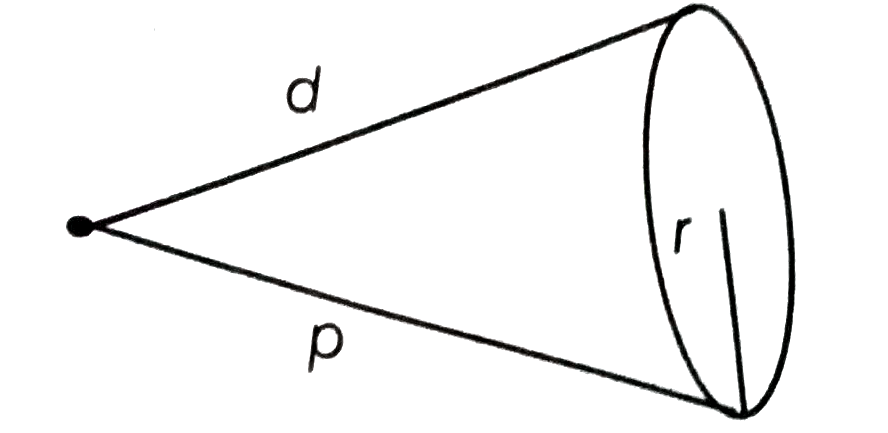
(ii) Let `Deltat` be the time spent in getting the energy `phi`= (work functiojn of metal). Consider the figure,
`" "(P)/(4pid^(2))xxpir^(2)Deltat=phi_(0)`
`implies" "Deltat=(4phi_(0)d^(2))/(Pr^(2))`
`" "=(4xx(2xx1.6xx10^(-19))xx2^(2))/(20xx(1.5xx10^(-10))^(2))~~28.4s`
(iv) Number of photons receivbed by atomic disc in time `Deltat` is
`" "N=(n'xxpir^(2))/(4pid^(2))xxDeltat`
`implies" "=(n'r^(2)Deltat)/(4d^(2))`
`" "=((5xx10^(19))xx(1.5xx10^(10))^(2)xx28.4)/(4xx(2)^(2))~~2`
(v) As time of emiccion of electrons is 11.04 s.
Hence, the photoelectric emission is not instantaneous in this problem.
In photoelectric emission, there is an collision between incident photon and free electron of the metal surface, which lasts for ever very short interval of time `(~~10^(-9)S),` hence we say photoelectric emission is instantaneous.
Promotional Banner

Topper's Solved these Questions

  • CURRENT ELECTRICITY

    NCERT EXEMPLAR|Exercise Current Electricity|31 Videos
  • ELECTRIC CHARGES AND FIELD

    NCERT EXEMPLAR|Exercise Electric Charges And Field|31 Videos

Similar Questions

Explore conceptually related problems

Light of wavelength 4000 Å is incident on a metal surface. The maximum kinetic energy of emitted photoelectron is 2 eV. What is the work function of the metal surface ?

Light of wavelength 2000 Å falls on a metallic surface whose work function is 4.21 eV. Calculate the stopping potential

Light of wavelength 3000Å is incident on a metal surface whose work function is 1 eV. The maximum velocity of emitted photoelectron will be

When light of wavelength lesser than 6000 Å is incident on a metal, electrons are emitted. The approximate work - function of the metal is :

A bulb emits light of 4500 Å . The bulb is rated as 150 watt and 9 % of the energy is emited as light . How many photons are emitted by the bulb per second ?

Calculate no. of photons emitted by 60W bulb in 10 hours that produces light of wavelength 6.626 Å

Light of wavelength 2000Å is incident on a metal surface of work function 3.0 eV. Find the minimum and maximum kinetic energy of the photoelectrons.

Light of wavelenght 5000 Å fall on a metal surface of work function 1.9 eV Find a. The energy of photon b. The kinetic energy of photoelectrons

NCERT EXEMPLAR-DUAL NATURE OF RADIATION AND MATTER-Dual Nature Of Radiation And Matter
  1. Two particles A(1) and A(2) of masses m(1), m(2) (m(1)gtm(2)) have the...

    Text Solution

    |

  2. The de-broglie wavelength of a photon is twice the de-broglie waveleng...

    Text Solution

    |

  3. Photons absorbed in matter are converted to heat. A source emitting n ...

    Text Solution

    |

  4. A particle moves in a closed orbit around the origin, due to a force w...

    Text Solution

    |

  5. A proton and an alpha-particle are accelerated, using the same potenti...

    Text Solution

    |

  6. (i) In the explanations of photoelectric effect, we assume one photon ...

    Text Solution

    |

  7. There are materials which absorb photon of shorter wavelength and emit...

    Text Solution

    |

  8. Do all the electrons that absorb a photon come out as photoelectrons?

    Text Solution

    |

  9. There are two sources of light, each emitting with a power of 100W. On...

    Text Solution

    |

  10. Consider figure for photoemission. How would you reconcile with moment...

    Text Solution

    |

  11. Consider a metal exposed to light of wavelength 600nm. The maximum ene...

    Text Solution

    |

  12. Assuming an electron is confined to a 1nm wide region, find the wavele...

    Text Solution

    |

  13. Two monochromatic beam A and B of equal intensity I, hit a screen. The...

    Text Solution

    |

  14. Two particles A and B of de-broglie wavelength lambda(1) and lambda(2)...

    Text Solution

    |

  15. A neutron beam of energy E scatters from atoms on a surface with a spa...

    Text Solution

    |

  16. Consider a thn target (10^(-2) m square, 10^(-3) m thinkness) of sodiu...

    Text Solution

    |

  17. Consider an electron in front of metallic surface at a distance d (tr...

    Text Solution

    |

  18. A student performs an experiment on photoelectric effect, using two ma...

    Text Solution

    |

  19. A particle A with a mass m(A) is moving with a velocity v and hits a p...

    Text Solution

    |

  20. Consider a 20W bulb emitting light of wavelength 5000Å and shinning on...

    Text Solution

    |

