

Home
Class 10
PHYSICS
Draw a circuit diagram of an electric ci...

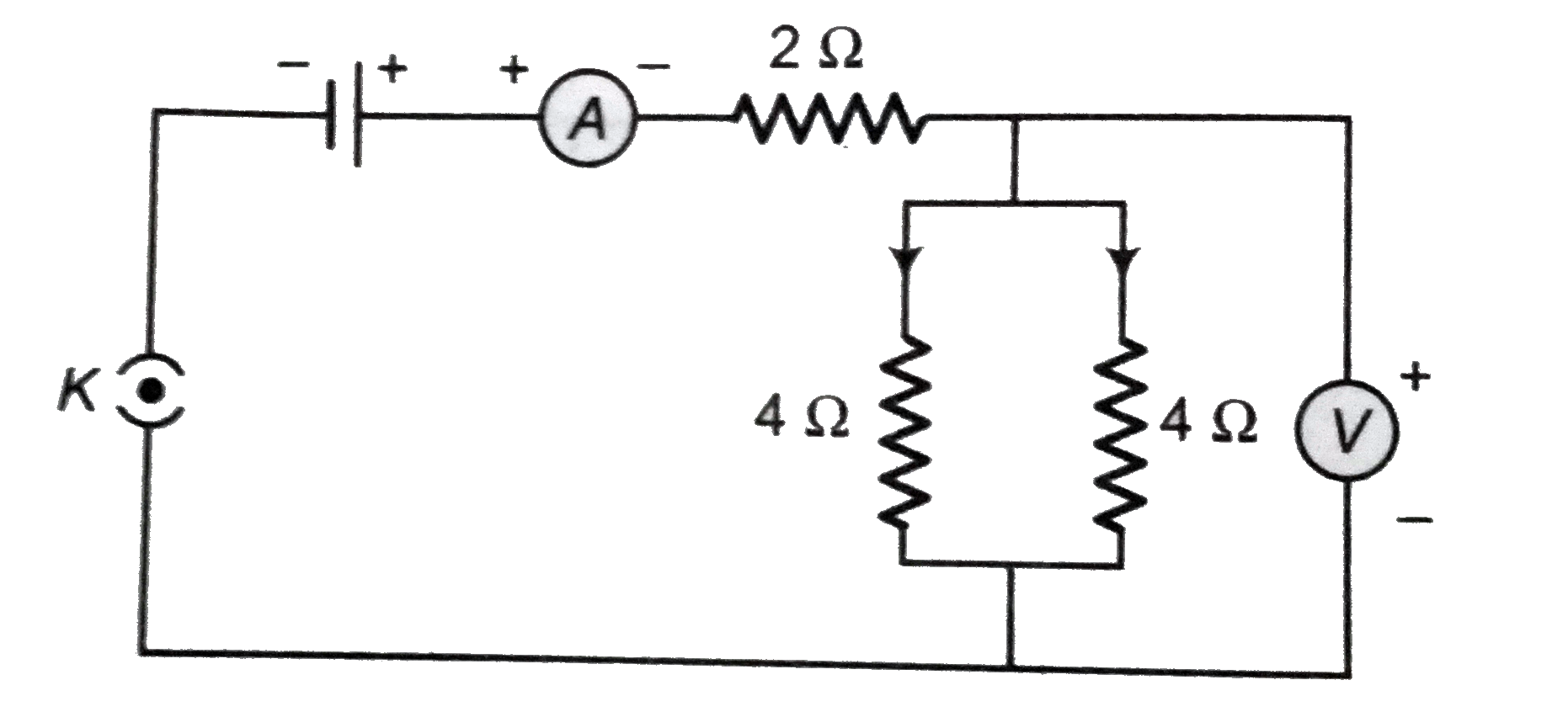
Draw a circuit diagram of an electric circuit containing a cell, a key, an ammeter, a resistance of `2 Omega` in series with a combination of two resistors (`4 Omega` each) in parallel and a voltmeter across the parallel combination. Will the potential difference across the `2 Omega` resistor be the same as that across the parallel combination of `4 Omega` resistors ? Give reason.

Text Solution

Verified by Experts

The circuit diagram containing a cell, a key, a resistor of `2 Omega` in series with a combination of two resistors (`4Omega` each) in parallel and a voltmeter across the parallel combination is shown below

The resistance of parallel combination of two resistors (`4Omega` each) is `2Omega`.
The same current passes through the `2Omega` resistor and `2Omega` (equivalent of two parallel resistor of `4Omega`). So, voltage drop by them will be same, hence the voltage V is same across `2Omega` resistor and the parallel combination of two resistors, cell of `4Omega`.
Promotional Banner

Topper's Solved these Questions

  • LIGHT : REFLECTION AND REFRACTION

    NCERT EXEMPLAR|Exercise Light : Reflection And Refraction|38 Videos

Similar Questions

Explore conceptually related problems

The potential drop across the 3 Omega resistor is

Draw a circuit diagram of an electric circuit containing a cell, a key, an ammeter, a resistance of 4 Omega in series with a combination of two resistors (8 Omega) in parallel and a voltmeter across the parallel combination. Each of them dissipate maximum energy and can withstand a maximum power of 16 W without melting. Find the maximum current that can flow through the three resistors.

In the circuit shown below: The potential difference across the 3 Omega resistor is:

Draw the circuit diagram of an electric circuit containing a battery of 6 V, a key , an ammeter , a resistor of 4 Omega in series with a combination of two resistors of 8 Omega each in parallel, and a voltmeter across the parallel combination. (a) Calculate the resistance of the circuit . (b) Find the current flowing in the circuit. (c) What will be the voltage across the parallel combination of resistors?

Draw a circuit diagram of an electric circuit containing a cell, a key, an ammeter, a resistor of 4Omega in series with a combination of two resistors ( 8Omega each ) in parallel and a voltmeter across parallel combination. Each of them dissipate maximum energy and can withstand a maximum power of 16 W without melting. Find the maximum current that can flow through the three resistors.

In the given circuit diagram, potential difference across 2 Omega resistance is

If power dissipated in the 9 Omega resistor in the resistor shown is 36 W , the potential difference across the 2 Omega resistor is

Calculate the potential difference across the 2k Omega resistor in the circuit shown in figure. The internal resistance of the cells are negligible.

NCERT EXEMPLAR-ELECTRICITY-Electricity
  1. An electric kettle consumes 1 kW of electric power when operated at 22...

    Text Solution

    |

  2. Two resistors of resistances 2 Omega and 4 Omega when connected to a b...

    Text Solution

    |

  3. Unit of electric power may also be expressed as :

    Text Solution

    |

  4. A child has drawn the electric circuit to study Ohm's law as shown in ...

    Text Solution

    |

  5. Three 2 Omega resistors, A, B and C are connected as shown in figure. ...

    Text Solution

    |

  6. Should the resistance of an ammeter be low or high ? Give reason.

    Text Solution

    |

  7. Draw a circuit diagram of an electric circuit containing a cell, a key...

    Text Solution

    |

  8. How does use of a fuse-wire protect electrical appliances ?

    Text Solution

    |

  9. What is electrical resistivity ? In a series electrical circuit compri...

    Text Solution

    |

  10. What is the commercial unit of electrical energy ? Represent it in ter...

    Text Solution

    |

  11. (a) A current of 1 A flows in a series curcuit containing an electric ...

    Text Solution

    |

  12. Why is parallel arrangement used in domestic wiring ?

    Text Solution

    |

  13. B1,B2 and B3 are three identical bulbs connected as shown in (fig. 3.4...

    Text Solution

    |

  14. Three incandecent bulbs of 100 W each are connected in series in an el...

    Text Solution

    |

  15. State Ohm's law ? How can it be verified experimentally ? Does it hold...

    Text Solution

    |

  16. What is electrical resistivity ? How does it depend om temperature. Gi...

    Text Solution

    |

  17. How will you infer with the help of an experiment that the same curren...

    Text Solution

    |

  18. How will you conclude that the same potential difference (voltage) exi...

    Text Solution

    |

  19. What is Joule's heating effect ? How can it be demonstrated experiment...

    Text Solution

    |

  20. Find out the folowing in the electric circuit given in (Fig. 3.48). ...

    Text Solution

    |