

Home
Class 10
PHYSICS
Three incandecent bulbs of 100 W each ar...

Three incandecent bulbs of `100 W` each are connected in series in an electric circuit. In another circuit another set of three bulbs of the same wattage are connected in parallel to the same source.
(a) Will the bulbs in the two circuits glow with the same brightness ? Justify your answer.
(b) Now let one bulb in both the circuits get fused. Will the rest of the bulbs continue to glow in each circuit ? Give reason.

Text Solution

Verified by Experts

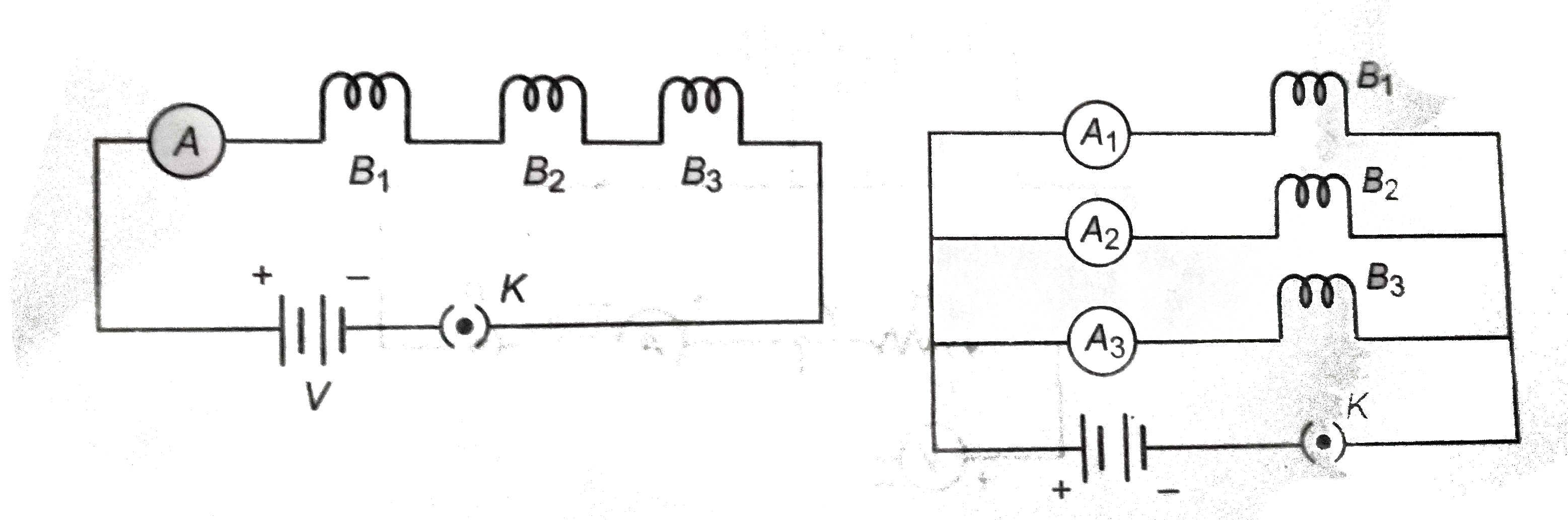
(a) Let us assume that the resistance of each bulb be R. The circuit diagram in two cases may be drawn as given below

Equivalent resistance in series combination `R_(3) = R + R + R = 3R`, voltage = V
Let current through each bulb in series combination be `I_(1)`. By Ohm's law,
`V = I_(1) xx 3R rArr I_(1) = (V)/(3R)`
So, power consumption of each bulb in series combination.
`P_(1) = I_(1)^(2) (3R) = ((V)/(3R))^(2) xx 3R = (V^(2))/(9R^(2)) xx 3R`
`= (V^(2))/(3R) = (V^(2))/(3R)` ....(i)
For parallel circuit, (1)
The resistance of each bulb = R
Voltage across each bulb = V `" "[because "same voltage in parallel combination"]`
`therefore` Power consumption of each bulb in parallel combination.
`P_(2) = (V^(2))/(R)` ....(ii)
`because` From Eqs. (i) and (ii). we have `(P_(2))/(P_(1)) = (V^(2)//R)/(V^(2)//3R)`
`(V^(2))/(R) xx (3R)/(V^(2)) = 3 rArr P_(2) = 3P_(1)`
Therefore, each bulb in parallel combination glows 3 times brighter to that of each bulb in series combination.
(b) When one bulb fused in both the circuit, then in series combination, circuit gets broken and current stops flowing and remaining bulb don't glow. Whereas in parallel combination, same voltage continue to act on the remaining voltage and hence, other bulbs continue to glow with same brightness.
Promotional Banner

Topper's Solved these Questions

  • LIGHT : REFLECTION AND REFRACTION

    NCERT EXEMPLAR|Exercise Light : Reflection And Refraction|38 Videos

Similar Questions

Explore conceptually related problems

Three incandescent bulbs of 100 W each are connected in series in an electric circuit. In another circuit, another set of three bulbs of the same wattage are connected in parallel to the same source. (a) Will the bulbs in the two circuits glow with the same brightness ? Justify your answer. (b) Now let one bulb in both circuits get fused. Will the rest of the bulbs continue to glow in each circuit ? Give reason. (a) In a household electric circuits, different appliances are connected in parallel to one another. Give two reasons for the same. (b) An electrican puts a fuse of rating 5 A in that part of domestic electrical circuit in which electrical heater of rating 1.5 kW, 220 V is operating. What iis likely to happen in this case and why ? What change, if any, needs to be made ?

Two electric bulbs A and B are rated as 60 W and 100 W . They are connected in parallel to the same source. Then,

Three electric bulbs of rating 60 W each are joined in series and then connected to electric mains. The power consumed by these three bulbs will be

Bulb in this circuit doesn't glow, why?

Three bulbs of 40, 60 and 100 watt are connected in series with the source of 200 volt. Then which of the bulb will be glowing the most –

In which case, bulb glows in the circuit.

Two electric bulbs A and B are rated 60 and 100 W , respectively. If they are connected in parallel to the same source , then

NCERT EXEMPLAR-ELECTRICITY-Electricity
  1. An electric kettle consumes 1 kW of electric power when operated at 22...

    Text Solution

    |

  2. Two resistors of resistances 2 Omega and 4 Omega when connected to a b...

    Text Solution

    |

  3. Unit of electric power may also be expressed as :

    Text Solution

    |

  4. A child has drawn the electric circuit to study Ohm's law as shown in ...

    Text Solution

    |

  5. Three 2 Omega resistors, A, B and C are connected as shown in figure. ...

    Text Solution

    |

  6. Should the resistance of an ammeter be low or high ? Give reason.

    Text Solution

    |

  7. Draw a circuit diagram of an electric circuit containing a cell, a key...

    Text Solution

    |

  8. How does use of a fuse-wire protect electrical appliances ?

    Text Solution

    |

  9. What is electrical resistivity ? In a series electrical circuit compri...

    Text Solution

    |

  10. What is the commercial unit of electrical energy ? Represent it in ter...

    Text Solution

    |

  11. (a) A current of 1 A flows in a series curcuit containing an electric ...

    Text Solution

    |

  12. Why is parallel arrangement used in domestic wiring ?

    Text Solution

    |

  13. B1,B2 and B3 are three identical bulbs connected as shown in (fig. 3.4...

    Text Solution

    |

  14. Three incandecent bulbs of 100 W each are connected in series in an el...

    Text Solution

    |

  15. State Ohm's law ? How can it be verified experimentally ? Does it hold...

    Text Solution

    |

  16. What is electrical resistivity ? How does it depend om temperature. Gi...

    Text Solution

    |

  17. How will you infer with the help of an experiment that the same curren...

    Text Solution

    |

  18. How will you conclude that the same potential difference (voltage) exi...

    Text Solution

    |

  19. What is Joule's heating effect ? How can it be demonstrated experiment...

    Text Solution

    |

  20. Find out the folowing in the electric circuit given in (Fig. 3.48). ...

    Text Solution

    |