

Home
Class 10
PHYSICS
State Ohm's law ? How can it be verified...

State Ohm's law ? How can it be verified experimentally ? Does it hold good under all conditions ? Comment.

Text Solution

Verified by Experts

Ohm's law states that the electric current flowing through a conductor is directly proportional to the potential differece applied across its ends, provided the physical conditions such as temperature remains unchanged.
If v is the potential difference applied across the ends of conductor through which current/flows, then according to Ohm's law.
`V prop I rArr V = IR`
`I = (V)/(R)`
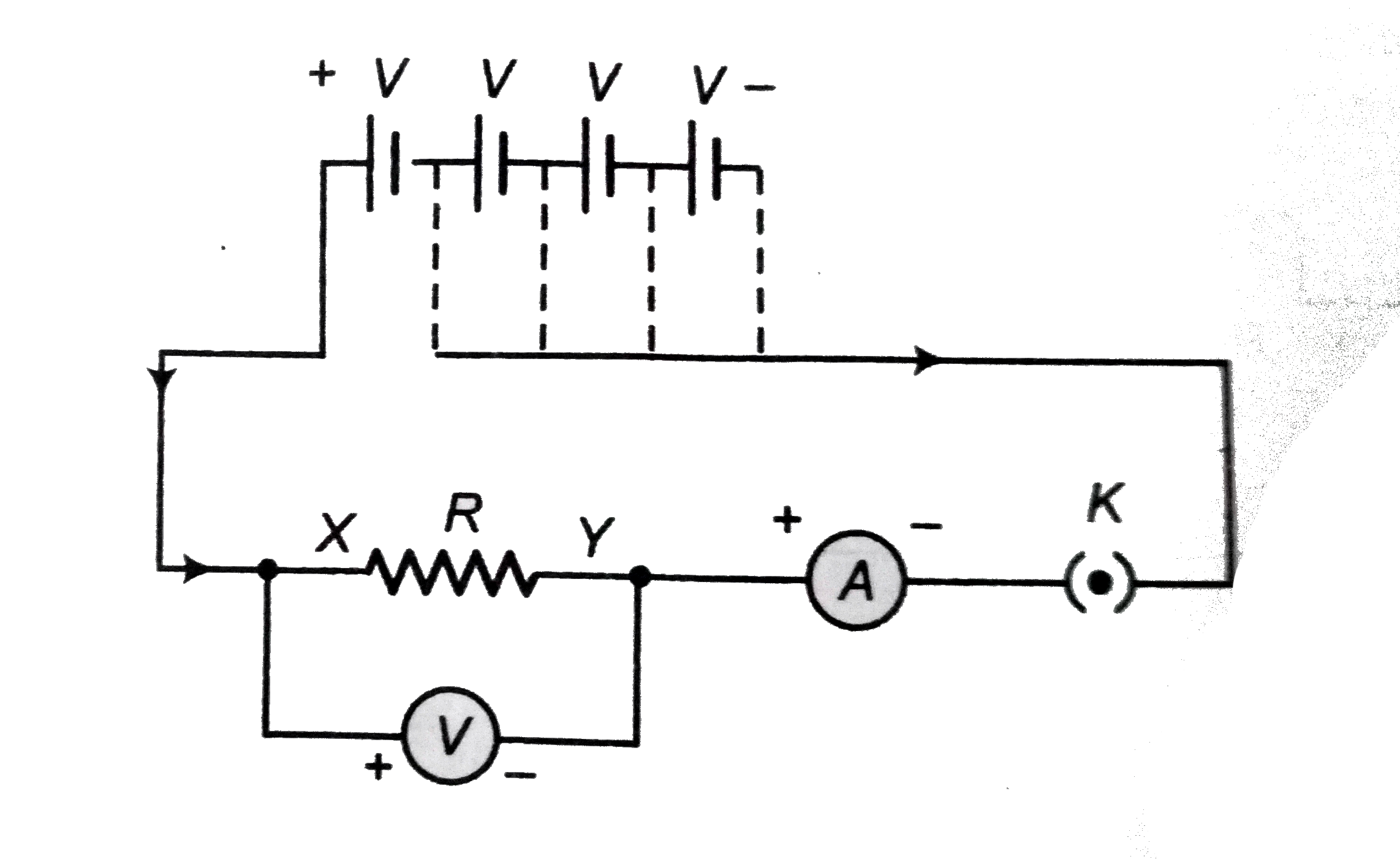
where, R is the constant of proportionality called resistance of conductor at a given temperature. The experimental set up of Ohm's law is made as the circuit shown belown in the figure, consisting of a nichrome wire XY, an ammeter (A). A voltmeter (V) and four cell of 1.5 V each.

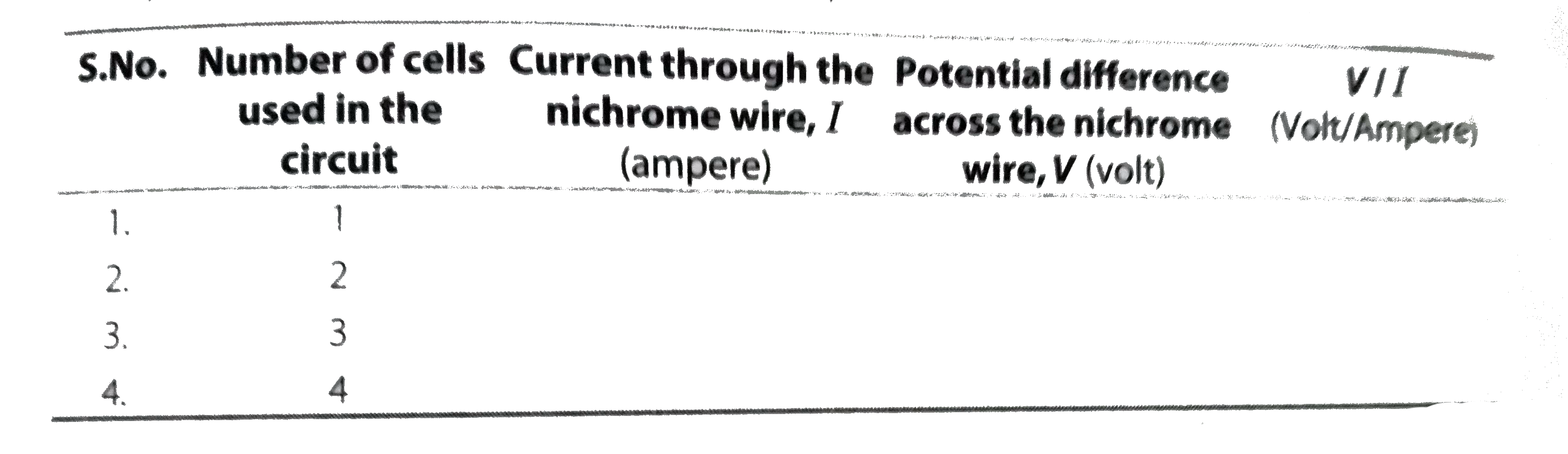
The reading in the ammeter A for the current and reading of the voltmeter V for the potential difference across the nichrome wire XY is measure and recorded in the table given below, first by using only one cell and then by the two, three and four cells in successive readings.

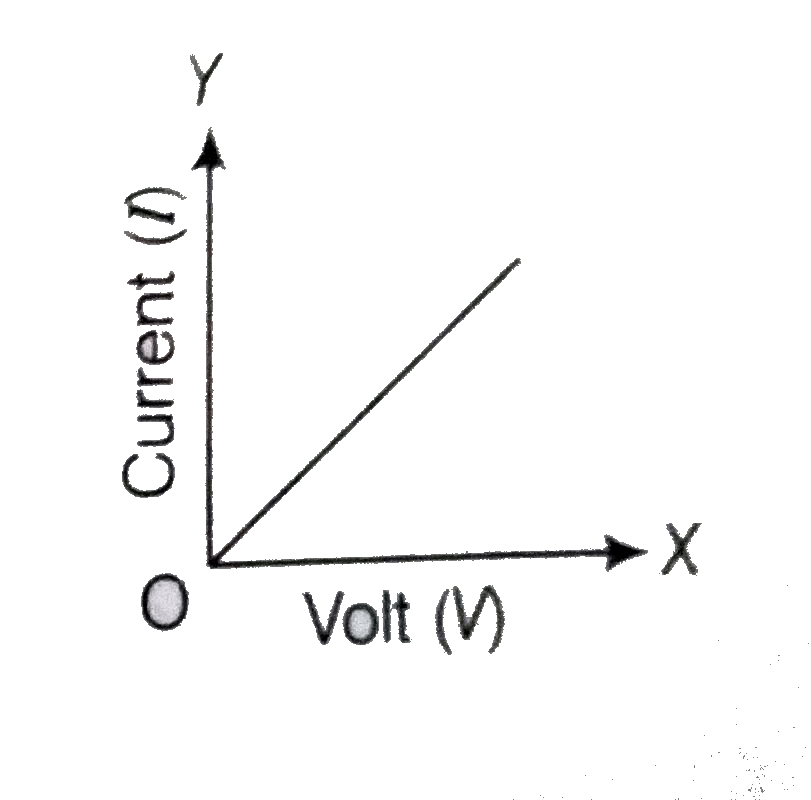
Calculating the ratio of V to I for each pair of potential difference V and current I. A graph is plotted between V and I and the nature of the graph is observed as shown here. The same value for V/I is obtained corresponding to one, two, three and four cells in successive reading. Also, the V - I graph is obtained as straight line that passes through the origin. The law is only valid for ohmic conductor e.g. metals.
Thus, V/I is a constant, i.e., `V prop I`
This verifies Ohm's law.
Ohm's law does not hold good under all conditions as it is not a fundamental law of nature like Newton's law. It is obeyed by metalic conductors only when physical conditions like temperature etc. are kept unchanged. It is not obeyed by a lamp filament, junction diode, thermistor etc. These are called non-ohmic conductor.
Promotional Banner

Topper's Solved these Questions

  • LIGHT : REFLECTION AND REFRACTION

    NCERT EXEMPLAR|Exercise Light : Reflection And Refraction|38 Videos

Similar Questions

Explore conceptually related problems

State Hooke’s law. How can it be verified experimentally ?

State Ohm's law. How can it be verified experimentally ? Explain with the help of a circuit diagram. Express the result graphically.

State Pascal's law. How can it be demonstrated?

State Archimedas' principle. How can it be experimentally verified ?

State and explain Lenz's law. Give one exmple to illustrate the law. How will you verify it experimentally ? Does it obey the principle of energy consevartion ?

State the law of conservation of mass. How is it verified experimentally ?

(a) Water boils in an electric kettle in 15 minutes after being swiched on. Using the same mains supply, should the length of the heating element be increased or decreased if the water is to boiled in 10 minutes ? Why ? Does Ohm's law hold good under all conditions ?

How can laws of reflection be experimentally verified?

Ideal gas equation strictly obeys gas laws under all conditions of

NCERT EXEMPLAR-ELECTRICITY-Electricity
  1. An electric kettle consumes 1 kW of electric power when operated at 22...

    Text Solution

    |

  2. Two resistors of resistances 2 Omega and 4 Omega when connected to a b...

    Text Solution

    |

  3. Unit of electric power may also be expressed as :

    Text Solution

    |

  4. A child has drawn the electric circuit to study Ohm's law as shown in ...

    Text Solution

    |

  5. Three 2 Omega resistors, A, B and C are connected as shown in figure. ...

    Text Solution

    |

  6. Should the resistance of an ammeter be low or high ? Give reason.

    Text Solution

    |

  7. Draw a circuit diagram of an electric circuit containing a cell, a key...

    Text Solution

    |

  8. How does use of a fuse-wire protect electrical appliances ?

    Text Solution

    |

  9. What is electrical resistivity ? In a series electrical circuit compri...

    Text Solution

    |

  10. What is the commercial unit of electrical energy ? Represent it in ter...

    Text Solution

    |

  11. (a) A current of 1 A flows in a series curcuit containing an electric ...

    Text Solution

    |

  12. Why is parallel arrangement used in domestic wiring ?

    Text Solution

    |

  13. B1,B2 and B3 are three identical bulbs connected as shown in (fig. 3.4...

    Text Solution

    |

  14. Three incandecent bulbs of 100 W each are connected in series in an el...

    Text Solution

    |

  15. State Ohm's law ? How can it be verified experimentally ? Does it hold...

    Text Solution

    |

  16. What is electrical resistivity ? How does it depend om temperature. Gi...

    Text Solution

    |

  17. How will you infer with the help of an experiment that the same curren...

    Text Solution

    |

  18. How will you conclude that the same potential difference (voltage) exi...

    Text Solution

    |

  19. What is Joule's heating effect ? How can it be demonstrated experiment...

    Text Solution

    |

  20. Find out the folowing in the electric circuit given in (Fig. 3.48). ...

    Text Solution

    |