

Home
Class 10
PHYSICS
How will you conclude that the same pote...

How will you conclude that the same potential difference (voltage) exists across three resistors connected in a parallel arrangement to a battery ?

Text Solution

Verified by Experts

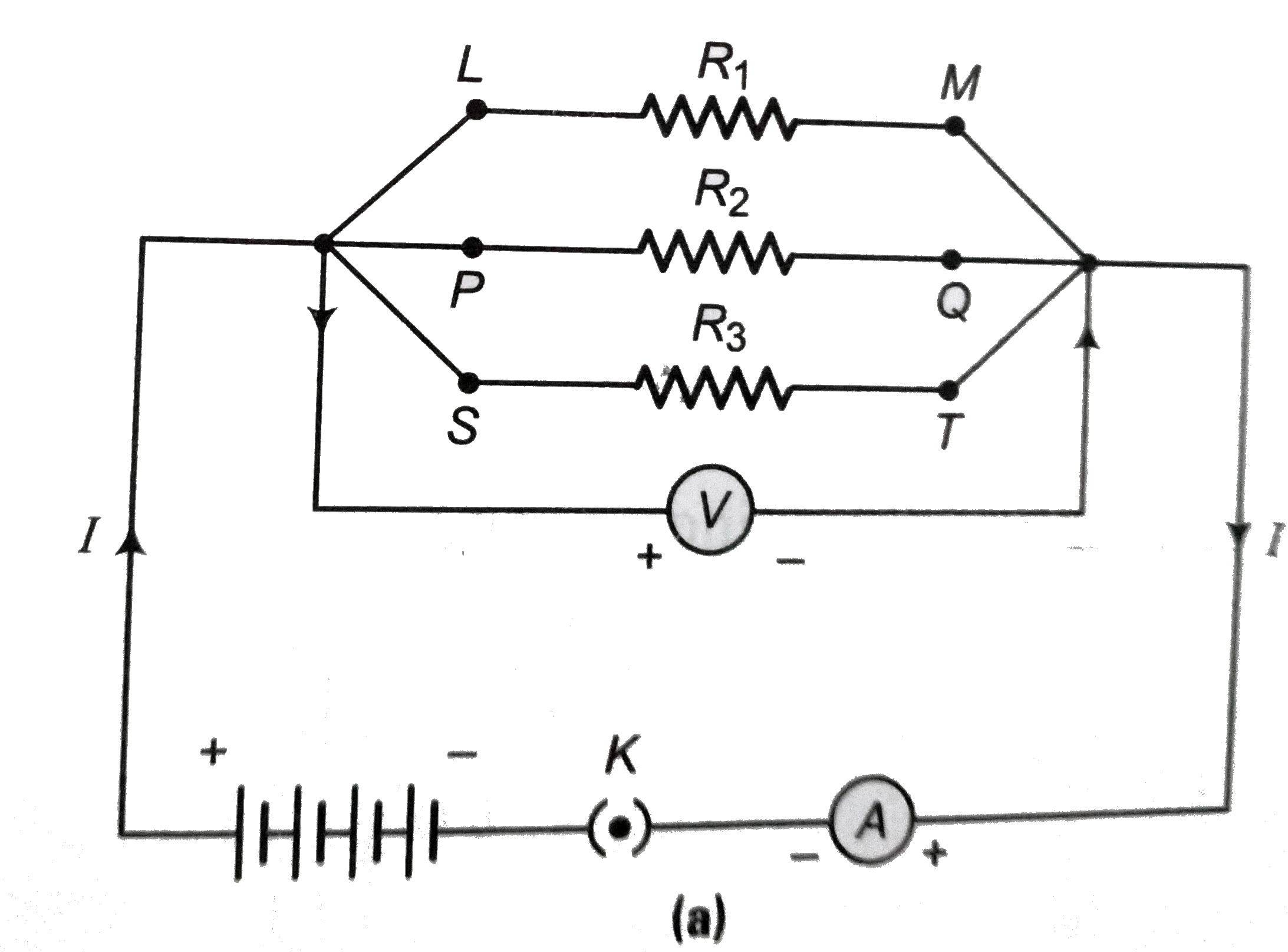
The experimental set-up comprises of three resistors `R_(1), R_(2)` and `R_(3)` which are joined in parallel combination and connecting them with a battery, an ammeter (A), a voltmeter (V) and a plug key K, as shown in figure (a).
The key K is closed and the voltmeter and ammeter readings are recorded.

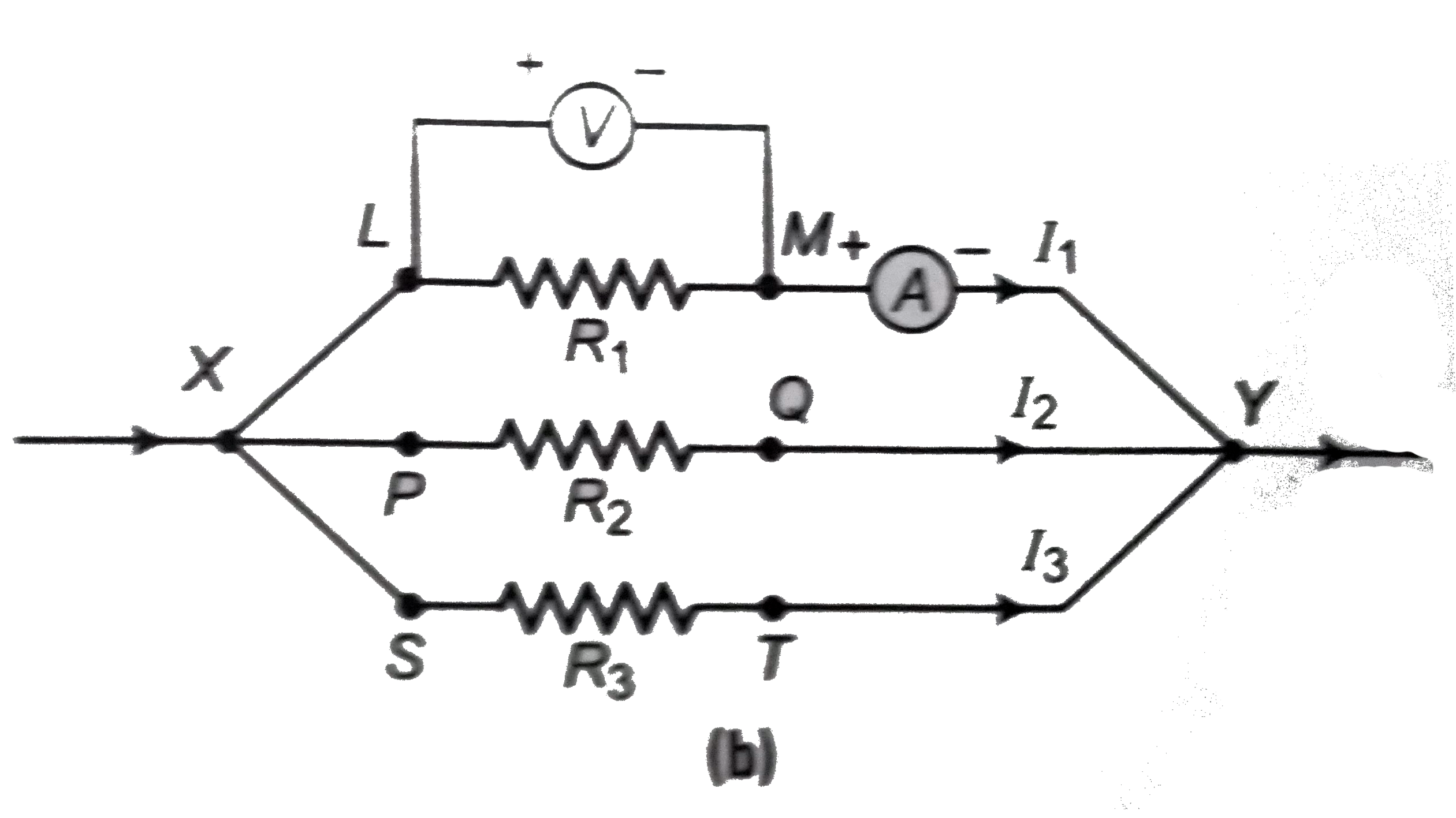
The key K is open and removing the ammeter and voltmeter from the circuit and insert the voltmeter V in parallel with `R_(1)` and ammeter is series with the resistor `R_(1)`, as shown in fig. (b)

Similarly, measuring the potential differences across resistance `R_(2)` and `R_(3)`. It is found that voltmeter gives identical reading which leads to conclude that the voltage or potential difference across each resistors is same and equal to the potential difference across the combination.
Promotional Banner

Topper's Solved these Questions

  • LIGHT : REFLECTION AND REFRACTION

    NCERT EXEMPLAR|Exercise Light : Reflection And Refraction|38 Videos

Similar Questions

Explore conceptually related problems

A 2.0 mu F capacitor and a 4.0 mu F , capacitor are connected in parallel across in 300V potential difference (a) What is the total energy stored by them? (b) They are next connected in series across that potential difference. What is the ratio of the total energy stored by them in the parallel arrangement to that in the series arrangement?

Potential difference across the terminal of a non ideal battery is

Potential different across the terminals of the battery shown in figure is

Draw a circuit diagram of an electric circuit containing a cell, a key, an ammeter, a resistance of 2 Omega in series with a combination of two resistors ( 4 Omega each) in parallel and a voltmeter across the parallel combination. Will the potential difference across the 2 Omega resistor be the same as that across the parallel combination of 4 Omega resistors ? Give reason.

An inductor is connected in series with a resistor of resistance 1000 Omega and a capacitor of capacitance 2 mu F. Potential difference of 100 V exists across the resistor . Angular frequency of source is 200 rad/s, and the same is equal to resonant frequency of the circuit find the rms voltage across inductor .

NCERT EXEMPLAR-ELECTRICITY-Electricity
  1. An electric kettle consumes 1 kW of electric power when operated at 22...

    Text Solution

    |

  2. Two resistors of resistances 2 Omega and 4 Omega when connected to a b...

    Text Solution

    |

  3. Unit of electric power may also be expressed as :

    Text Solution

    |

  4. A child has drawn the electric circuit to study Ohm's law as shown in ...

    Text Solution

    |

  5. Three 2 Omega resistors, A, B and C are connected as shown in figure. ...

    Text Solution

    |

  6. Should the resistance of an ammeter be low or high ? Give reason.

    Text Solution

    |

  7. Draw a circuit diagram of an electric circuit containing a cell, a key...

    Text Solution

    |

  8. How does use of a fuse-wire protect electrical appliances ?

    Text Solution

    |

  9. What is electrical resistivity ? In a series electrical circuit compri...

    Text Solution

    |

  10. What is the commercial unit of electrical energy ? Represent it in ter...

    Text Solution

    |

  11. (a) A current of 1 A flows in a series curcuit containing an electric ...

    Text Solution

    |

  12. Why is parallel arrangement used in domestic wiring ?

    Text Solution

    |

  13. B1,B2 and B3 are three identical bulbs connected as shown in (fig. 3.4...

    Text Solution

    |

  14. Three incandecent bulbs of 100 W each are connected in series in an el...

    Text Solution

    |

  15. State Ohm's law ? How can it be verified experimentally ? Does it hold...

    Text Solution

    |

  16. What is electrical resistivity ? How does it depend om temperature. Gi...

    Text Solution

    |

  17. How will you infer with the help of an experiment that the same curren...

    Text Solution

    |

  18. How will you conclude that the same potential difference (voltage) exi...

    Text Solution

    |

  19. What is Joule's heating effect ? How can it be demonstrated experiment...

    Text Solution

    |

  20. Find out the folowing in the electric circuit given in (Fig. 3.48). ...

    Text Solution

    |