Home
Class 9
CHEMISTRY
(a) Tabulate the differences in the char...

(a) Tabulate the differences in the characteristics of states of matter.
(b) Comment upon the following: rigidity. Compressibility. Fluidity. Filling a gas container, shape, kinetic energy and density.

Text Solution

Verified by Experts
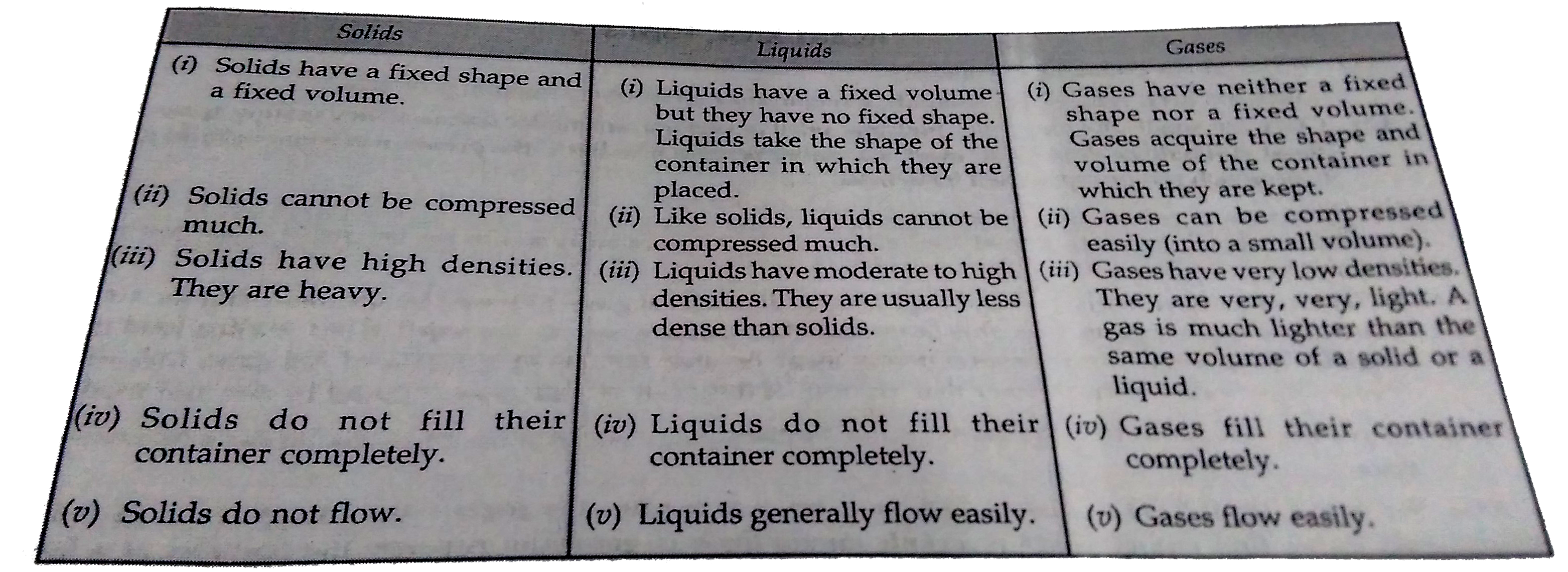
(a) The main differences in the characteristics of the three states of matter, solids, liquids and gases are given below :

(b) (i) Rigidity. Rigidity refers to the property of a solid to resist change in its shape (or resist deformation) when an outside force is applied. In most simple terms, rigidity means 'stiffness'. The particles in a solid are very closely packed and there are very strong forces of attraction between them, so solids posses high rigidity. Liquids and gases are not rigid because the positions of their particles are not fixed.
(ii) Compressibility. Compressibility is the property of a fluid (or a solid) due to which its volume decreases when pressure is applied. The particles in gases have large spaces between them due to which their volume decrease too much when pressure is applied on them. So, gases have high compressibility. On the other hand , the particles in solids and liquids are closely packed, so solids and liquids do not have much compressibility.
(iii) Fluidity. The property of flowing easily is called fluidity. Gases and liquids exhibit the property of fluidity, so they are called fluids. Due to large interparticles distance and very weak forces of attraction, gases can flow extremely easily. So, the gases have very high fluidity. And because of comparatively smaller interparticle distances and stronger forces of attraction between their particles, the fluidity of liquids is less than that of gases. Solids are not fluids, they have no fluidity.
(iv) Filling a gas container. A gas fills its container completely because due to high kinetic energy and negligible interparticles forces of attraction, the particles in a gas move with high speeds in all directions and occupy all the space in the container.
(v) Shape. The external form or appearance of a substance is called its shape. A solid has a fixed shape because the particles in a solid are closely packed and their positions are fixed due to strong forces of attraction between them. The liquids and gases do not have fixed shapes because the positions of particles in them are not fixed due to comparatively weaker forces of attraction between them.
(vi) Kinetic energy. The energy possessed by a material due to the motion of its particles is called kinetic energy. At a given temperature, the particles in a gas have the maximum kinetic energy because they move with high speeds due to weakest forces of attraction among them. Liquids have lesser kinetic energy (than gases) whereas solids have the the least kinetic energy at a given temperature.
(vii) Density. The mass per unit volume of a material is called its density. Solids have high densities because their particles are very close together. Liquids have usually lower densities than solids because their particles are somewhat more loosely packed than that in solids. Gases have the lowest densities because their particles are very far apart from one another.
Promotional Banner

Topper's Solved these Questions

  • MATTER IN OUR SURROUNDINGS

    LAKHMIR SINGH & MANJIT KAUR|Exercise HOTS|5 Videos
  • IS MATTER AROUND US PURE

    LAKHMIR SINGH & MANJIT KAUR|Exercise NCERT BOOK PAGE 24|1 Videos
  • MODEL TEST PAPER 1

    LAKHMIR SINGH & MANJIT KAUR|Exercise SECTION B|3 Videos

Similar Questions

Explore conceptually related problems

Tabulate the differences in the states of matter on the basis of the following characteristics : (i) Rigidity (ii) Kinetic energy (iii) Density.

State if each of the following statements is true or false. Give reasons for your answer. a) In an elastic collision of two bodies, the momentum and energy of each body is conserved. b)Total energy of a systm is always conserved,no matter what internal and external forces on the body are present. Work done in the motion of a body over a closed loop is zero for every force in nature. d) In an inelastic collision, the final kinetic energy is always less than the initial kinetic energy of the sytem.

In a photoelectric experiment, a monochromatic light is incident on the metal plate A. It was observed that with V = 5 "volt" , the maximum kinetic energy of photoelectrons striking plate B was 1 eV . The polarity of the applied potential difference was as shown in figure (a). With polarity of the applied potential difference reversed (as shown in figure (b)) and frequency of incident light doubled, it was observed that in saturation state, the kinetic energy of electrons striking plate B ranged between 5 eV to 20 eV. Find the work function of metal used in plate A.

A fixed container is fitted with a piston which is attached to a spring of spring constant k . The other and of the spring is attached to a rigid wall. Initially the spring is in its natural length and the length of container between the piston and its side wall is L . Now an dideal diatomic gas is slowly filled in the container so that the piston moves quasistatically. It pushed the piston by x so that the spring now is compressed by x . The total rotaional kinetic energy of the gas molecules in terms of the displacement x of the piston is (there is vacuum outside the container)

Two identical containers A and B are filled with two different liquids of equal masses. The level of the liquid in container A is found to be one-fourth of the level of the liquid in container B. What is the ratio of thedensity of two liquids? If the density of he liquid in the container A is 2 " g " cm^(-3) , then find the density of the mixture of the two liquids.

LAKHMIR SINGH & MANJIT KAUR-MATTER IN OUR SURROUNDINGS -NCERT
  1. CHARACTERISTICS OF PARTICLES OF MATTER

    Text Solution

    |

  2. The mass per unit volume of a substance is called density (density = m...

    Text Solution

    |

  3. (a) Tabulate the differences in the characteristics of states of matte...

    Text Solution

    |

  4. Give reasons (a) A gas fills completely the vessel in which it is ke...

    Text Solution

    |

  5. Liquids generally have lower density as compared to solids but you mus...

    Text Solution

    |

  6. Convert the following temperatures to celsius scale : (a) 300 K (...

    Text Solution

    |

  7. What is the physical state of water at: a. 250^(@)C b. 100^(@)C ?

    Text Solution

    |

  8. For any substance, why does the temperture remain constant during the ...

    Text Solution

    |

  9. Suggest a method to liquefy atmospheric gases.

    Text Solution

    |

  10. Why does a desert cooler cool better on a hot dry day?

    Text Solution

    |

  11. How does the water kept in an earthen pot (mataka) become cool during ...

    Text Solution

    |

  12. Why does our palm feel cold when we put some acetone or petror or per...

    Text Solution

    |

  13. Why are we able to sip hot tea or milk faster from a saucer rather tha...

    Text Solution

    |

  14. What type of clothes should we wear in summer?

    Text Solution

    |

  15. Convert the following temperatures to the celsius scale. (a) 293k (...

    Text Solution

    |

  16. Convert the folowing temperature to the kelvin scale. (a) 25^(@)C (b...

    Text Solution

    |

  17. Give reason for the following observations. (a) Naphthalene balls d...

    Text Solution

    |

  18. Arrange the following substances in increasing order of forc es of att...

    Text Solution

    |

  19. What is the physical state of water at : (a) 25^(@)C ? (b) 0^(@)...

    Text Solution

    |

  20. Give two reasons to justify- (a) Water at room temperaure is a liqui...

    Text Solution

    |

