Home
Class 9
CHEMISTRY
The students of class IX have made placa...

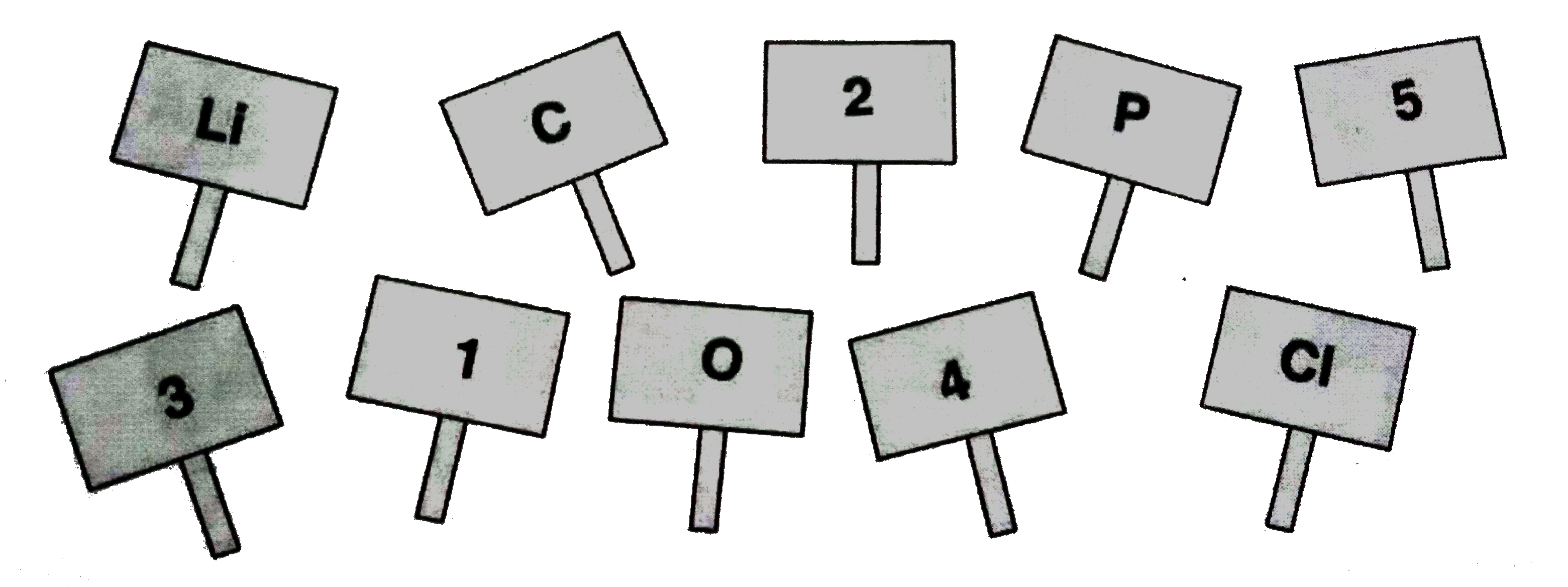
The students of class IX have made placards showing the symbols of some elements and valencies of these elements. These placards somehow got mixed up as shown below :

On this basis of these placards the chemistry teacher, Mrs. Shanti, asked a student Vikas to answer the following questions :
(a) Choose the symbol of an element from among the placards which exhibits valencies of 3 and 5. What is the name of is the name of this element ? Is it a metal or a non-metal ?
(b) Choose the symbol of an element from the given placards which shows a valency of 2. What is the name of this element ? Is it a metal or a non-metal ?
(c) Work out the formula of the compound formed between the element of valency 3 and element of valency 2. Also name this compound
(d) What values are displayed by Vikas in this episode ?

Text Solution

Verified by Experts

(a) The symbol of element which exhibits the valencies of 3 and 5 is P. The name of this element is phosphorus. It is a non-metal
(b) The symbol of element which exhibits a valency of 2 is O. The name of this element is oxygen. It is also a non-metal
(c) The formula of compound formed between phosphorus element exhibiting a valency of 3 and oxygen element of valency 2 can be worked out as follows :

Thus, the formula of compound formed between phosphorus element of valency 3 and oxygen element of valency 2 is `P_(2)O_(3)`. The name of this compound is phosphorus trioxide
(d) The formula of compound formed between phosphorus element exhibiting a valency of 5 and oxygen element of valency 2 can be worked out as follows :

Thus, the formula of compound between phosphorus element of valency 5 and oxygen element of valency 2 is `P_(2)O_(5)`. The number of this compound is phosphorus pentoxide
(e) The values displayed by Vikas in this episode are (i) Knowledge of the symbols of elements and their valencies, and (ii) Ability to apply knowledge in solving problems.
Promotional Banner

Topper's Solved these Questions

  • STRUCTURE OF ATOM

    LAKHMIR SINGH & MANJIT KAUR|Exercise Very Short Answer|1 Videos
  • STRUCTURE OF ATOM

    LAKHMIR SINGH & MANJIT KAUR|Exercise NCERT Book, Page 50|1 Videos
  • STRUCTURE OF ATOM

    LAKHMIR SINGH & MANJIT KAUR|Exercise Value Based Questions|17 Videos
  • MODEL TEST PAPER 5

    LAKHMIR SINGH & MANJIT KAUR|Exercise Section B|2 Videos

Similar Questions

Explore conceptually related problems

Two elements having valency 4.

The valency of an element is

An element which can exhibit valencies of 2, 4 and 6 can be :

Which element does not show a valency of 2

The atomic number of an element is 15. Hence, it will show a valency of

The symbols for different elements are given below. Identify the elements As

Which element in the given below does not show variable valency ?

LAKHMIR SINGH & MANJIT KAUR-STRUCTURE OF ATOM-Exercise
  1. What are the limitations of Rutherford's model of the atom ?

    Text Solution

    |

  2. Describe Bohr's model of the atom.

    Text Solution

    |

  3. Compare all the proposed models of an atom given in this chapter.

    Text Solution

    |

  4. Summarise the rules for writing of distribution of electrons in variou...

    Text Solution

    |

  5. Define valency by taking examples of silicon and oxygen.

    Text Solution

    |

  6. Explain with examples (i) Atomic number (ii) Mass number (iii) Isotope...

    Text Solution

    |

  7. Na^(+) has completely filled K and L shells. Explain.

    Text Solution

    |

  8. Bromine occurs in nature mainly in the form of two isotopes Br(35)^(79...

    Text Solution

    |

  9. A sample of an element X contains two isotopes .(8)^(16)X and .(8)^(18...

    Text Solution

    |

  10. If Z = 3, what would be the valency of the element? Also, name the ele...

    Text Solution

    |

  11. Composition of the nuclei of two atomic species X and Y is given as un...

    Text Solution

    |

  12. For the following statements, write T for true and F for false : (a)...

    Text Solution

    |

  13. Rutherford's alpha particle scattering experiment led to the discovery...

    Text Solution

    |

  14. Isotopes of an element have : (a) the same physical properties (b)...

    Text Solution

    |

  15. Number of valence electrons in Cl^(– ) ion are:

    Text Solution

    |

  16. Which one of the following is a correct electronic configuration of so...

    Text Solution

    |

  17. Complete the following table :

    Text Solution

    |

  18. Imran and Rohan are best friends. They study in different schools in S...

    Text Solution

    |

  19. Ravi was performing some experiements related to the laws of chemical ...

    Text Solution

    |

  20. The students of class IX have made placards showing the symbols of som...

    Text Solution

    |


