Home
Class 10
CHEMISTRY
In the following diagram for the first t...

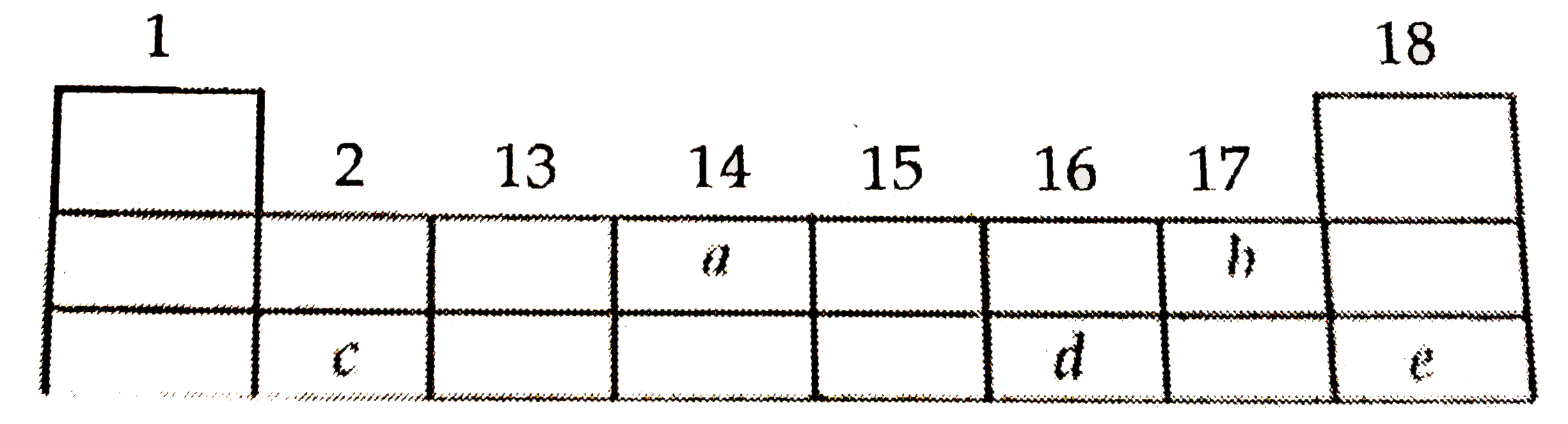
In the following diagram for the first three periods of the periodic table, five elements have been represented by the letters `a,b,c,d` and `e` (which are not their chemical symbols):

(i) Select the letter which represents a halogen.
(ii) Select the letter which represents a noble gas.
(iii) What type of bond is formed between `a` and `b`?
(iv) What type of bond is formed between `c` and `b`?
(v) Which element will form a divalent anion?

Text Solution

Verified by Experts

(i) The halogens are placed in group 17. Now, in the above given table the element present in group 17 is b. Thus, the letter b represents a halogen.
(ii) The noble gases are placed in group 18 of the periodic table. In the above given table, the element placed in group 18 is e. Thus, the letter e represents a noble gas.
(iii) We have now to find the type of bond formed betwen the elements a and b. Now, if we look at the above given table, we find that element a is placed non-metal reacts with another non-metal, the covalent bonds are formed. So, the bond between a and b is covalent bond.
(iv) And now we have to find out the type of bond between the elements c and b. The element c is in group 2 so it is a metal. The element b is in group 17 so it is a non metal. We know that when a metal reacts with a non -metal, then an ionic bond is formed. Thus, the bond formed between the elements c and b will be ionic bond.
(v) We will now find out that element which forms a divalent anion. A divalent means a negative ion having 2 units of negative charge. A divalent anion is formed by a non-metal atom having 6 valence electrons (so that it can accept 2 more electrons to complete the octet and form a divalent anion). Thus a divalent anion will be formed by a non metal element of group 16 because it will have 6 valence electrons in its atom. Now, in the above given table, the elemented has been placed in group 16 of the periodic table, so element will form a divalent anion.
Promotional Banner

Topper's Solved these Questions

  • PERIODIC CLASSIFICATION OF ELEMENTS

    LAKHMIR SINGH & MANJIT KAUR|Exercise SHORT ANSWER TYPE|8 Videos
  • PERIODIC CLASSIFICATION OF ELEMENTS

    LAKHMIR SINGH & MANJIT KAUR|Exercise LONG ANSWER TYPE|3 Videos
  • PERIODIC CLASSIFICATION OF ELEMENTS

    LAKHMIR SINGH & MANJIT KAUR|Exercise VERY SHORT ANSWER TYPE|6 Videos
  • METALS AND NON-METALS

    LAKHMIR SINGH & MANJIT KAUR|Exercise Short Answer Type Qustions|1 Videos
  • TEST PAPER 1

    LAKHMIR SINGH & MANJIT KAUR|Exercise Section B|4 Videos

Similar Questions

Explore conceptually related problems

The following diagram shows a part of the periodic table containing first there periods in which five elements have been represented by the letters a,b,c,d and e (which are not their chemical symbols): (i) Select the letter which represents an alkali metal. (ii) Select the letter which represents a noble gas. (iii) Select the letter which represents a halogen. (iv) What type of bond is formed between a and e ? (v) What type of bond is formed between d and e ?

The following truth table represents which type of gate?

A to F are the structural formulae of some organic compound (i) give the letter which represent the family. (ii) Give the letters which donot represent hydrocarbons. (iii) How can 'C' be converted into 'A'?

If d represents the bond length, then select the correct relation.

The following diagram shows a part of the periodic table in which the elements are arranged according to their atomic numbers. ( The letters given here are not the chemical symbols of the elements): (i) Which elements has a bigger atom , a or f ? (ii) Which element has a higer valency, K or o ? (iii) Which element is more metallic, i or K ? (iv) Which element is more non - metallic , d or g ? (v) Select a letter which represents a non-metal of valency 2. (vi) Select a letter which represents a noble gas.

Which one of the following belongs to representative group of elements in the periodic table?

An element A has an atomic number of 6. Another element B has 17 electrons in its one neutral atom. (a) In which groups of the periodic table would you expect to find these elements? (b) What type of bond is formed between A and B ? (c) Suggest a formula of the compound formed between A and B .

LAKHMIR SINGH & MANJIT KAUR-PERIODIC CLASSIFICATION OF ELEMENTS-Exercise
  1. Raghav is a student of class X who was trying to convert the groundnut...

    Text Solution

    |

  2. Reshma is the student of class X in a city school. One day she was sit...

    Text Solution

    |

  3. Given alongside is a part of the periodic table: As we move horizont...

    Text Solution

    |

  4. How would the tendency to gain electrons change on moving from left to...

    Text Solution

    |

  5. How would the tendency to lose electrons change as we go from left to ...

    Text Solution

    |

  6. What property do all elements in the same column of the periodic table...

    Text Solution

    |

  7. What property do all the elements in the same group of the periodic ta...

    Text Solution

    |

  8. (a) What is the number of valence electrons in the atoms of first elem...

    Text Solution

    |

  9. State whether the following statement is true of fals: On going down...

    Text Solution

    |

  10. How does the valency of elements vary is going down a group of the per...

    Text Solution

    |

  11. Name the element which is in: (a) first group and third period: (b) ...

    Text Solution

    |

  12. How do electronic configurations of elements change in second period o...

    Text Solution

    |

  13. Arrangement the following elements in increasing order of their atomic...

    Text Solution

    |

  14. Arrange the following elements in the increasing order of their metall...

    Text Solution

    |

  15. Rewrite the folowing statements after correction if necessary: (i) ...

    Text Solution

    |

  16. Fill in the blanks in the following statements: (a) The horizontal r...

    Text Solution

    |

  17. Nitrogen (atomic number 7) and phosphorus (atomic number 15) belong to...

    Text Solution

    |

  18. (a) How does the size of atoms (atomic size) generally vary in ging fr...

    Text Solution

    |

  19. In the following diagram for the first three periods of the periodic t...

    Text Solution

    |

  20. The elements X,Y and Z belong to groups 2,14 and 16 respectively of th...

    Text Solution

    |
