

Home
Class 9
PHYSICS
The speed- time graph of a car is given ...

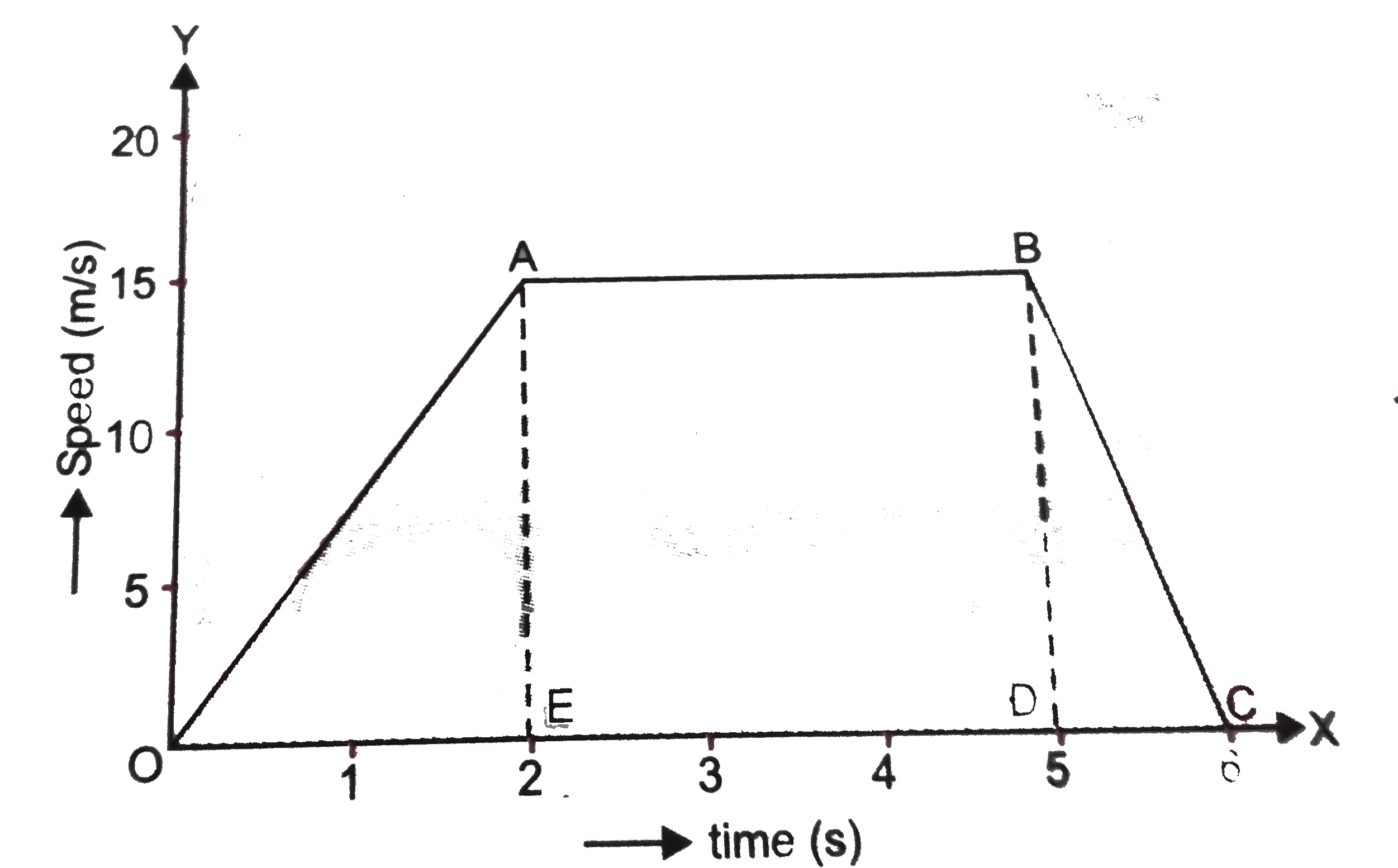
The speed- time graph of a car is given in (figure) The car weights `1000kg`
(a) What is the distance travelled by the car in first two seconds?
(b) What is the braking force applied at the end of `5 seconds` to bring the car to a stop within one second?

Text Solution

Verified by Experts

(i) We will first calculate the distance travelled in the first two seconds. From the given graph we find that :
Distance travelled in first two seconds = Area under line AB and the time axis
=Area of triangle AB2
`=1/2xx`base`xx`Height
`=1/2xx2xx15`
=15 m
Thus, the distance travelled by the car in the first two seconds is 15 metres.
(ii) The braking force is to be calculated by using the formula
Force=mass`xx`acceleration
or F=m`xx`a
Here, the mass of the car is given as 1000 kg but the acceleration in the last one second (from point C to point D) is to be obtained from the graph shown above. Now, we know that the acceleration is given by the slope of speed-time graph. So,
Acceleration in last one second = Slope of line CD
=`("Perpendicular")/("Base")`
`=15/1`
`=15m//s^(2)`
If we look at the above given graph, we will find that the speed of the car is decreasing from point C to point D. That is, the acceleration from C to D is negative and hence it should be written with a minus sign. Thus,
Acceleration, a =-15 `m//s^(2)`
Now,putting m= 1000 kg and a =15 m/`s^(2)` in formula (1), we get:
Force,F=1000 `xx` (-15)
=-15000N
Thus, the force applied by the brakes to stop the car is 15000 newtons. The negative sign of force here shows that the force is being applied in a direction opposite to the motion of the car. That is, it is a retarding force.
Promotional Banner

Topper's Solved these Questions

  • FORCE AND LAWS OF MOTION

    LAKHMIR SINGH & MANJIT KAUR|Exercise Exercise|145 Videos
  • GRAVITATION

    LAKHMIR SINGH & MANJIT KAUR|Exercise NCERT book|1 Videos

Similar Questions

Explore conceptually related problems

A car weigh 1500 kg . Its speed time graph is shown in (figure). Calculate the force required at the end of 5 seconds to bring the car to a stop within one second.

The velocity- time graph of car moving on a straight track is given below. The car weight 1000kg. The distance travelled by the car during the whole motion is:

The distance travelled by a motor car in t second after the brakes are applied is a feet, where s = 22t -12t^(2) .

The distance travelled by a motor car in t seconds after the brakes are applied is s feet where s=22t-12t^(2) . The distance travelled by the car before it stops, is

A car travels at a speed of 50 m/s. for 5 hours. What is the distance (in km) travelled by the car?

The speed of a car as a function of time is shown in figure. Find the distance travelled by the car in 8 seconds and its acceleration.

The speed of a car increases uniformly from zero to 10ms^-1 in 2s and then remains constant (figure) a. Find the distance travelled by the car in the first two seconds. b. Find the distance travelled by the car in the next two seconds. c. Find the total distance travelled in 4s .

The velocity-time graph of a car moving along a straight road is shown in figure. The average velocity of the car in first 25 seconds is

A car moves at the speed of 72 km/hr. What is the speed of the car in meters per second ?

LAKHMIR SINGH & MANJIT KAUR-FORCE AND LAWS OF MOTION-Exercise
  1. The speed- time graph of a car is given in (figure) The car weights 10...

    Text Solution

    |

  2. What name is given to the product of mass and velocity of a body ?

    Text Solution

    |

  3. Name the physical quantity which is considered to be a measure of the ...

    Text Solution

    |

  4. The SI unit of momentum is

    Text Solution

    |

  5. State whether momentum is scalar or vector.

    Text Solution

    |

  6. What is the total momentum of the bullet and the gun before firing?

    Text Solution

    |

  7. Name the physical quantity whose unit is kg ms^(-1).

    Text Solution

    |

  8. What will be the momentum of a body of mass 'm which is moving with a ...

    Text Solution

    |

  9. What is the usual name of the forces which cannot produce motion in a ...

    Text Solution

    |

  10. Name the unbalanced force which slows down a moving bicycle when we st...

    Text Solution

    |

  11. State whether the following statement is true or false Unbalanced fo...

    Text Solution

    |

  12. When a ball is dropped from a height, its speed increases gradually. N...

    Text Solution

    |

  13. Name the property of bodies (or objects) to resist a change in their s...

    Text Solution

    |

  14. What is the other name for Newton's first law of motion?

    Text Solution

    |

  15. The mass of object A is 6 kg whereas that of another object B is 34 kg...

    Text Solution

    |

  16. Name the scientist who gave the laws of motion.

    Text Solution

    |

  17. State whether force is a scalar or a vector quantity.

    Text Solution

    |

  18. With which physical quantity should the speed of a running bull be mul...

    Text Solution

    |

  19. Fill in the following blanks with suitable words: (a) …... is a meas...

    Text Solution

    |

  20. It is easier to stop a tennis ball than a cricket ball moving with the...

    Text Solution

    |

  21. Explain the meaning of the following equation: p=mxxv where symbol...

    Text Solution

    |