Home
Class 9
PHYSICS
Illustrate the law of conservation of en...

Illustrate the law of conservation of energy by discussing the energy changes which occur when we draw a pendulum bob to one side and allow it to oscillate. Why does the bob eventually come to rest ?

Text Solution

Verified by Experts
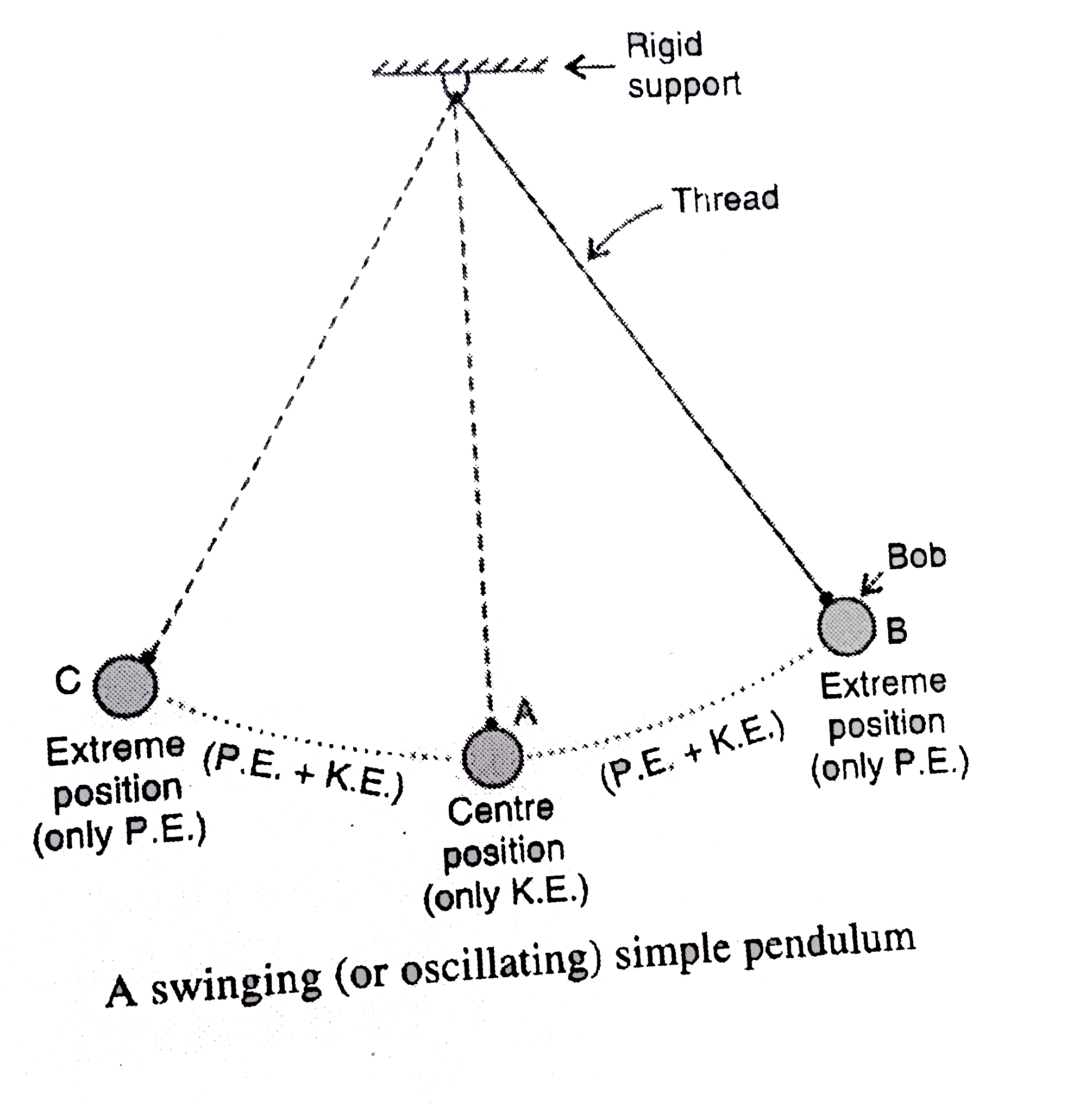
Initially, the simple pendulum is at rest with its bob in the centre position (or mean position) A. When the pendulum bob is pulled to one side to position B (to give it potential energy because of higher position of B with respect to position A), and then released, the bob starts swinging (moving back and forth) between position B and C (see Figure).

(i) When the pendulum bob is at position B, it has only potential energy (but no kinetic energy).
(ii) As the bob starts moving down from position B to position A, its potential energy goes on decreasing but its kinetic energy goes on increasing.
(iii) When the bob reaches the centre position A, it has only kinetic energy (but no potential energy).
(iv) As the bob goes from position A towards position C its kinetic energy goes on decreasing but its potential energy goes on increasing.
(v) On reaching the extreme position C, the bob stops for a very small instant of time. So at position C, the bob has only potential energy (but no kinetic energy).
From the above discussion we conclude that at the extreme positions B and C of a swinging pendulum, all the energy of pendulum bob is potential, and at the centre position A, all the energy of the pendulum bob is kinetic. At all other intermediate positions, the energy of pendulum bob is partly potential and partly kinetic. But the total energy of the swinging pendulum at any instant of time ramains the same (or conserved).
The swinging pendulum bob eventually comes to rest because it loses energy due to the friction at the point of support of the pendulum and friction of air (or air resistance) acting on the swinging pendulum bob. This energy is converted into heat energy and sound energy which go into the environment.
Promotional Banner

Topper's Solved these Questions

  • WORK AND ENERGY

    LAKHMIR SINGH & MANJIT KAUR|Exercise Long Answer Type Questions|2 Videos
  • WORK AND ENERGY

    LAKHMIR SINGH & MANJIT KAUR|Exercise Multiple Choice Questions|1 Videos
  • WORK AND ENERGY

    LAKHMIR SINGH & MANJIT KAUR|Exercise Multiple Choice Questions|1 Videos
  • SOUND

    LAKHMIR SINGH & MANJIT KAUR|Exercise Value Based Questions|20 Videos

Similar Questions

Explore conceptually related problems

One of the fundamental laws of physics is that matter is most stable with the lowest possible energy. Thus, the electron in a hydrogen atom usually moves in the n=1 orbit, the orbit in which it has the lowest energy. When the electon is in this lowest energy orbit, the atom is said to be in its ground electronic state. If the atom receives energy from an outside source, it is possible for the electron to move ot an orbit with a higher n value, in which case the atoms is in an excited state with a higher energy. The law of conservation of energy says that we cannot create or destroy energy. Thus, if a certain amount of external energy is required to excite an electron from one energy level to another, then that same amount of energy will be liberated when the electron returns to its initial state. Lyman series is observed when the electron returns to the lowest orbit while Balmer series is formed when the electron returns returns to second orbit. Similarly, Paschen, Brackett and Pfund series are formed when electrons returns to the third, fourth and fifth orbits from higher energy orbits respectively. When electrons return form n_(2) " to " n_(1) state, the number of lines in the spectrum will equal to ((n_(2)-n_(1))(n_(2)-n_(1)+1))/(2) If the electon comes back from energy level having energy E_(2) to energy level having energy E_(1) , then the difference may be expressed in terms of energy of photon as : E_(2)-E_(1)=DeltaE, deltaE implies (hc)/(lambda) Since, h and c are constant, deltaE corresponds to definite energy. Thus, each transition from one energy level to another will produce a radiatiob of definite wavelength. This is actually Wave number of a spectral line is given by the formula barv=R((1)/(n_(1)^(2))-(1)/(n_(2)^(2))) . where R is a Rydberg's constant (R=1.1xx10^(7) m^(-1)) The emission spectra is observed by the consequence of transition of electrons from higher energy state to ground state of He^(+) ion. Six different photons are observed during the emission spectra, then what will be the minimum wavelength during the transition?

One of the fundamental laws of physics is that matter is most stable with the lowest possible energy. Thus, the electron in a hydrogen atom usually moves in the n=1 orbit, the orbit in which it has the lowest energy. When the electon is in this lowest energy orbit, the atom is said to be in its ground electronic state. If the atom receives energy from an outside source, it is possible for the electron to move ot an orbit with a higher n value, in which case the atoms is in an excited state with a higher energy. The law of conservation of energy says that we cannot create or destroy energy. Thus, if a certain amount of external energy is required to excite an electron from one energy level to another, then that same amount of energy will be liberated when the electron returns to its initial state. Lyman series is observed when the electron returns to the lowest orbit while Balmer series is formed when the electron returns returns to second orbit. Similarly, Paschen, Brackett and Pfund series are formed when electrons returns to the third, fourth and fifth orbits from higher energy orbits respectively. When electrons return form n_(2) " to " n_(1) state, the number of lines in the spectrum will equal to ((n_(2)-n_(1))(n_(2)-n_(1)+1))/(2) If the electon comes back from energy level having energy E_(2) to energy level having energy E_(1) , then the difference may be expressed in terms of energy of photon as : E_(2)-E_(1)=DeltaE, deltaE implies (hc)/(lambda) Since, h and c are constant, deltaE corresponds to definite energy. Thus, each transition from one energy level to another will produce a radiatiob of definite wavelength. This is actually Wave number of a spectral line is given by the formula barv=R((1)/(n_(1)^(2))-(1)/(n_(2)^(2))) . where R is a Rydberg's constant (R=1.1xx10^(7) m^(-1)) If the wavelength of series limit of Lyman series for He^(+) ion is x Å, then what will be the wavelength of series limit of Balmer series for Li^(2+) ion?

One of the fundamental laws of physics is that matter is most stable with the lowest possible energy. Thus, the electron in a hydrogen atom usually moves in the n=1 orbit, the orbit in which it has the lowest energy. When the electon is in this lowest energy orbit, the atom is said to be in its ground electronic state. If the atom receives energy from an outside source, it is possible for the electron to move ot an orbit with a higher n value, in which case the atoms is in an excited state with a higher energy. The law of conservation of energy says that we cannot create or destroy energy. Thus, if a certain amount of external energy is required to excite an electron from one energy level to another, then that same amount of energy will be liberated when the electron returns to its initial state. Lyman series is observed when the electron returns to the lowest orbit while Balmer series is formed when the electron returns returns to second orbit. Similarly, Paschen, Brackett and Pfund series are formed when electrons returns to the third, fourth and fifth orbits from higher energy orbits respectively. When electrons return form n_(2) " to " n_(1) state, the number of lines in the spectrum will equal to ((n_(2)-n_(1))(n_(2)-n_(1)+1))/(2) If the electon comes back from energy level having energy E_(2) to energy level having energy E_(1) , then the difference may be expressed in terms of energy of photon as : E_(2)-E_(1)=DeltaE, deltaE implies (hc)/(lambda) Since, h and c are constant, deltaE corresponds to definite energy. Thus, each transition from one energy level to another will produce a radiatiob of definite wavelength. This is actually Wave number of a spectral line is given by the formula barv=R((1)/(n_(1)^(2))-(1)/(n_(2)^(2))) . where R is a Rydberg's constant (R=1.1xx10^(7) m^(-1)) An electron in H-atom in M-shell on de-excitation to ground state gives maximum ........... spectrum lines.

One of the fundamental laws of physics is that matter is most stable with the lowest possible energy. Thus, the electron in a hydrogen atom usually moves in the n=1 orbit, the orbit in which it has the lowest energy. When the electon is in this lowest energy orbit, the atom is said to be in its ground electronic state. If the atom receives energy from an outside source, it is possible for the electron to move ot an orbit with a higher n value, in which case the atoms is in an excited state with a higher energy. The law of conservation of energy says that we cannot create or destroy energy. Thus, if a certain amount of external energy is required to excite an electron from one energy level to another, then that same amount of energy will be liberated when the electron returns to its initial state. Lyman series is observed when the electron returns to the lowest orbit while Balmer series is formed when the electron returns returns to second orbit. Similarly, Paschen, Brackett and Pfund series are formed when electrons returns to the third, fourth and fifth orbits from higher energy orbits respectively. When electrons return form n_(2) " to " n_(1) state, the number of lines in the spectrum will equal to ((n_(2)-n_(1))(n_(2)-n_(1)+1))/(2) If the electon comes back from energy level having energy E_(2) to energy level having energy E_(1) , then the difference may be expressed in terms of energy of photon as : E_(2)-E_(1)=DeltaE, deltaE implies (hc)/(lambda) Since, h and c are constant, deltaE corresponds to definite energy. Thus, each transition from one energy level to another will produce a radiatiob of definite wavelength. This is actually Wave number of a spectral line is given by the formula barv=R((1)/(n_(1)^(2))-(1)/(n_(2)^(2))) . where R is a Rydberg's constant (R=1.1xx10^(7) m^(-1)) What transition in the hydrogen spectrum would have the same wavelength as Balmer transitio, n=4 " to "n=2 in the He^(+) spectrum?

Hess's law of heat of summatiion is based on law of conservation of energy. It has found significance in deriving heats of many reactions which either do not take place or if take place, than other side reactions also accompany it. For example heat of reaction for C+(1)/(2)O_(2) rarr CO can not be studied directly as it occurs with simultaneous reaction of oxidation of CO to CO_(2) . Bond energy is referred as heat enthalpy when a bond is broken to produce isolated gaseous atoms. In case of breaking up of bonds between unlike atoms e.g., C-H bond in CH_(4) , bond energy is referred as avarage bond energy as four C-H bonds are broken up. The heat of fusion for water is +1.44kcal . The heat requried to change 27g ice at 0^(@)C to water is :

Hess's law of heat of summatiion is based on law of conservation of energy. It has found significance in deriving heats of many reactions which either do not take place or if take place, than other side reactions also accompany it. For example heat of reaction for C+(1)/(2)O_(2) rarr CO can not be studied directly as it occurs with simultaneous reaction of oxidation of CO to CO_(2) . Bond energy is referred as heat enthalpy when a bond is broken to produce isolated gaseous atoms. In case of breaking up of bonds between unlike atoms e.g., C-H bond in CH_(4) , bond energy is referred as avarage bond energy as four C-H bonds are broken up. Heat of dissociation of CH_(4) and C_(2)H_(6) are 360 and 620kcal mol^(-1) . The C-C bond energy would be :

Hess's law of heat of summatiion is based on law of conservation of energy. It has found significance in deriving heats of many reactions which either do not take place or if take place, than other side reactions also accompany it. For example heat of reaction for C+(1)/(2)O_(2) rarr CO can not be studied directly as it occurs with simultaneous reaction of oxidation of CO to CO_(2) . Bond energy is referred as heat enthalpy when a bond is broken to produce isolated gaseous atoms. In case of breaking up of bonds between unlike atoms e.g., C-H bond in CH_(4) , bond energy is referred as avarage bond energy as four C-H bonds are broken up. Which of the following statements are correct ? (1) The dissociation of a ond is always endothermic (2) The formation of a bond is always exothermic. (3) Heat of formation of an atom =1//2xx bond energy like atoms covalent bond. (4) The heat enthalpy change in a chemical reaction is equal but opposite to the heat enthalpy if reaction is reversed. (5) Hess's law can be verified experimentally.

LAKHMIR SINGH & MANJIT KAUR-WORK AND ENERGY-Exercise
  1. An object thrown at a certain angle to the ground moves in a curved pa...

    Text Solution

    |

  2. A battery lights a bulb. Describe the energy changes involved in the p...

    Text Solution

    |

  3. Certain force acting on a 20 kg mass changes its velocity from 5m//s t...

    Text Solution

    |

  4. A mass of 10 kg is at a point A on a table. It is moved to a point B. ...

    Text Solution

    |

  5. The potential energy of a freely falling object decreases progressivel...

    Text Solution

    |

  6. What are the verious energy transformations that occur when you are ri...

    Text Solution

    |

  7. Does the transfer of energy take palce when you push a huge rock with ...

    Text Solution

    |

  8. A certain household has consumed 250 units of energy during a month. H...

    Text Solution

    |

  9. An object of mass 40 kg is raised to a height of 5 m above the ground....

    Text Solution

    |

  10. What is the work done by the force of gravity on a satellite moving ro...

    Text Solution

    |

  11. Can there be displacement of an object in the absence of any force act...

    Text Solution

    |

  12. A person holds a bundle of hay over his head for 30 minutes and gets t...

    Text Solution

    |

  13. An electric heater is rated 1500W. How much energy does it use in 10 ...

    Text Solution

    |

  14. Illustrate the law of conservation of energy by discussing the energy ...

    Text Solution

    |

  15. An object of mass m is moving with a constant velocity upsilon How muc...

    Text Solution

    |

  16. calculate the work required to be done to stop a car of 1500 kg moving...

    Text Solution

    |

  17. In each of the following a force F is acting on an object of mass m. ...

    Text Solution

    |

  18. Soni says that the acceleration in an object could be zero even when s...

    Text Solution

    |

  19. find the energy in kWh consumed in 10 hours by four devices of power 5...

    Text Solution

    |

  20. A freely falling object eventually stops on reaching the ground. What ...

    Text Solution

    |

