Home
Class 12
MATHS
If the sum of lengths of hypotenuse and ...

If the sum of lengths of hypotenuse and a side of a right angled triangle is given, show that area of triangle is maximum, when the angle between them is `pi/3dot`

Text Solution

Verified by Experts
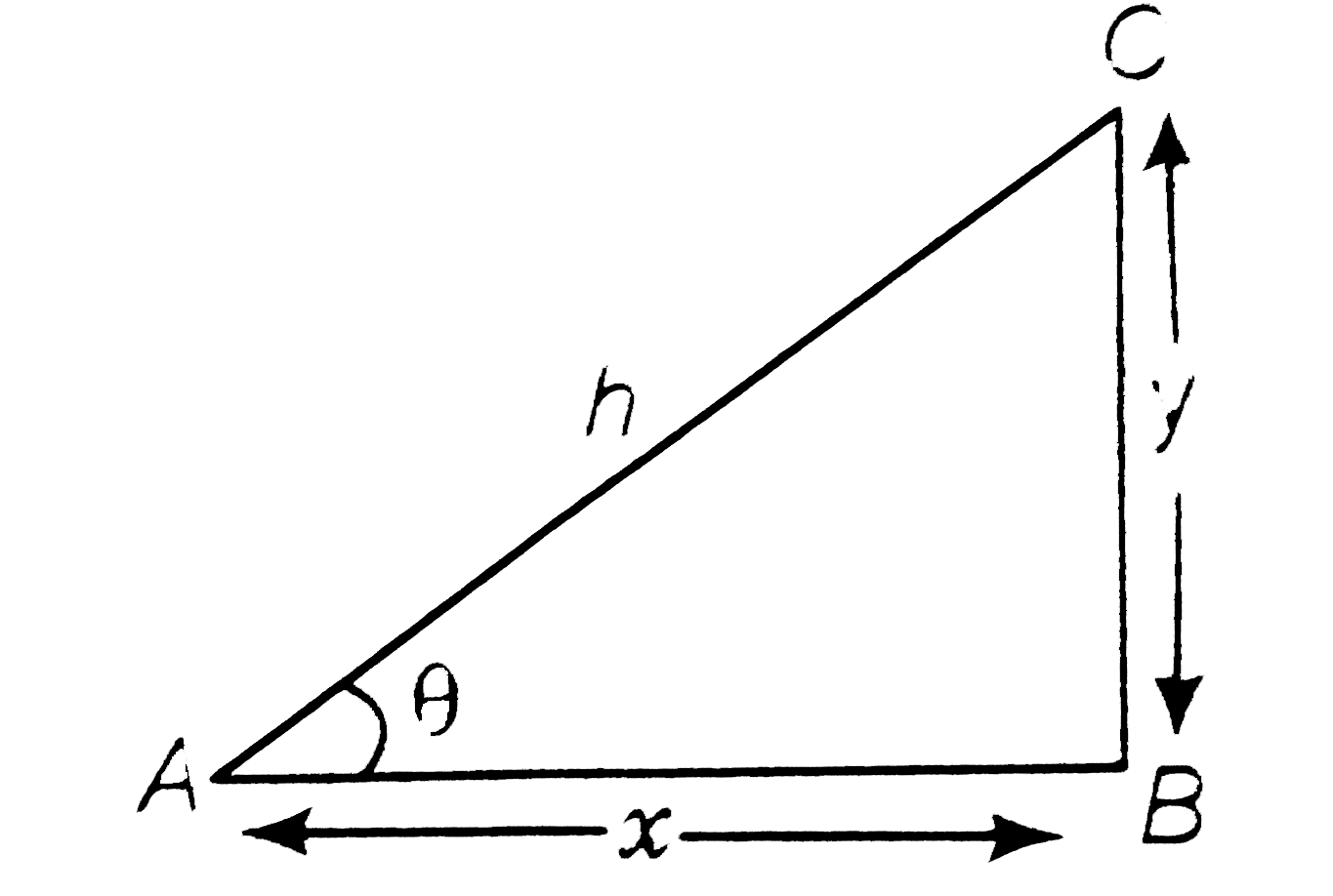
Let ABC be a triangle with AC =h, AB=x and BC=y.
Also, `angleCAB=theta`
Let h+x=k

`costheta=x/h`
`rArr x=hcostheta` [Using eq.]
`rArr h+hcostheta=k`
`rArr h(1+costheta)=k` ...............(i)
Also, area of `DeltaABC= 1/2(AB.BC)`
`A=1/2.x.y`
`=1/2hcostheta.hsintheta` `[therefore sintheta=y/n]`
`=1/2h^(2)sintheta.costheta`
`=(2h^(2))/(4)sintheta.costheta`
Since, `h=k/(1+costheta)`..............(ii)
`therefore A=1/4(k/(1+costheta))`
`A=1/4(k/(1+costheta))^(2).sin2theta`
`rArr A=k^(2)/4.(sin2theta)/(1+costheta)^(2)`.............(iv)
`therefore (dA)/((d)theta)=k^(2)/4[[(1+costheta)^(2).cos2theta.2-sin2theta.2(1+costheta).(0-sintheta))/((1+costheta)^(4))]`
`k^(2)/4 {((2)(1+costheta)[(1+costheta).cos2theta+sin2theta(sintheta)))/((1+costheta)^(4))}`
`(k^(2)/4).(2)/(1+costheta)^(3)[(1+costheta).cos2theta+2sin^(2)theta.costheta]`
`=(k^(2))/(2(1+costheta)) [(1+costheta)(1-2sin^(2)theta) + 2sin^(2)theta.costheta]`
`=k^(2)/(2(1+costheta)^(2))[1+costheta-2sin^(2)theta-2sin^(2)theta.costheta+2sin^(2)theta.costheta]`
`k^(2)/(2(1+costheta)^(3))[(1+ costheta)-2sin^(2)theta]`
`=k^(2)/(2(1+costheta)^(3))[(1+costheta)=2sin^(2)theta]`
`=k^(2)/(2(1+costheta)^(3)) (2cos^(2)theta+costheta-1)`............(v)
For `(dA)/((d)theta)=0`,
`k^(2)/(2(1+costheta)^(3))(2cos^(2)theta+costheta-1)=0`
`rArr 2cos^(2)theta+2costheta-costheta-1=0`
`rArr 2costheta(costheta+1)-1(costheta+1)=0`
`rArr (2costheta-1)(costheta+1)=0`
`rArr costheta =1/2 or costheta=-1`
`rArr theta = pi/3` [positive]
or `theta=2npi+-pi` [not possible]
`therefore theta=pi/3`
Again, differentiating w.r.t `theta` in Eq. (v), we get
`d/(d(theta))(dA)/(d(theta)) = d/(d(theta))[k^(2)/(2(1+costheta)^(3))(2cos^(2)theta+costheta-1)]`
`therefore (d^(2)A)/(d(theta)^(2))=d/(d(theta))[((k^(2)(2costheta-1))(1+costheta))/(2(1+costheta))^(3)]=d/(d(theta))[k^(2)/2.(2costheta-1)/(1+costheta)^(2)]`
`=k^(2)/2[((1+costheta)(1+costheta)(-2sintheta)+2sintheta(2costheta-1)]/(1+costheta)^(2)]`
`=k^(2)/2[(-2sintheta-2sintheta.costheta+4sintheta.costheta-2sintheta)/(1+costheta)^(4)]`
`=k^(2)/2[(-4sintheta-sin2theta+2sin2theta)/(1+costheta)^(3)]=k^(2)/2[(sin2theta-4sintheta)/(1+costheta)^(3)]`
`(d^(2)A)/(d(theta)^(2))_(at theta=pi/3) = k^(2)/2[(sin2pi/3-4sinpi/3)/(1+cospi/3)^(3)]=k^(2)/2[(sqrt(3)/2-(4sqrt(3))/(2))/(1+1/2)^(3)]`
`=k^(2)/2[(-3sqrt(3).8)/(2.27)]=-k^(2)(2sqrt(3))/9`
Which is less than zero.
Hence, area of the right angled triangle is maximum, when the angle between them is `pi/3`.
Promotional Banner

Topper's Solved these Questions

  • APPLICATION OF INTEGRALS

    NCERT EXEMPLAR|Exercise Application Of Integrals|68 Videos

Similar Questions

Explore conceptually related problems

If the sum of the lengths of the hypotenues and a side of a right angled triangle is given, show that the area of the triangle is maximum when the angle between them is pi/3 .

If the sum of the lengths of the hypotenuse and another side of a right-angled triangle is given,show that the area of the triangle is maximum when the angle between these sides is (pi)/(3).

If the sum of a side and hypotenuse of a right angled triangle is given then show that area of triangle will be maximum when the angle between side and the hypotenuse is pi//3 .

If the length of the hypotenuse of a right angled triangle is 10 cm, then what is the maximum area of such a right angled triangle?

The maximum area of a right angled triangle with hypotenuse h is

In the right triangle BAC, angle A=pi/2 and a+b=8 . The area of the triangle is maximum when angle C , is

Prove that the perimeter of a right-angled triangle of given hypotenuse is maximum when the triangle is isosceles

NCERT EXEMPLAR-APPLICATION OF DERIVATIVES-Application Of Derivatives
  1. At what points, the slope of the curve y=-x^3+3x^2+9x-27 at point (...

    Text Solution

    |

  2. Prove that f(x)=sinx+sqrt(3)cosx has maximum value at x=pi/6 .

    Text Solution

    |

  3. If the sum of lengths of hypotenuse and a side of a right angled tr...

    Text Solution

    |

  4. Find the points of local maxima, local minima and the points of inf...

    Text Solution

    |

  5. A telephone company in a town has 500 subscribers on its list and c...

    Text Solution

    |

  6. If the straight line xcosalpha+ysinalpha=p touches the curve (x^2)/(a^...

    Text Solution

    |

  7. An open box with a square base is to be made out of a given quantit...

    Text Solution

    |

  8. Find the dimensions of the rectangle of perimeter 36cm which will s...

    Text Solution

    |

  9. The sum of the surface areas of a sphere and a cube is given. Show tha...

    Text Solution

    |

  10. A B is a diameter of a circle and C is any point on the circle. ...

    Text Solution

    |

  11. A metal box with a square base and vertical sides is to contain 102...

    Text Solution

    |

  12. The sum of the surface areas of the rectangular parallelopiped with...

    Text Solution

    |

  13. The sides of an equilateral triangle are increasing at the rate of ...

    Text Solution

    |

  14. A ladder 5 m long is leaning against a wall. The bottom of the ladder ...

    Text Solution

    |

  15. The curve y= x^(1/5) has at (0, 0)

    Text Solution

    |

  16. Find the equation(s) of normal(s) to the curve 3x^2-y^2=8 which is (ar...

    Text Solution

    |

  17. If the curves ay+x^2=7 and x^3=y cut orthogonally at (1, 1) then a= ...

    Text Solution

    |

  18. If y=x^4-12 and if x changes from 2 to 1.99. what is the appoinmate ch...

    Text Solution

    |

  19. Find the equation of the tangent to the curve (1+x^2)y=2-x , where it ...

    Text Solution

    |

  20. The points at which the tangents to the curve y=x^(3)-12x+18 are paral...

    Text Solution

    |

