Home
Class 12
MATHS
A B is a diameter of a circle and C i...

`A B` is a diameter of a circle and `C` is any point on the circle. Show that the area of ` A B C` is maximum, when it is isosceles.

Text Solution

Verified by Experts
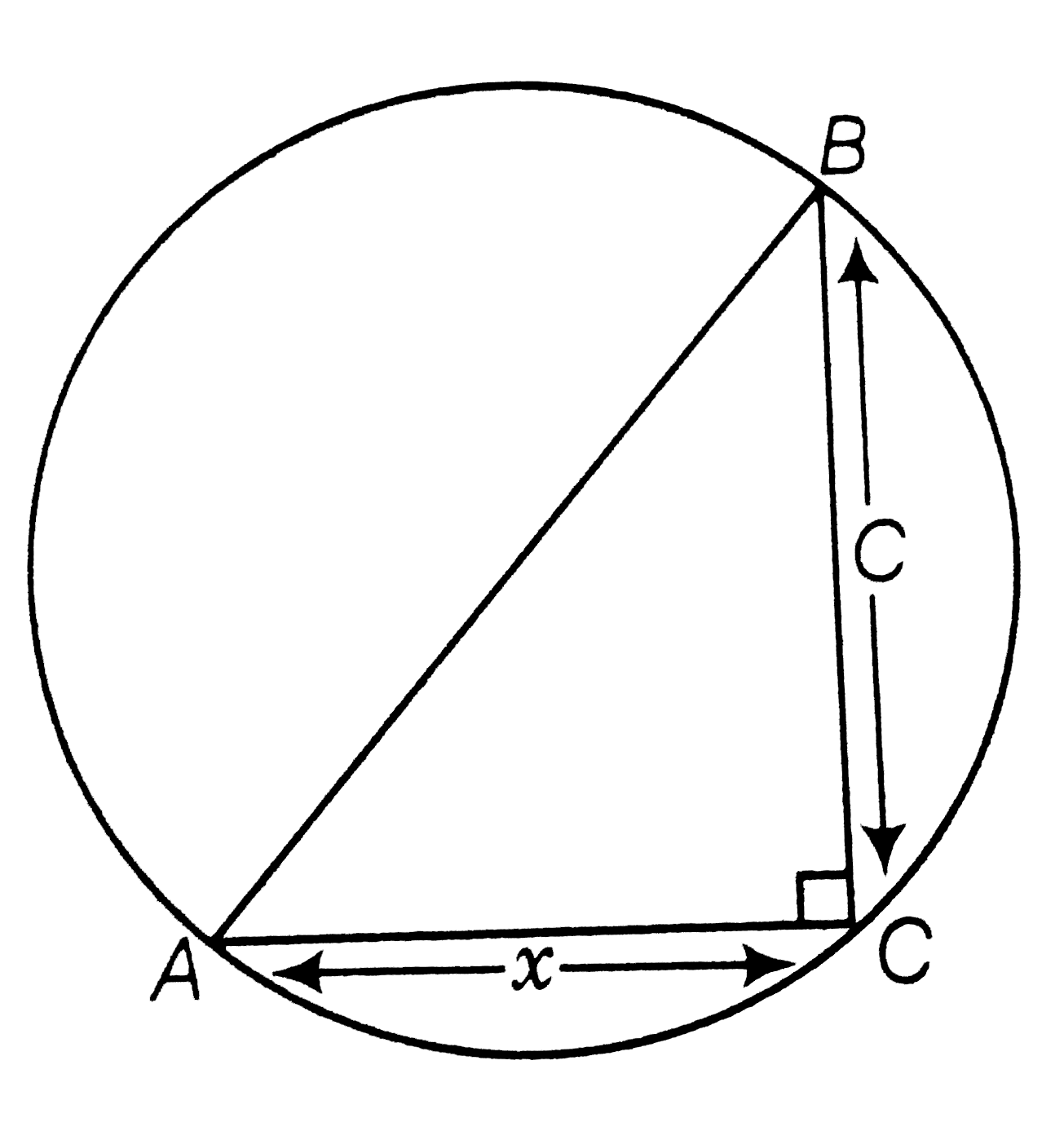
We have, AB=2r
and `angleACB=90^(@)` [since, angle in the semi-circle is always `90^(@)`]
Let AC=x and BC=y
`therefore (2r)^(2)=x^(2)+y^(2)`
`rArr y^(2)=4r^(2)-x^(2)`
`rArr y=sqrt(4r^(2)-x^(2))` ……………………(i)
Now, area of `DeltaABC, A=1/2 xx x xx y`
`=1/2 xx x xx (4r^(2)-x^(2))^(1//2)` [using Eq. (i)]
Now, differentiating both sides w.r.t. x, we get
`(dA)/(dB) = 1/2[x.1/2(4r^(2)-x^(2))^(-1/2). (0-2x)+(4r^(2)-x^(2))^(1//2).1]`
`=1/2[(-2x)^(2)/(2sqrt(4r^(2)-x^(2)))+(4r^(2)-x^(2))^(1//2)]`
`1/2[(-x^(2))/(sqrt(4r^(2)-x^(2)))+sqrt(4r^(2)-x^(2))]`
`=1/2[(-x^(2)+4r^(2)-x^(2))/(sqrt(4r^(2)-x^(2)))]=1/2[(-2x^(2)+4r^(2))/(sqrt(4r^(2)-x^(2)))]`
`rArr (dA)/(dx) = [(-x^(2)+2r^(2))/(sqrt(4r^(2)-x^(2)))]`
Now, `(dA)/(dx) =0`
`rArr -x^(2)+2r^(2)=0`
`rArr r^(2)+1/2x^(2)`
`rArr r=1/sqrt(2)x^(2)`
`therefore x=rsqrt(2)`x

Again, differentiating both sides, w.r.t. x, we get
`(d^(2)A)/(dx^(2)) =(sqrt(4r^(2)-x^(2)).(-2x)+(2r^(2)-x^(2)).1/2(4r^(2)-x^(2))^(1//2)(-2x))/(sqrt(4r^(2)-x^(2))^(2))`
`=(-4x(sqrt(4r^(2)-x^(2)))+(2r^(2)-x^(2))(-2x))/(2.(4r^(2)-x^(2))^(3//2))`
`=(-4x(4r^(2)-x^(2))+(2r^(2)-x^(2)).(-2x))/(2.(4r^(2)-x^(2))^(3//2))`
`=(-16xr^(2)+4x^(3)+(2r^(2)-x^(2))(-2x))/(2.(4r^(2)-x^(2))^(3//2))`
`(d^(2)A)/(dx^(2))_(x=rsqrt(2))=(-16.rsqrt(2).r^(2)+4.(rsqrt(2))^(3)+[2r^(2)-(rsqrt(2))^(2)].(-2.rsqrt(2)))/(2.(4r^(2)-2r^(2))^(3//2))` `[therefore x=rsqrt(2)]`
`=(16.sqrt(2).r^(3)+8sqrt(2)r^(3))/(2(2r^(2))^(3//2))=(8sqrt(2)r^(2)[r-2])/(4r^(3))`
`=(-8sqrt(2)r^(3))/(4r^(3))=-2sqrt(2) lt0`
For `x=rsqrt(2)`, the area of triangle is maximum.
For `x=rsqrt(2)`, `y=sqrt(4r^(2)-(rsqrt(2))^(2))=sqrt(2r^(2))=rsqrt(2)`
Since, `x=rsqrt(2)=y`
Hence, the triangle is isosceles.
Promotional Banner

Topper's Solved these Questions

  • APPLICATION OF INTEGRALS

    NCERT EXEMPLAR|Exercise Application Of Integrals|68 Videos

Similar Questions

Explore conceptually related problems

AB is a diameter of a circle and C is any point on the circle.Show that the area of ABC is maximum,when it is isosceles.

AB is a diameter of a circle and C is any point on the circumference of the circle.Then (a) the area of Delta ABC is maximum when it is isosceles (b) the area of Delta ABC is minimum when it is isosceles (c) the perimeter of Delta ABC is minimum when it is isosceles (d) none of these

If AOB is a diameter of a circle and C is a point on the circle, then AC^(2)+BC^(2)=AB^(2) .

If A(3,-4),B(7,2) are the ends of a diameter of a circle and C is a point on the circle then the circumcentre of ABC is

If diameter of a circle is r cm, then the area of a circle is :

If diameter of a circle is 2r cm, then area of the circle is :

If A(3,-4),B(7,2) are the ends of a diameter of a circle and C(3,2) is a point on the circle then the orthocentre of the Delta ABC is

If diameter of a circle is ( r )/( 2) cm , Then the area of a circle is :

In figure, AOB is a diameter of the circle and C, D, E are any three points on the semi-circle. Find the value of angleACD+ angleBED .

NCERT EXEMPLAR-APPLICATION OF DERIVATIVES-Application Of Derivatives
  1. Find the dimensions of the rectangle of perimeter 36cm which will s...

    Text Solution

    |

  2. The sum of the surface areas of a sphere and a cube is given. Show tha...

    Text Solution

    |

  3. A B is a diameter of a circle and C is any point on the circle. ...

    Text Solution

    |

  4. A metal box with a square base and vertical sides is to contain 102...

    Text Solution

    |

  5. The sum of the surface areas of the rectangular parallelopiped with...

    Text Solution

    |

  6. The sides of an equilateral triangle are increasing at the rate of ...

    Text Solution

    |

  7. A ladder 5 m long is leaning against a wall. The bottom of the ladder ...

    Text Solution

    |

  8. The curve y= x^(1/5) has at (0, 0)

    Text Solution

    |

  9. Find the equation(s) of normal(s) to the curve 3x^2-y^2=8 which is (ar...

    Text Solution

    |

  10. If the curves ay+x^2=7 and x^3=y cut orthogonally at (1, 1) then a= ...

    Text Solution

    |

  11. If y=x^4-12 and if x changes from 2 to 1.99. what is the appoinmate ch...

    Text Solution

    |

  12. Find the equation of the tangent to the curve (1+x^2)y=2-x , where it ...

    Text Solution

    |

  13. The points at which the tangents to the curve y=x^(3)-12x+18 are paral...

    Text Solution

    |

  14. The tangent to the curve y=e^(2x) at the point (0,1) meets X-axis at

    Text Solution

    |

  15. The slope of the tangent to the curve x=t^2+3t-8,y=2t^2-2t-5at the po...

    Text Solution

    |

  16. The two curves x^3-3xy^2+2=0 and 3x^2y-y^3-2=0

    Text Solution

    |

  17. 24. Find the intervals in which the following function is (a) increasi...

    Text Solution

    |

  18. The function f:R rarr R be defined by f(x)=2x+cosx then f

    Text Solution

    |

  19. If y=x(x-3)^(2) decreases for the values of x given by

    Text Solution

    |

  20. The function f(x) =4sin^(3)x-6sin^(2)x +12 sinx + 100 is strictly

    Text Solution

    |

