Home
Class 12
CHEMISTRY
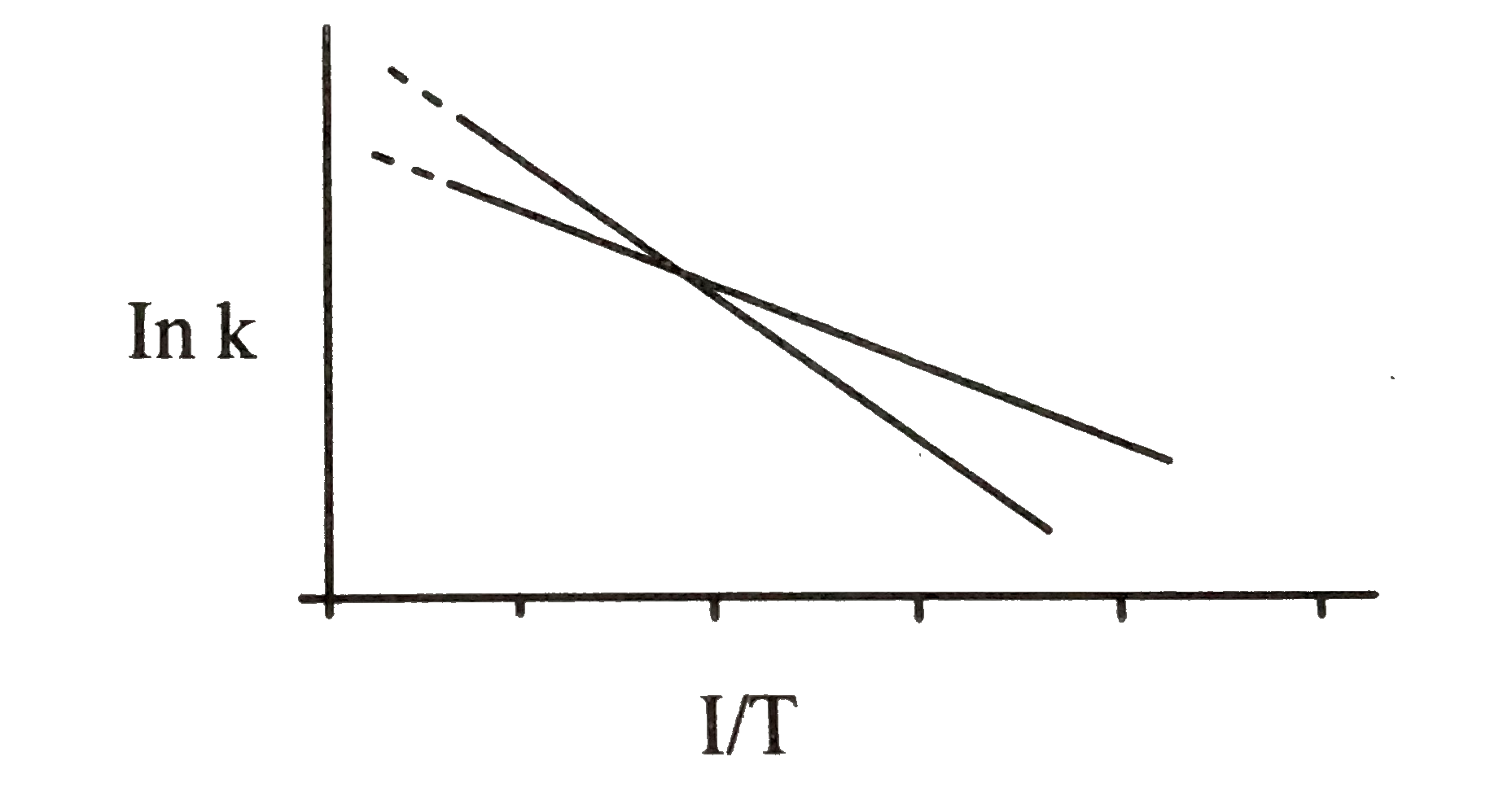
The Arrhenius plots of two reactions, I ...

The Arrhenius plots of two reactions, I and II are shown graphically-

The graph suggest that-

A

`E_(I) gt E_(II) and A_(I)gtA_(II)`

B

`E_(II) gt E_(I) and A_(II)gtA_(I)`

C

`E_(I) gt E_(II) and A_(II)gtA_(I)`

D

`E_(II) gt E_(1) and A_(I)gtA_(II)`

Text Solution

Verified by Experts

The correct Answer is:

A

For plot between In k v/s I/T y-intrercept in In A
& slope is `(-E_(a))/(R)`
therefore, `E_(II) lt E_(1) and A_(I) gt A_(II)`
Promotional Banner

Topper's Solved these Questions

  • KVPY

    KVPY PREVIOUS YEAR|Exercise PART-I BIOLOGY|1 Videos
  • KVPY

    KVPY PREVIOUS YEAR|Exercise PART-2 CHEMISTRY|15 Videos
  • KVPY

    KVPY PREVIOUS YEAR|Exercise Mathematics|10 Videos
  • KVPY 2021

    KVPY PREVIOUS YEAR|Exercise PART II CHEMISTRY|10 Videos

Similar Questions

Explore conceptually related problems

The Arrhenius relationship of two different reaction is shown below: Which reaction is faster at a lower temperature?

The Arrhenius relationship of two different reactions is shown below. Which reaction is faster at a lower temperature and which is more sensitive to changes of temperature ?

The Arrhenius relationship of two different reactions is shown below. Which reaction is faster at a lower temperature and which is more sensitive to changes of temperature ?

Correct statement regarding these two reaction I and II

Figure shows the displacement time graphs of two simple harmonic motions I and II. From the graph it follows that

The displacement time graph for two sound waves A and B are shown in the figure. Then the ratio of their intensities I_(A)//I_(B) is equal to

The slope of Arrhenius Plot (lnK v/s 1/T) of 1st order reaction is -5x 10^3 K. The value of E_a of the reaction is.

i) Write the mathematics expressions relating the variation of the rate constant of a reaction with temperatures. ii) How can you graphically find the activation energy of the reaction from the above expression? iii) The slope of the line in the graph of log k(k=rate constant) versus 1//T is -5841 . Calculate the activation energy of the reaction.

What is the order of a reaction that produces the graphs shown ?

KVPY PREVIOUS YEAR-KVPY-PART-I CHEMISTRY
  1. When 1.88 g of AgBr(s) is added to a 10^(-3) M aqueous solution of KB...

    Text Solution

    |

  2. Aniline reacts with excess Br(2)//H(2)O to give the major product

    Text Solution

    |

  3. The metal with the highest oxidation state presnt in K(2)CrO(4),NbCl(...

    Text Solution

    |

  4. The number of geometrical isomers of [CrCl(2)(en)(NH(3))(2)], where en...

    Text Solution

    |

  5. The element that combines with oxygen to give an amphoteric oxide is...

    Text Solution

    |

  6. The Arrhenius plots of two reactions, I and II are shown graphically- ...

    Text Solution

    |

  7. Ni(CO)(4) is

    Text Solution

    |

  8. In the following reaction the major product X is -

    Text Solution

    |

  9. Given the structure of D-(+)- glucose as The structure of L-(-)-g...

    Text Solution

    |

  10. In a cubic close packed structure, fractional contributions of an atom...

    Text Solution

    |

  11. The equilibirum constant K(c) of the reaction, 2AhArrB+C is 0.5 at 25^...

    Text Solution

    |

  12. Major products formed in the reaction of t-butyl methyl ether with HI ...

    Text Solution

    |

  13. If the molar conductivities ("in" S cm^(2) "mol"^(-1)) of NaCl,KCl and...

    Text Solution

    |

  14. 4-Formyl benzoic acid on treatment with one equivalent of hydrazine f...

    Text Solution

    |

  15. Two elements, Xand Y, have atomic numbers 33 and 17 , rspectively. The...

    Text Solution

    |

  16. The number of moles of KMnO(4) required to oxidize one equivalent of K...

    Text Solution

    |

  17. Three successive measurements in an experiment gave the values 10.9, 1...

    Text Solution

    |

  18. The latent heat of melting of ice at 0^(@)C is 6 kJ "mol"^(-1) . The e...

    Text Solution

    |

  19. The major product of the following reaction

    Text Solution

    |

  20. The energies of d(xy) and d(z)^(2) orbits in octahedral and tetrahedr...

    Text Solution

    |
