Home
Class 12
CHEMISTRY
The energies of d(xy) and d(z)^(2) orbit...

The energies of `d_(xy) and d_(z)^(2)` orbits in octahedral and tetrahedral transition metal complexes are such that-

A

`E(d_(xy)) gt E (d_(z)^(2))` in both tetrahedral and octahedral complexes

B

`E(d_(xy)) lt E (d_(z)^(2))` in both tetrahedral and octahedral complexes

C

`E(d_(xy)) gt E (d_(z)^(2))` in tetrahedral bt `E(d_(xy)) lt E (d_(z)^(2))` in octahedral complexes

D

`E(d_(xy)) lt E (d_(z)^(2))` in tetrahedral bt `E(d_(xy)) gt E (d_(z)^(2))` in octahedral complexes

Text Solution

Verified by Experts

The correct Answer is:
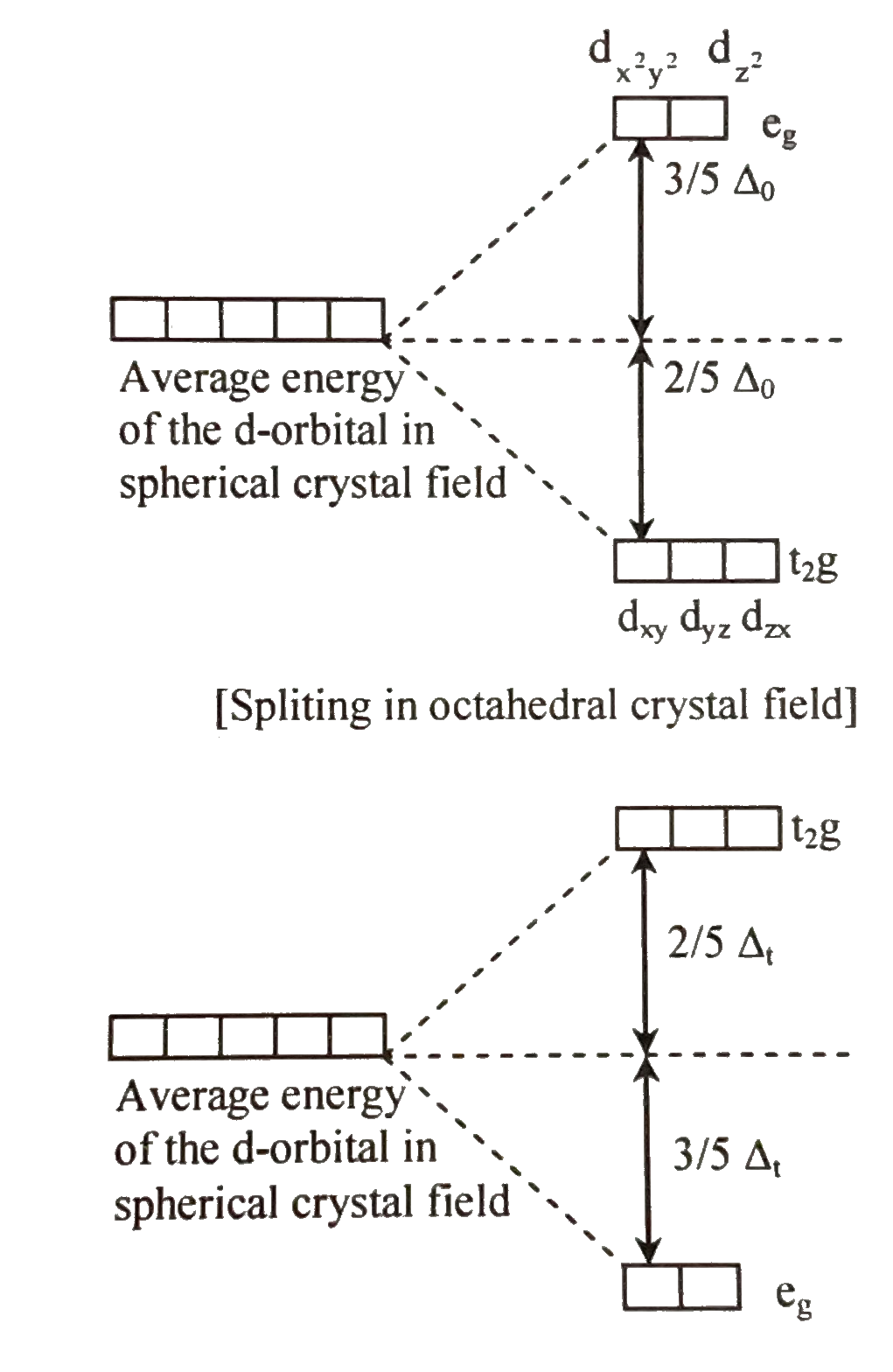
C

Energy of `d_(z^(2))` is greater than `d_(xy)` in case of octahedral crystal field while energy of `d_(z^(2))` is less than `d_(xy)` in case of tetrahedral splitting
Promotional Banner

Topper's Solved these Questions

  • KVPY

    KVPY PREVIOUS YEAR|Exercise PART-I BIOLOGY|1 Videos
  • KVPY

    KVPY PREVIOUS YEAR|Exercise PART-2 CHEMISTRY|15 Videos
  • KVPY

    KVPY PREVIOUS YEAR|Exercise Mathematics|10 Videos
  • KVPY 2021

    KVPY PREVIOUS YEAR|Exercise PART II CHEMISTRY|10 Videos

Similar Questions

Explore conceptually related problems

t_(2g) orbitals in octahedral complexes are

Spin only magnetic moments of a d^(8) ion in octahedral square planar and tetrahedral complexes, respectively are .

The orbitals having lower energy in tetrahedral complexs according to CFT are

d_(z)2 orbital is combination of :

Which of the following statements are correct? (i) In octahedral complexes, d_z2, d_(x^2-y^2) orbitals have higher energy than d_(xy) , d_(yz) and d_(zx) orbitals. (ii) In tetrahedral complexes, d_(xy), d_(yz), d_(zx) orbitals have higher energy than d_z2 and d_(x^2-y^2) orbitals. (iii) The colours of complexes are due to electronic transitions from one set of d-orbitals to another set of orbitals. (iv) Delta_(tetrahedral)=9/4, Delta_(octahedral)

Why are different colours observed in octahedral and tetrahedral complexes for the same metal and same ligands ?

d_(z^(2)) orbital has zero electron density in xy-plane. Comment.

KVPY PREVIOUS YEAR-KVPY-PART-I CHEMISTRY
  1. When 1.88 g of AgBr(s) is added to a 10^(-3) M aqueous solution of KB...

    Text Solution

    |

  2. Aniline reacts with excess Br(2)//H(2)O to give the major product

    Text Solution

    |

  3. The metal with the highest oxidation state presnt in K(2)CrO(4),NbCl(...

    Text Solution

    |

  4. The number of geometrical isomers of [CrCl(2)(en)(NH(3))(2)], where en...

    Text Solution

    |

  5. The element that combines with oxygen to give an amphoteric oxide is...

    Text Solution

    |

  6. The Arrhenius plots of two reactions, I and II are shown graphically- ...

    Text Solution

    |

  7. Ni(CO)(4) is

    Text Solution

    |

  8. In the following reaction the major product X is -

    Text Solution

    |

  9. Given the structure of D-(+)- glucose as The structure of L-(-)-g...

    Text Solution

    |

  10. In a cubic close packed structure, fractional contributions of an atom...

    Text Solution

    |

  11. The equilibirum constant K(c) of the reaction, 2AhArrB+C is 0.5 at 25^...

    Text Solution

    |

  12. Major products formed in the reaction of t-butyl methyl ether with HI ...

    Text Solution

    |

  13. If the molar conductivities ("in" S cm^(2) "mol"^(-1)) of NaCl,KCl and...

    Text Solution

    |

  14. 4-Formyl benzoic acid on treatment with one equivalent of hydrazine f...

    Text Solution

    |

  15. Two elements, Xand Y, have atomic numbers 33 and 17 , rspectively. The...

    Text Solution

    |

  16. The number of moles of KMnO(4) required to oxidize one equivalent of K...

    Text Solution

    |

  17. Three successive measurements in an experiment gave the values 10.9, 1...

    Text Solution

    |

  18. The latent heat of melting of ice at 0^(@)C is 6 kJ "mol"^(-1) . The e...

    Text Solution

    |

  19. The major product of the following reaction

    Text Solution

    |

  20. The energies of d(xy) and d(z)^(2) orbits in octahedral and tetrahedr...

    Text Solution

    |

