Home
Class 12
MATHS
Circles C(1) and C(2) of radii r and R r...

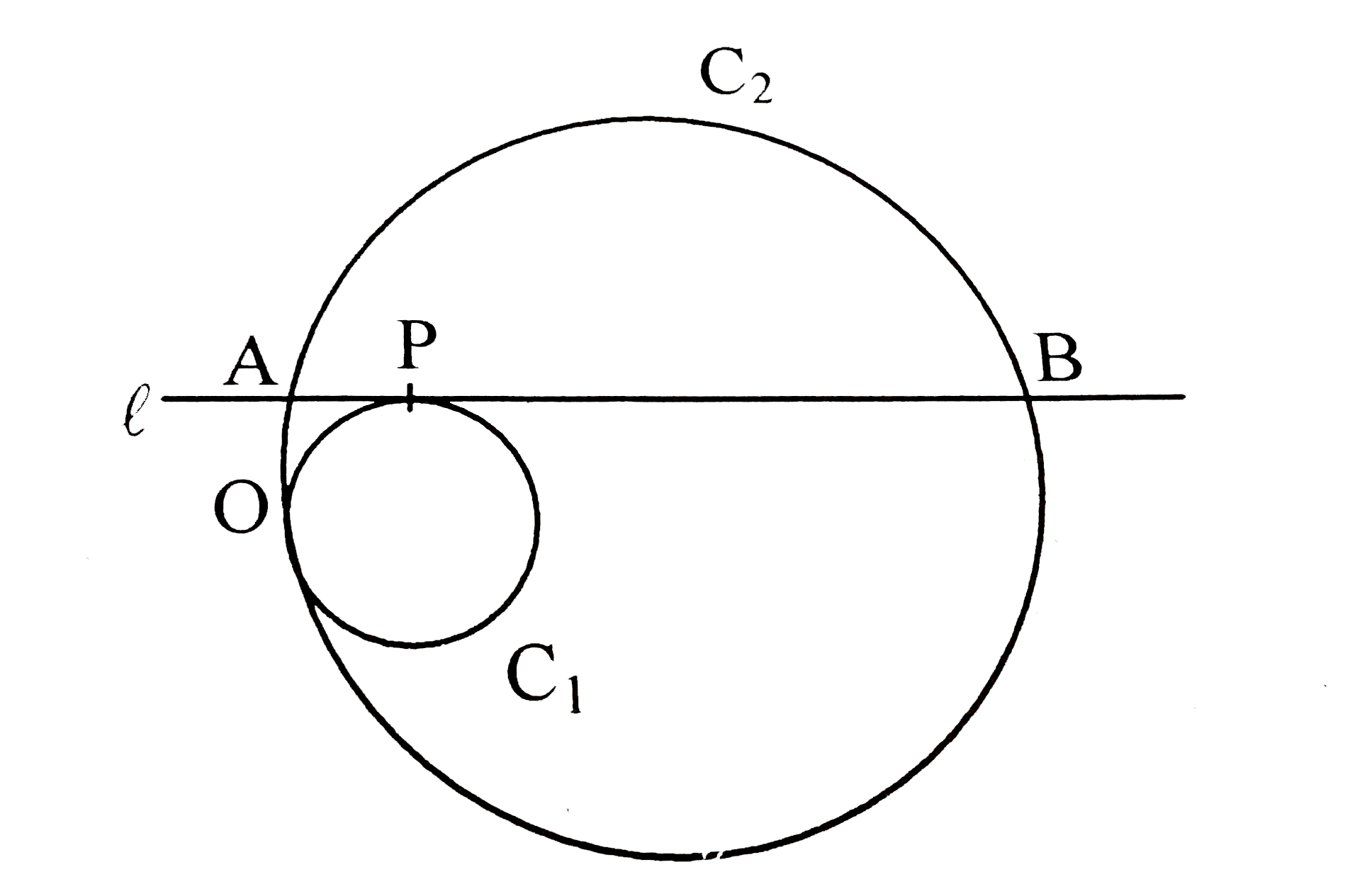
Circles `C_(1)` and `C_(2)` of radii r and R respectively, touch each other as shown in the figure. The lime l, which is parallel to the line joining the centres of `C_(2)` and `C_(2)` is tangent to `C_(1)` at P and intersects `C_(2)` at A,B.If `R^(2)=2r^(2)`, then `angleAOB` equals-

A

`22(1)/(2)@`

B

`45^(@)`

C

`60^(@)`

D

`67(1)/(2)@`

Text Solution

Verified by Experts

The correct Answer is:
B


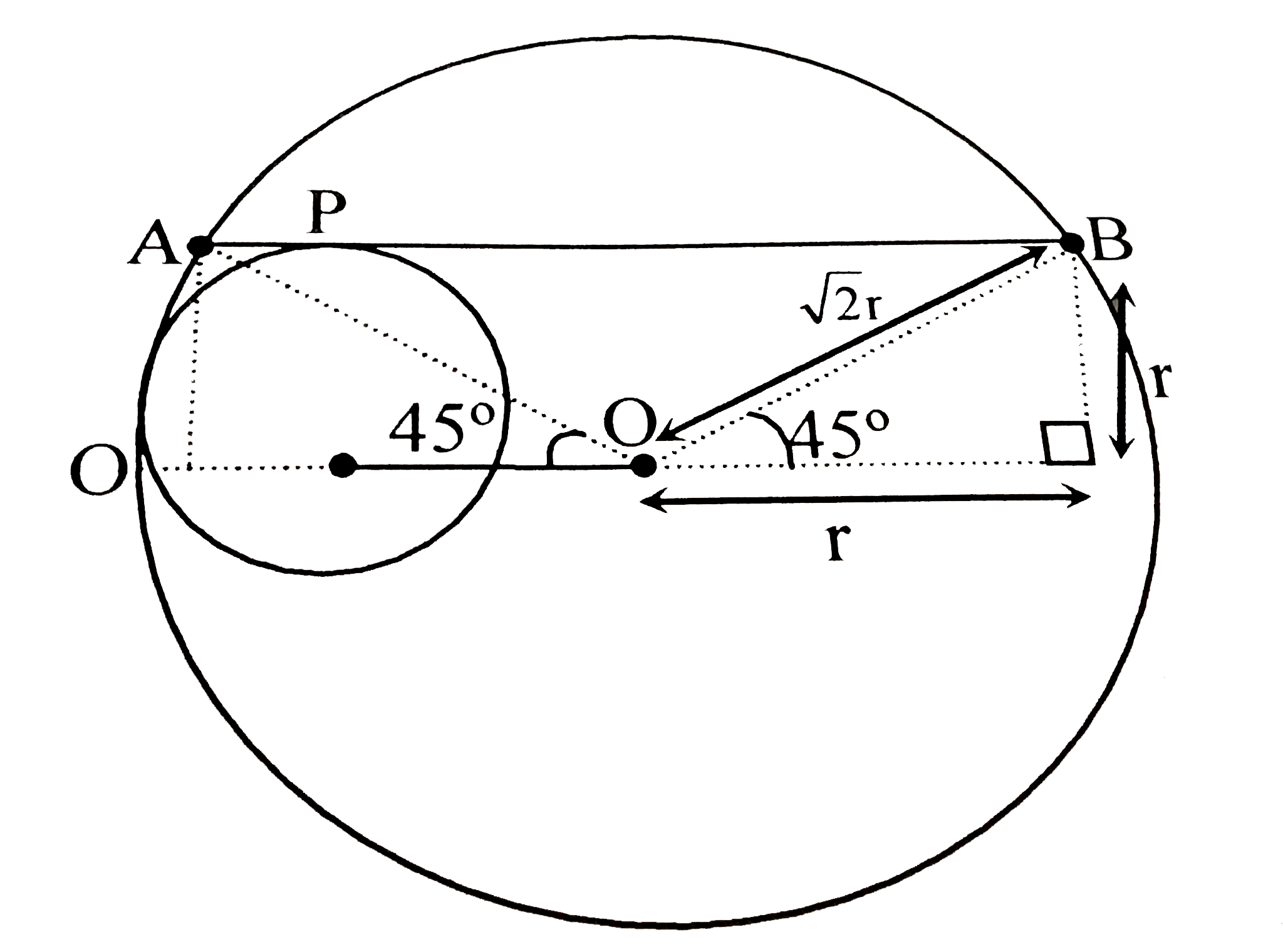
Chose AB subten `90^(@)` at centre.
so that AB subtend `45^(@)` at O (circumference of circle)
Promotional Banner

Similar Questions

Explore conceptually related problems

The centres of two circles C_(1) and C_(2) each of unit radius are at a distance of 6 unit from each other. Let P be the mid-point of the line segment joining the centres of C_(1) and C_(2) and C be a circle touching circles C_(1) and C_(2) externally. If a common tangent to C_(1) and C passing through P is also a common tangent to C_(2) and C, then the radius of the circle C, is

Three circles with centres C_(1),C_(2) and C_(3) and radii r_(1),r_(2) and r_(3) where *r_(-)1

Three circle C_(1),C_(2)andC_(3) with radii r_(1),r_(2) and r_(3) (where r_(1)ltr_(2)ltr_(3) ) are placed as shown in the given figure. What is the value of r_(2) ?

The centres of two circles C_1 and C_2, each of unit radius are at a distance of 6 units from each other. Let P be the mid point of the line segment joining the centres of C_1 and C_2, and C be a circle touching circles C_1 and C_2 externally. If a common tangent to C_1 and C passing through P is also a common tangent to C_2 and C. then the radius of the circle C is.

The radical axis of two circles having centres at C_(1) and C_(2) and radii r_(1) and r_(2) is neither intersecting nor touching any of the circles, if

Two circles C _(1) and C _(2) with equal radii r are centered at (3,2) and (6,5) respectively. If C _(1) and C _(2) intersect orthogonally, then r is equal to.

The circle C_(1) : x^(2)+y^(2)=3 , with cenre at O, intersects the parabola x^(2)=2y at the point P in the first quadrant. Let the tangent to the circle C_(1) at P touches other two circles C_(2) and C_(3) at R_(2) and R_(3) respectively. Suppose C_(2) and C_(3) have equal radii 2sqrt(3) and centres Q_(2) and Q_(3) respectively. If Q_(2) and Q_(3) lie on the y-axis, then Q_(2)Q_(3)=

