Home
Class 12
MATHS
There are boxes labelled B(1),B(2), . . ...

There are boxes labelled `B_(1),B_(2), . . . .,B_(6)`. In each trial, two fair dice `D_(1)D__(2)` are thrown. If `D_(1)` shows j and `D_(2)` shows k, then j balls are put into the box the `B(k)`. After n trials, what is the probability that `B_(1)` contains at most one ball ?

A

`((5^(n-1))/(6^(n-1)))+((5^(n))/(6^(n)))((1)/(6))`

B

`((5^(n))/(6^(n)))+((5^(n-1))/(6^(n-1)))((1)/(6))`

C

`((5^(n))/(6^(n)))+n((5^(n-1))/(6^(n-1)))((1)/(6))`

D

`((5^(n))/(6^(n)))+n((5^(n-1))/(6^(n-1)))((1)/(6^(2)))`

Text Solution

Verified by Experts

The correct Answer is:
D

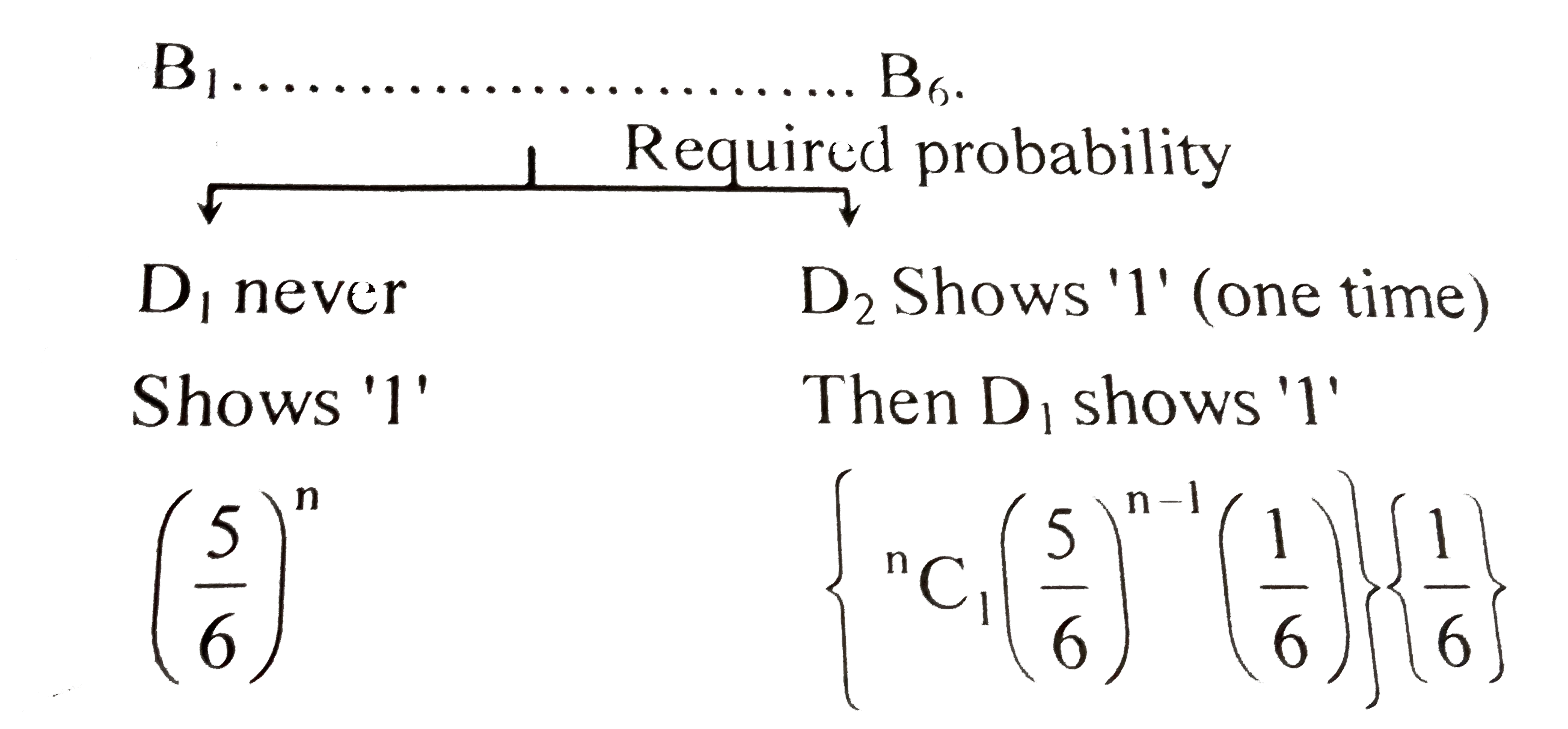
`B_(1) . . . . . . . . . . . . . . . . . .B_(6)`.

Required probability `=((5)/(6))^(n)+n((5^(n-1))/(6^(n-1)))((1)/(6))`
Promotional Banner

Similar Questions

Explore conceptually related problems

Four fair dice D_(1),D_(2),D_(2) and D_(4) each having six faces numbered 1, 2, 3, 4, 5 and 6 are rolled simultaneously. The probability that shows a number appearing on one of D_(1),D_(2) and D_(2) is:

four fair dice D_(1),D_(2),D_(3) and D_(4) each having six faces numbered 1,2,3,4,5 and 6 are rolled simultaneously.The probability that D_(4) shows a number appearing on one of D_(1),D_(2),D_(3) is

Two similar boxes B_(i)(i=1,2) contain (i+1) red and (5-i-1) black balls.One box is chosen at random and two balls are drawn randomly.What is the probability that both the balls are of different colours?

A bag contains 5 black balls, 4 white balls and 3 red balls. If a ball is selected randomwise the probability that it is black or red ball is a. 1/3 b. 1/4 c. /12 d. 2/3

Three boxes are labeled as A, B and C and each box contains 5 balls numbered 1, 2, 3, 4 and 5. The balls in each box are well mixed and one ball is chosen at random from each of the 3 boxes. If alpha, beta and gamma are the number on the ball from the boxes A, B and C respectively, then the probability that alpha=beta+gamma is equal to

9 different balls are to be arranged in 4 different boxes number B_1,B_2,B_3 and B_4 . If the probability that B_3 has exactly three balls is k(3/4)^9 then find k

Bag A contains 4W and 3B balls and bag B contains 2W and 2B balls.From bag A, two balls are transferred to bag B. A ball is then drawn from bag Band is found to be a black ball.what is the probability that the transferred ball are 1W and 1B ?

