Home
Class 12
CHEMISTRY
A metal (X) dissolves both in HCl and di...

A metal (X) dissolves both in HCl and dilute NaOH to liberate `H_(2)`. Addition of `NH_(4)Cl` and excess `NH_(4)OH` to HCl solution of X produces Y as a precipitate. Y is also produced by addding `NH_(4)Cl` to the NaOH solution of X. The Species X and Y, respectively, are

A

`Zn and Zn(OH)_(2)`

B

`Al and Al(OH)_(3)`

C

`Zn and Na_(2)ZnO_(2)`

D

`Al and NaAlO_(2)`

Text Solution

Verified by Experts

The correct Answer is:
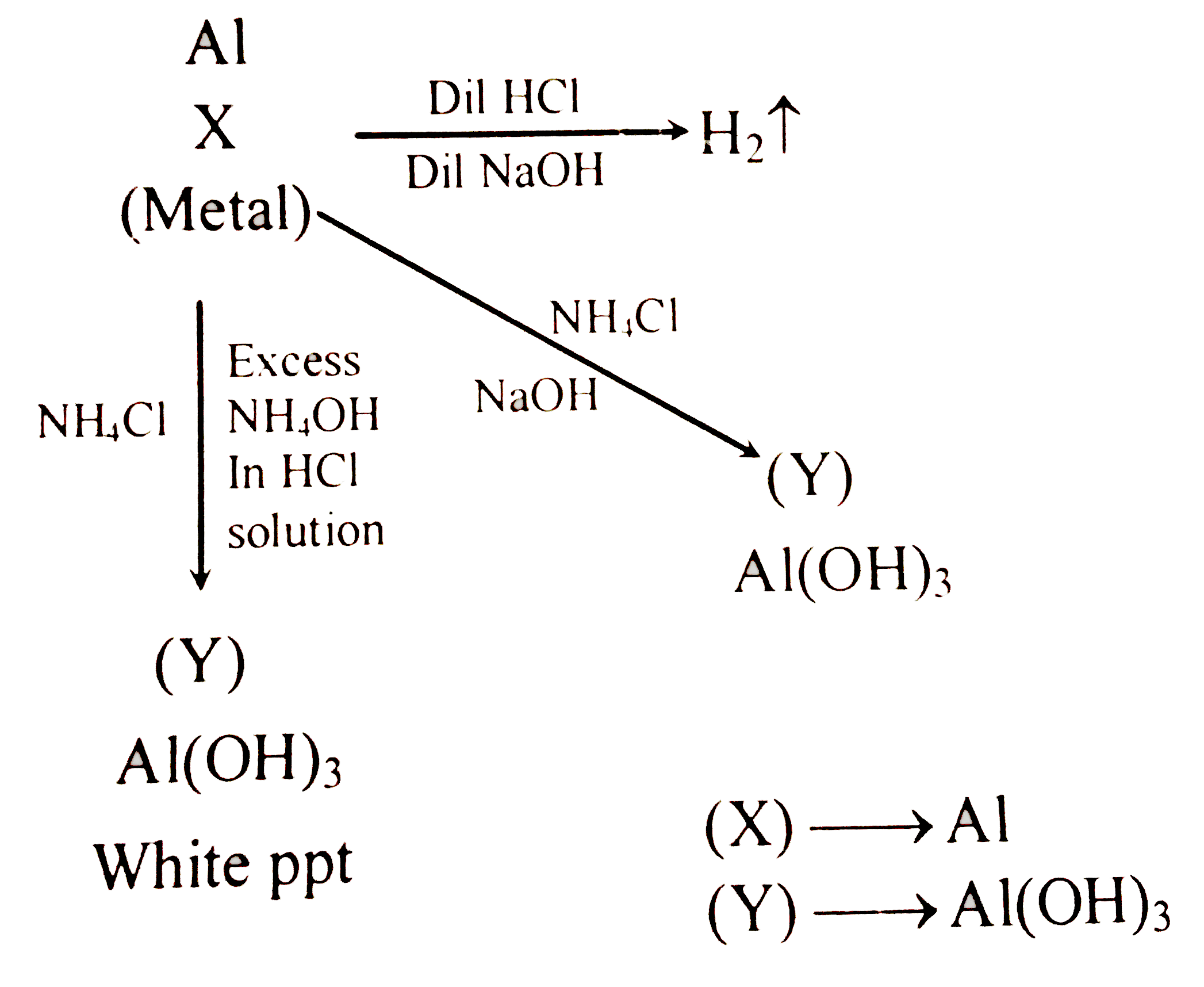
B


`(X)toAl`
`(Y)toAl(OH)^(3)`
Promotional Banner

Similar Questions

Explore conceptually related problems

NH_(4)Cl on heating with NaOH liberates

When NH_(4)Cl is added to a solution of NH_(4)OH :

When NH_(4)Cl is added to a solution of NH_(4)OH :

Aqueous solution of metallic nitrate X reacts with NH_4OH to form Y which dissolves in excess NH_4OH . The resulting complex is reduced by acetaldehyde to deposit the metal. X and Y, respectively, are

Which of the following nitrate salt solution neither produce ppt. with excess NaOH nor with excess NH_(4)OH solution?

An inorganic Lewis acid (X) shows the following reactions : (a) It fumes in moist air. (b) The intensity of fumes increase when a rod dippod in NH_(4) OH is brought near it. ( c) To an aqueous solution of (X) , addition of NH_(4)Cl and NH_(4)OH gives a precipitate which dissolves in NaOH solution. (d) An acidic solution of (X) does not give a precipitate with H_(2) S . Identify (X) and gives chemical reactions for (a) to (d) .

A white substance (A) reacts with dilute H_(2)SO_(4) to produce a colourless suffocating gas (B) and a colourless solution (C )/ The reaction of gas (B) with potassium iodate and starch solution produce a blue colour solution. Aqueous Solution of (A) gives a white precipitate with BaCl_(2) solution which is soluble in dilute HCl . Addition of aqueous NH_(3) or NaOH to (C ) produced first a precipitate which dissolves in excess of the respective reagent to poduced a clear solution. Similarly addition of excess of potassium ferrocyanide to (C ) produced a precipitate (D) which also dissolves in aqeous NaOH giving a clear solution. Identify (A),(B),(C ) and (D ). Write the equation of the reactions involved.

