

Home
Class 12
PHYSICS
Two square plates (lxxl) and dielectric ...

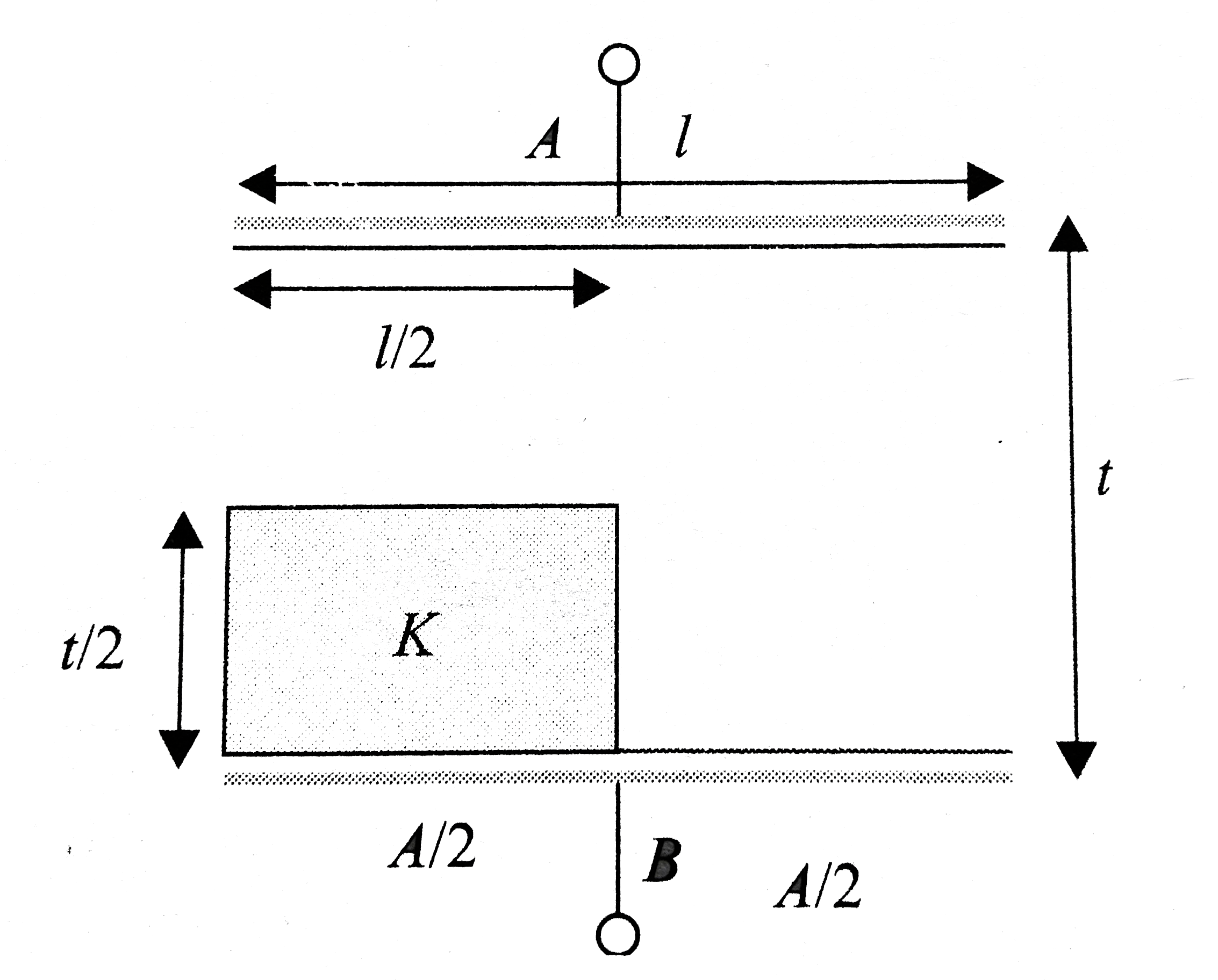
Two square plates `(lxxl)` and dielectric `(l/2xxt/2xxl)` are arranged as shown in. Find the equivalent capacitance of the structrue.
.

Promotional Banner

Similar Questions

Explore conceptually related problems

In the arrangement shown , find the equivalent capacitance between A and B

In the arrangement shown , find the equivalent capacitance between A and B

Four square plates, each with edge length a, are arranged as shown in the following figure. The equivalent capacitance between A and C is

Fig shows a parallel plate capacitor of plate area A and plate separation d . Its entire space is filled with three different dielectric slabs of same thickness. Find the equivalent capacitance of the arrangment.

Two parallel plate capacitors, each of capacitance 40 muF, are connected is series. The space between the plates of one capacitor is filled with a dielectric material of dielectric constant K =4. Find the equivalent capacitacne of the system.

Two parallel plate capacitors, each of capacitance 40 muF , are connected is series. The space between the plates of one capacitor is filled with a dielectric material of dielectric constant K =4. Find the equivalent capacitacne of the system.

Two parallel plate capacitors, each of capacitance 40 muF, are connected is series. The space between the plates of one capacitor is filled with a dielectric material of dielectric constant K =4. Find the equivalent capacitacne of the system.

Capacitor has square plates of side l .Three dielectrics fill the space as shown (their dielectric constants are given).Find equivalent capacitance.

Three different types of dielectric slabs have been arranged between the plates of a parallel plate capacitor, as shown in the figure. The equivalent capacitance of the system between the points P and Q will be

Three different types of dielectric slabs have been arranged between the plates of a parallel plate capacitor, as shown in the figure. The equivalent capacitance of the system between the points P and Q will be