Home
Class 12
PHYSICS
A particle of mass 9xx10^(-31) kg having...

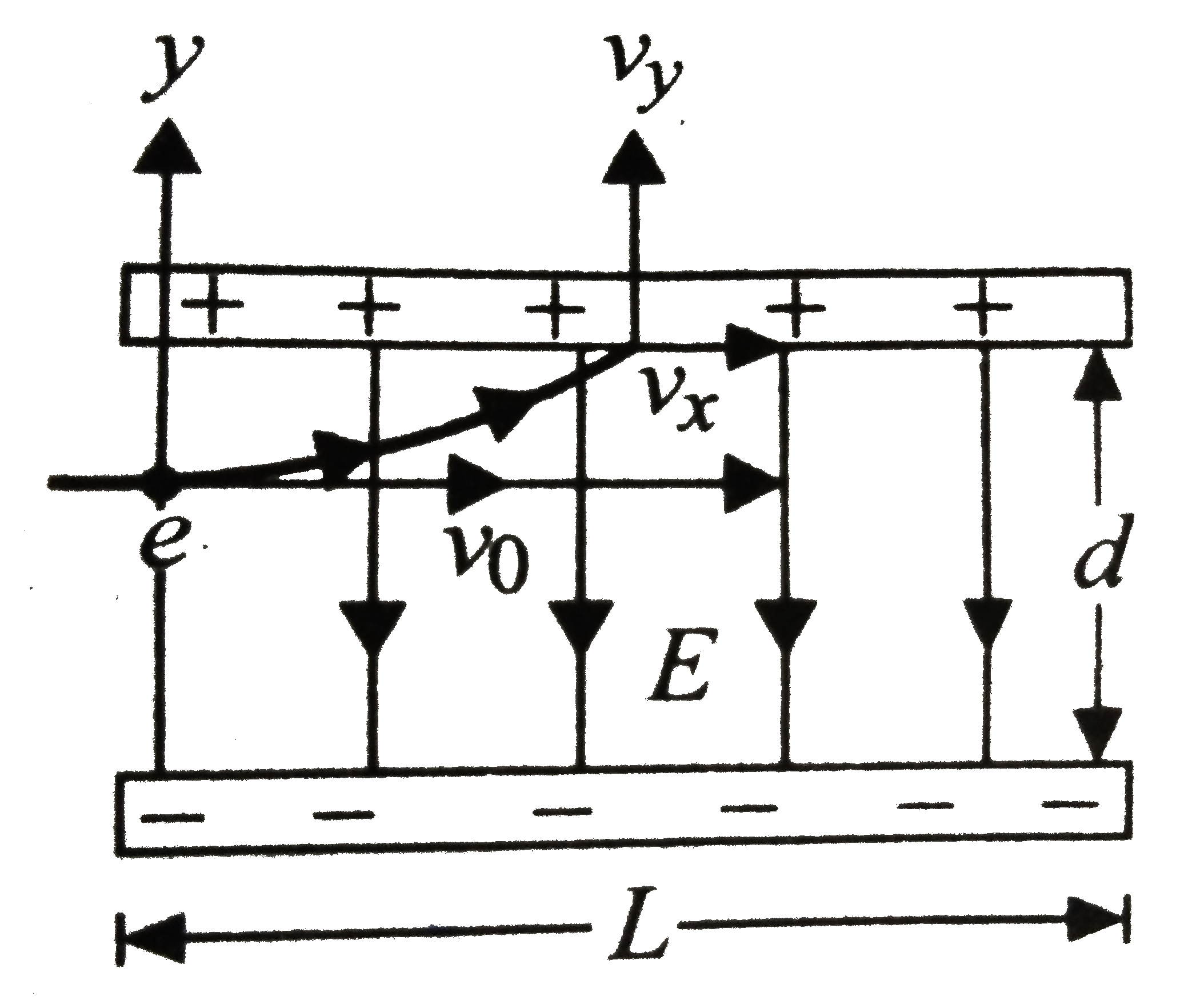
A particle of mass `9xx10^(-31)` kg having a negative charge of `1.6xx10^(-19)C` is projected horizontally with a velocity of `10^(6)ms^(-1)` into a region between two infinite horizontal parallel plates of metal. The distance between the plates is `d=0.3cm` and the particle enters 0.1cm below the top plate, THe top and bottom plates are connected, respectively to the positive and negative terminal of a 30V battery. Find the components of the velocity of the particle just before it hits one of the plates.

A

`V_(x)=10^(5)m//s`

B

`V_(y)=1.89xx10^(6)m//s`

C

`V_(x)=0`

D

`V_(y)=10^(5)m//s`

Text Solution

Verified by Experts

The particle will hit the upper plate because of attraction
Electric field = `(30)/(0.3xx10^(-2))=10000V//m`
Upward acceleration = `("force")/("mass")=(eE)/(m)=(1.6xx10^(-19)xx10000)/(9xx10^(-31))=1.78xx10^(15)m//s^(2)`
Take the initial direction of the particles as the x-axis and the field direction as the y-axis.
From, `v^(2)-v_(0)^(2)=2as`,
`v_(y)^(2)=2xx1.78xx10^(15)xx(0.1xx10^(-2))`
`v_(y)=1.89xx10^(6)m//s`
The initial velocity along the x-axis remains unchanged as there is no acceleration along the direction.
`therefore v_(y)=1.89xx10^(6)m//sandv_(x)=10^(5)m//s`
Promotional Banner

Topper's Solved these Questions

  • ELECTROSTANTICS

    FIITJEE|Exercise EXERCISE|10 Videos
  • ELECTROSTANTICS

    FIITJEE|Exercise ASSIGNMENT PROBLEMS (SUBJECTIVE) LEVEL - I|14 Videos
  • ELECTROSTANTICS

    FIITJEE|Exercise SOLVED PROBLEMS (SUBJECTIVE)|10 Videos
  • ELECTROMAGNETIC WAVE & WAVE OPTICS

    FIITJEE|Exercise ASSIGNMENT PROBLEMS Objective : Level-II (MULTI CHOICE SINGLE CORRECT)|21 Videos
  • ELECTROSTATICS

    FIITJEE|Exercise Example|14 Videos

Similar Questions

Explore conceptually related problems

A particle of mass 9xx10^(-31) kg having a negative charge of 1.6xx10^(-19)C is projected horizontally with a velocity of 10^(6)ms^(-1) into a region between two infinite horizontal parallel plates of metal. The distance between the plates is d=0.3cm and the particle enters 0.1cm below the top plate, THe top and bottom plates are connected, respectively to the positive and negative terminal of a 30V battery. Find the components of hte velocity of hte paricle just before it hits one of the plates.

In a parallel capacitor the potential difference between the plates is V ,A particle of mass m and charge -Q leaves the negative plate and reaches the positive plate at distance d in time t with a momentum p .Then

The capacity of a parallel plate capacitor is 10 μF when the distance between its plates is 9 cm. What will be its capacity if the distance between the plates is reduced by 6 cm.

The capcity of a parallel plate condenser is 10 muF , when the distance between its plates is 8 cm . If the distance between the plates is reduced to 4 cm , then the capacity of this parallel plate condenser will be

The plates of a parallel plate capacitance 1.0 F are separated by a distance d =1 cm. Find the plate area .

A parallel-plate capacitor haas plates of unequal area . The large r plates is connected to the positive terminal of the brttery and the smaller plate to its nagative terminal. Let Q, and Q_ be the charges appearing on the positive and negative appearing on the

An electron is projected with an initial velocity of 10^(7)ms^(-1) into an electric field between two parallel plates 1 cm apart. The electron enters the field at a point midway between the plates. If the electron just misses the positivity charged plate as it emerges from the field, find the magnnitude of the electric density between the plates. (Length of each plate is 2 cm, mass of electron= 9xx10^(-31) kg and charge of electron =1.6xx10^(-19) C)

A small particale carying a negative charge of 1.6xx10^(-19)C ia suspended in equilibrium between the horizontal metal plates 5 cm apart, having a potential difference of 3000 V across them. Find the mass of the particle.

