Home
Class 10
BIOLOGY
Roots not only absorb fluid from soil, b...

Roots not only absorb fluid from soil, but returns a portion of their percullar secretions back into it. Who proved it from his experiments?

Text Solution

Verified by Experts
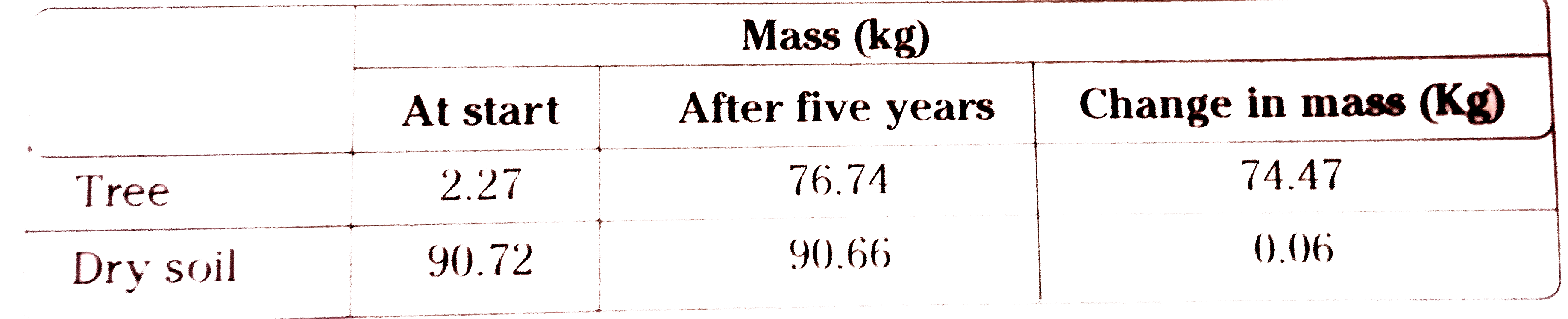
1) A Belgian scientist Jan Baptist Von Helmont (1648) conducted an experiment that continued for five years .
2) Von Helmont took a small willow tree and planted it in a large pot with soil.
3) Before he did this, he carefully measured the mass of the dry soil and mass of the tree.
4) He covered the soil with a lid so that nothing could fall on to the surface of the soil and add to its mass.
5) There were holes in the lid so that the tree could grow out of the soil and that air and water could reach the roots.
6) Von Helmont left the tree for five years, giving it only rain water to absorb.
7) At the end of five years he measured the mass of the tree and the mass of the dry soil for a second time.
8) The results of this expe f iment are shown below .

9) This experiment changed the belief of hundreds of years . This is because Von Helmont arrived at a result that
a) The substances needed for the growth of a plant do not come from the soil only .
b) The plant grow because of the water it gets.
Promotional Banner

Topper's Solved these Questions

  • NUTRITION- FOOD SUPPLYING SYSTEM

    VGS PUBLICATION-BRILLIANT|Exercise CREATIVE QUESTIONS FOR NEW MODEL PAPER (2 MARK QUESTIONS)|27 Videos
  • NUTRITION

    VGS PUBLICATION-BRILLIANT|Exercise EXERCISE|446 Videos
  • OBSERVING 4 'R' S

    VGS PUBLICATION-BRILLIANT|Exercise CHOOSE THE CORRECT ANSWERS|3 Videos

Similar Questions

Explore conceptually related problems

What do yon prove from this experiment ?

What do you prove from this experiment ?

The only electron in the hydrogen atom resides under ordinary conditions on the first orbit. When energy is supplied, the electron moves to higher energy orbit depending on the amount of energy absorbed. When this electron returns to any of the lower orbits, it emits energy. Lyman series is formed when the electron returns to the lowest orbit while Balmer series is formed when the electron returns to second orbit. Similarly, Paschen, Brackett and Pfund series are formed when electron returns to the third, fourth orbits from higher energy orbits respectively (as shown in figure) Maximum number of lines produced when an electron jumps from nth level to ground level is equal to (n(n-1))/(2) . For example, in the case of n = 4, number of lines produced is 6. (4 rarr 3, 4 rarr 2, 4 rarr 1, 3 rarr 2, 3 rarr 1, 2 rarr 1) . When an electron returns from n_(2) to n_(1) state, the number of lines in the spectrum will be equal to ((n_(2) - n_(1))(n_(2)-n_(1) +1))/(2) If the electron comes back from energy level having energy E_(2) to energy level having energy E_(2) then the difference may be expressed in terms of energy of photon as E_(2) - E_(1) = Delta E, lambda = (h c)/(Delta E) . Since h and c are constant, Delta E corresponds to definite energy, thus each transition from one energy level to another will prouce a higher of definite wavelength. THis is actually observed as a line in the spectrum of hydrogen atom. Wave number of the line is given by the formula bar(v) = RZ^(2)((1)/(n_(1)^(2)) - (1)/(n_(2)^(2))) Where R is a Rydberg constant (R = 1.1 xx 10^(7)) (i) First line of a series : it is called .line of logest wavelength. or .line of shortest energy.. (ii) Series limit of last of a series : It is the line of shortest wavelength or line of highest energy. The difference in the wavelength of the 2^(nd) line of Lyman series and last line of Bracket series in a hydrogen sample is

The only electron in the hydrogen atom resides under ordinary conditions on the first orbit. When energy is supplied, the electron moves to higher energy orbit depending on the amount of energy absorbed. When this electron returns to any of the lower orbits, it emits energy. Lyman series is formed when the electron returns to the lowest orbit while Balmer series is formed when the electron returns to second orbit. Similarly, Paschen, Brackett and Pfund series are formed when electron returns to the third, fourth orbits from higher energy orbits respectively (as shown in figure) Maximum number of lines produced when an electron jumps from nth level to ground level is equal to (n(n-1))/(2) . For example, in the case of n = 4, number of lines produced is 6. (4 rarr 3, 4 rarr 2, 4 rarr 1, 3 rarr 2, 3 rarr 1, 2 rarr 1) . When an electron returns from n_(2) to n_(1) state, the number of lines in the spectrum will be equal to ((n_(2) - n_(1))(n_(2)-n_(1) +1))/(2) If the electron comes back from energy level having energy E_(2) to energy level having energy E_(2) then the difference may be expressed in terms of energy of photon as E_(2) - E_(1) = Delta E, lambda = (h c)/(Delta E) . Since h and c are constant, Delta E corresponds to definite energy, thus each transition from one energy level to another will prouce a higher of definite wavelength. THis is actually observed as a line in the spectrum of hydrogen atom. Wave number of the line is given by the formula bar(v) = RZ^(2)((1)/(n_(1)^(2)) - (1)/(n_(2)^(2))) Where R is a Rydberg constant (R = 1.1 xx 10^(7)) (i) First line of a series : it is called .line of logest wavelength. or .line of shortest energy.. (ii) Series limit of last of a series : It is the line of shortest wavelength or line of highest energy. In a single isolated atom in electron makes transition from 5^(th) excited state to 2^(nd) state the maximum number of different types of photons observed as

The only electron in the hydrogen atom resides under ordinary conditions on the first orbit. When energy is supplied, the electron moves to higher energy orbit depending on the amount of energy absorbed. When this electron returns to any of the lower orbits, it emits energy. Lyman series is formed when the electron returns to the lowest orbit while Balmer series is formed when the electron returns to second orbit. Similarly, Paschen, Brackett and Pfund series are formed when electron returns to the third, fourth orbits from higher energy orbits respectively (as shown in figure) Maximum number of lines produced when an electron jumps from nth level to ground level is equal to (n(n-1))/(2) . For example, in the case of n = 4, number of lines produced is 6. (4 rarr 3, 4 rarr 2, 4 rarr 1, 3 rarr 2, 3 rarr 1, 2 rarr 1) . When an electron returns from n_(2) to n_(1) state, the number of lines in the spectrum will be equal to ((n_(2) - n_(1))(n_(2)-n_(1) +1))/(2) If the electron comes back from energy level having energy E_(2) to energy level having energy E_(2) then the difference may be expressed in terms of energy of photon as E_(2) - E_(1) = Delta E, lambda = (h c)/(Delta E) . Since h and c are constant, Delta E corresponds to definite energy, thus each transition from one energy level to another will prouce a higher of definite wavelength. THis is actually observed as a line in the spectrum of hydrogen atom. Wave number of the line is given by the formula bar(v) = RZ^(2)((1)/(n_(1)^(2)) - (1)/(n_(2)^(2))) Where R is a Rydberg constant (R = 1.1 xx 10^(7)) (i) First line of a series : it is called .line of logest wavelength. or .line of shortest energy.. (ii) Series limit of last of a series : It is the line of shortest wavelength or line of highest energy. Let v_(1) be the frequency of the series limit of the Lyman series, v_(2) be the frequency of the first line of the Lyman series, and v_(3) be the frequency of the series limit of the Balmer series

The only electron in the hydrogen atom resides under ordinary conditions on the first orbit. When energy is supplied, the electron moves to higher energy orbit depending on the amount of energy absorbed. When this electron returns to any of the lower orbits, it emits energy. Lyman series is formed when the electron returns to the lowest orbit while Balmer series is formed when the electron returns to second orbit. Similarly, Paschen, Brackett and Pfund series are formed when electron returns to the third, fourth orbits from higher energy orbits respectively (as shown in figure) Maximum number of lines produced when an electron jumps from nth level to ground level is equal to (n(n-1))/(2) . For example, in the case of n = 4, number of lines produced is 6. (4 rarr 3, 4 rarr 2, 4 rarr 1, 3 rarr 2, 3 rarr 1, 2 rarr 1) . When an electron returns from n_(2) to n_(1) state, the number of lines in the spectrum will be equal to ((n_(2) - n_(1))(n_(2)-n_(1) +1))/(2) If the electron comes back from energy level having energy E_(2) to energy level having energy E_(2) then the difference may be expressed in terms of energy of photon as E_(2) - E_(1) = Delta E, lambda = (h c)/(Delta E) . Since h and c are constant, Delta E corresponds to definite energy, thus each transition from one energy level to another will prouce a higher of definite wavelength. THis is actually observed as a line in the spectrum of hydrogen atom. Wave number of the line is given by the formula bar(v) = RZ^(2)((1)/(n_(1)^(2)) - (1)/(n_(2)^(2))) Where R is a Rydberg constant (R = 1.1 xx 10^(7)) (i) First line of a series : it is called .line of logest wavelength. or .line of shortest energy.. (ii) Series limit of last of a series : It is the line of shortest wavelength or line of highest energy. The wave number of electromagnetic radiation emitted during the transition of electron in between two levels of Li^(2+) ion whose principal quantum numbers sum if 4 and difference is 2 is

Adventitious roots absorb moisture from atmosphere in

VGS PUBLICATION-BRILLIANT-NUTRITION- FOOD SUPPLYING SYSTEM-CREATIVE QUESTIONS FOR NEW MODEL PAPER (4 MARK QUESTIONS)
  1. Differentiate between the nutrition process of plants and animals.

    Text Solution

    |

  2. List out the organs/systems involved in the process of digestion and e...

    Text Solution

    |

  3. If you have chance to meet any doctor (physician) or nutritionist, wha...

    Text Solution

    |

  4. I found that water was essential for the increase of plant mass. Name ...

    Text Solution

    |

  5. Write a note on Von Helmont's experiment focusing on how he concluded ...

    Text Solution

    |

  6. Roots not only absorb fluid from soil, but returns a portion of their ...

    Text Solution

    |

  7. Give an account of water soluble vitamins, their occurrence, deficienc...

    Text Solution

    |

  8. Give an account of water soluble vitamins, their occurrence, deficienc...

    Text Solution

    |

  9. Observe the information and answer the following questions. What ...

    Text Solution

    |

  10. Observe the information and answer the following questions. What ...

    Text Solution

    |

  11. Observe the information and answer the following questions. At wh...

    Text Solution

    |

  12. Observe the information and answer the following questions. Why c...

    Text Solution

    |

  13. Observe the information and answer the following questions. Where...

    Text Solution

    |

  14. Write the experimental procedure to prove that oxygen is produced duri...

    Text Solution

    |

  15. Draw a neat labelled diagram of T.S. of leaf. What is the function of ...

    Text Solution

    |

  16. Deekshith conduced an experiment to find the presence of starch in lea...

    Text Solution

    |

  17. Which issues do you take into consideration to tell that plants play a...

    Text Solution

    |

  18. We know that by taking different types of food materials we will get v...

    Text Solution

    |

  19. Describe what disaster occurs on earth, if photosynthesis life process...

    Text Solution

    |

  20. What are vitamins ? Why they are called essential nutrients ? What is ...

    Text Solution

    |

