

Home
Class 11
PHYSICS
Two light spring of force constants k(1)...

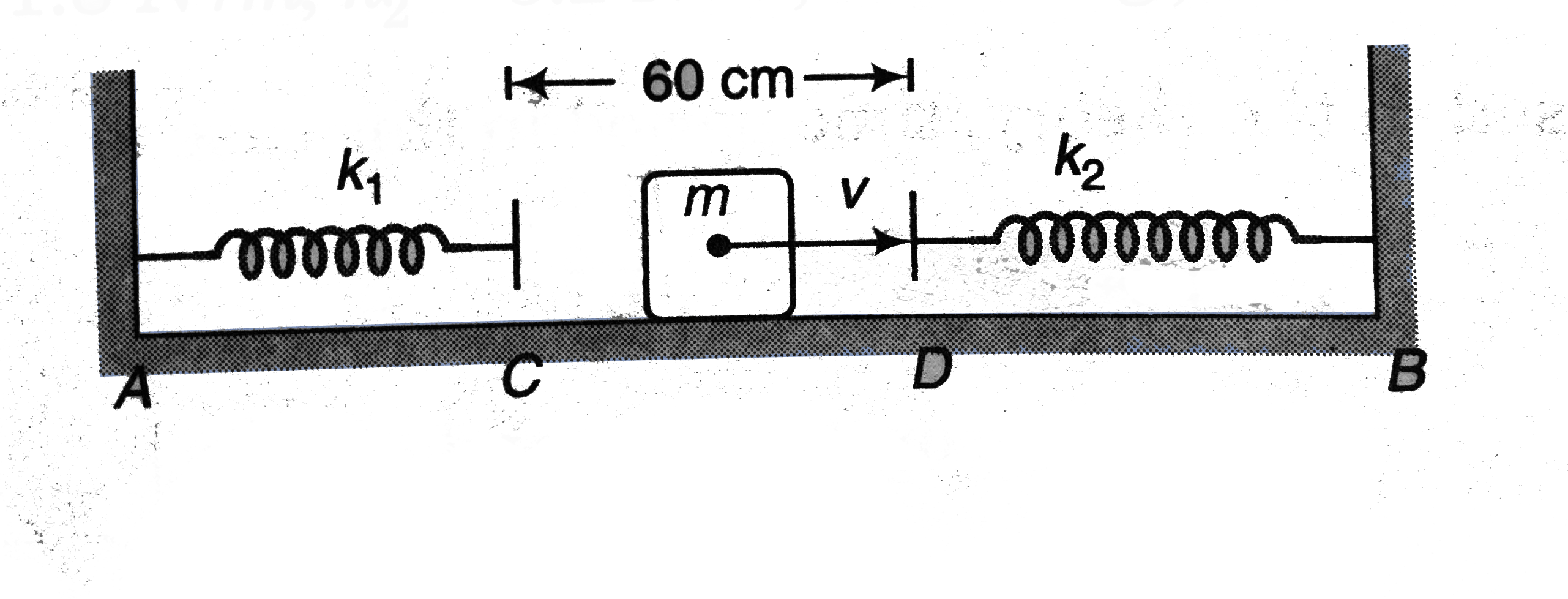
Two light spring of force constants `k_(1)` and `k_(2)` and a block of mass m are in one line `AB` on a smooth horizontal table such that one end of each spring is fixed on rigid supports and the other end is free as shown in the figure. The distance `CD` between the spring is `60cm`. If the block moves along `AB` with a velocity `120 cm//s` in between the springs, calculate the period of oscillation of the block. (take `k_(1) = 1.8 N//m`, `k_(2) = 3.2 N//m`, `m = 200 g`)

Promotional Banner

Similar Questions

Explore conceptually related problems

Two light spring of force constants k_(1) and k_(2) and a block of mass m are in the line AB on a smooth horizontal table such that one end of each spring is fixed on right supports and the other end is free as shown in figure The distance CD between the free ends of the spring is 60 cm . If the block (k_(1) = 1.8 N//m, k_(2) = 3.2 N//m and m = 200g) . Is the motion simple harmonic?

Two light spring of force constants k_(1) and k_(2) and a block of mass m are in the line AB on a smooth horizontal table such that one end of each spring is fixed on right supports and the other and is free as shown in figure The distance CD between the free ends of the spring is 60 cm . If the block (k_(1) = 1.8 N//m, k_(2) = 3.2 N//m and m = 200g) . Is the motion simple harmonic?

A block of mass m sliding n a smooth horizontal surface with velocity vecv meets a long horizontal spring fixed ast one end and having spring constant k as shown n figure. Find the maximum compression of the spring.

A block of mass m, lying on a smooth horizontal surface, is attached to a spring (of negligible mass) of spring constant k. The other end of the spring is fixed, as shown in the figure. The block is initally at rest in its equilibrium position. If now the block is pulled withe a constant force F, the maximum speed of the block is :

A block of mass m, lying on a smooth horizontal surface, is attached to a spring (of negligible mass) of spring constant k. The other end of the spring is fixed, as shown in the figure. The block is initally at rest in its equilibrium position. If now the block is pulled withe a constant force F, the maximum speed of the block is :

As shown in the figure, two light springs of force constant k_(1) and k_(2) oscillate a block of mass m. Its effective force constant will be

As shown in the figure, two light springs of force constant k_(1) and k_(2) oscillate a block of mass m. Its effective force constant will be

Two identical springs of spring constant k are attached to a block of mass m and to fixed supports as shown in the figure. The time period of oscillation is