Home
Class 10
MATHS
To find out the concentration of SO(2) i...

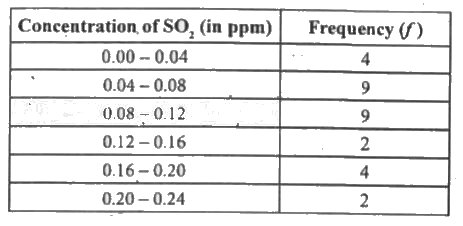
To find out the concentration of `SO_(2)` in the air (in parts per million, i.e., ppm), the data was collected for 30 localities in a certain city and is presented below:

Find the mean concentration of `SO_(2)` in the air.

Text Solution

Verified by Experts

The correct Answer is:

`bar(x) = (Sigma F_(i)x_(i))/(Sigmaf_(i)) = (2.90)/30 = 0.99 ` ppm
Promotional Banner

Topper's Solved these Questions

  • STATISTICS

    CPC CAMBRIDGE PUBLICATION|Exercise Exercise 13.2|6 Videos
  • STATISTICS

    CPC CAMBRIDGE PUBLICATION|Exercise Exercise 13.3|7 Videos
  • SOME APPLICATIONS OF TRIGONOMETRY

    CPC CAMBRIDGE PUBLICATION|Exercise EXERCISE 12.1|16 Videos
  • SURFACE AREAS AND VOLUMES

    CPC CAMBRIDGE PUBLICATION|Exercise EXERCISE 15.4|5 Videos

Similar Questions

Explore conceptually related problems

A study was conducted to find out the concentration of sulphur dioxide in the air in parts per million (ppm) of a certain city. The data obtained for 30 days is as follows : You were asked to prepare a frequency distribution table, regarding the concentration of sulphur dioxide in the air in parts per million (ppm) of a certain city for 30 days . Using this table, find the probability of the concentration of sulphur dioxide in the interval 0.12-0.16 on any of these days.

In , you were asked to prepare a frequency distribution table regarding the concentration of sulphur dioxide in the air in parts per million of a certain city for 30 day . Using this table , find the probability of the concentration of sulphur dioxide in the interval 0.12 - 0.16 on any of these days .

A study was conducted to find out the concentration of sulphur dioxide in the air in parts per million (ppm) of a certain city. The data obtained for 30 days is as follows : {:(0.03,0.08,0.08,0.09,0.04,0.17),(0.16,0.05,0.02,0.06,0.18,0.20),(0.11,0.08,0.12,0.13,0.22,0.07),(0.08,0.01,0.10,0.06,0.09,0.18),(0.11,0.07,0.05,0.07,0.01,0.04):} (ii) For how many days, was the concentration of sulphur dioxide more than 0.11 parts per million ?

A study was conducted to find out the concentration of sulphur dioxide in the air in parts per million (ppm) of a certain city. The data obtained for 30 days is as follows : {:(0.03,0.08,0.08,0.09,0.04,0.17),(0.16,0.05,0.02,0.06,0.18,0.20),(0.11,0.08,0.12,0.13,0.22,0.07),(0.08,0.01,0.10,0.06,0.09,0.18),(0.11,0.07,0.05,0.07,0.01,0.04):} (i) Makes a grouped frequency distribution table for this data with class intervals as 0.00-0.04,0.04-0.08, and so on.

Nitrogen pentoxide decomposes according to equation : 2N_(2)O_(5)(g) rarr 4NO_(2)(g) + O_(2)(g) . This first order reaction was allowed to proceed at 40^(@)C and the data below were collected : (a) Calculate the rate constant. Include units with your answer. (b) What will be the concentration of N_(2)O_(5) after 100 minutes ? (c ) Calculate the initial rate of reaction ?

A survey was conducted by a group of students as a part of their environment awareness programme, in which they collected the following data regarding the number of plants in 20 houses in a locality. Find the mean number of plants per house. Which method did you use for finding the mean, and why?

Write the equation for i) The action of SO_(2) with chlorine in the presence of charcoal ii) The actionof SO_(3) with concentrated sulphuric acid iii) The action of ozone with lead sulphide.

(i) Write the chemical names of CH_(3)COCH_(3),C_(2)H_(5)OH . (ii) What happens when acetic acid and ethanol react in presence of concentrated H_(2)SO_(4) ? Write the reactions there in.

During nitrogen estimation present in an organic compound by Kjeldahl.s method, the ammonia evolved from 0.5 g of the compound in Kjeldahl.s estimation of nitrogen neutralised 10 ml of 1 M H_(2)SO_(4) . Find the percentage of nitrogen in the compound.

(a) A point object is placed in front of a double convex lens ( of refractive index n = n_(2) // n_(1) with respect to air ) with its spherical faces of radii of curvature R_(1) and R_(2) . Show the path of rays due to refraction at first and subsequently at the second surface to obtain the formation of the real image of the object. Hence obtain the lens-maker's formula for a thin lens. A double convex lens having both faces of the same radius of curvature has refractive index 1.55. Find out the radius of curvature of the lens required to get the focal length of 20cm.
