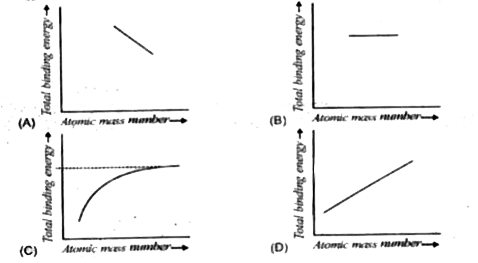
Which of the following graphs might represent the relationship between atomic mass number (i.e "atomic weight”) and the total binding energy of the nudeus, for nuclii heavier than Sr?
FIITJEE|Exercise (NUMERICAL BASED QUESTIONS)|4 Videos
Similar Questions
Explore conceptually related problems
The compound unstabel nucleus ._(92)^(236)U often decays in accordance with the following reaction ._(92)^(236)U rarr ._(54)^(140)Xe +._(38)^(94)Sr + other particles During the reaction, the uranium nucleus ''fissions'' (splits) into the two smaller nuceli have higher nuclear binding energy per nucleon (although the lighter nuclei have lower total nuclear binding energies, because they contain fewer nucleons). Inside a nucleus, the nucleons (protonsa and neutrons)attract each other with a ''strong nuclear'' force. All neutrons exert approxiamtely the same strong nuclear force on each other. This force holds the nuclear are very close together at intranuclear distances. Which of the following graphs might represent the relationship between atomic number (i.e., ''atomic weight'') and the total binding energy of the nucleus, for nuclei heavier than ._(38)^(94)Sr ?
Which of the following graph best represents the relationship between absolute temperature of gas and the average kinetic energy of the gas molecules?
Which one of the following is a correct relationship between mass and energy?
Which of the following represents the electronic configuration of an element with atomic number 17